
Softeners & filters
Whole House Water Filter: Does a Toronto Home Need One?
A whole house water filter treats every tap where the main enters the home. On Toronto water it is a taste and sediment choice, not a safety need, and for lead a certified tap filter works better.
On this page
- What does a whole house water filter do?
- Does Toronto water need whole house filtration?
- Can a whole house filter remove chloramine?
- Which certifications should a filter carry?
- Why is a tap filter better for lead?
- How do you size a whole house filter?
- What does a whole house filter cost to run?
- Common questions
Key takeaways
- A whole house (point-of-entry) filter sits on the main line after the water meter; common stages are a sediment pre-filter and activated carbon.
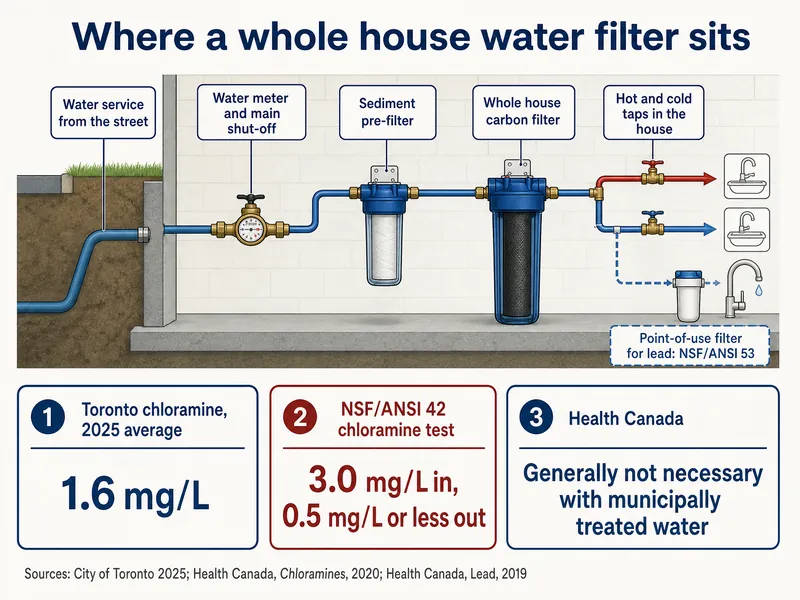
- Chloramine in Toronto's pipes averaged 1.6 mg/L in 2025, with results from 0.28 to 2.5 mg/L (City of Toronto).
- Health Canada sets no maximum for chloramines and says treatment devices are generally not necessary on municipal water (Chloramines, 2020).
- For chloramine claims under NSF/ANSI 42, a device must cut a 3.0 ± 0.3 mg/L challenge to 0.5 mg/L or less, per the same Health Canada document.
- For lead, Health Canada prefers a point-of-use filter at the drinking tap certified to NSF/ANSI 53 (Lead, 2019).
- Canada has no federal requirement for third-party testing of filters, so check the certification listing yourself.
Whole house filters are sold as a way to improve every shower, sink and appliance at once. On Lake Ontario water that the City already filters and disinfects, the real benefits are narrower: less chloramine taste and smell at every tap, and a sediment stage that catches grit after watermain work. This page covers what they do, what they cannot do, and how to judge one.
Whole house filtration on City water
- 1.6 mg/LMean chloramine residual measured across Toronto's pipes in 2025 (0.28–2.5 mg/L range)City of Toronto, 2025 results table
- 0.5 mg/LCeiling for chloramine left in the water during the NSF/ANSI 42 test, starting near 3 mg/LHealth Canada, Chloramines, 2020
- 4Water treatment plants that filter Toronto's lake water (sand and anthracite or activated carbon) before it reaches homesCity of Toronto, Tap Water in Toronto
- 550 kPaFixture pressure that triggers a required pressure-reducing valve, worth knowing before adding a filter housingOntario Building Code 2024, Article 7.6.3.3
What does a whole house water filter do?
A whole house water filter treats all the water entering the home at one point, usually just after the water meter and main shut-off. Most systems combine a sediment cartridge, which catches sand, rust flakes and grit, with an activated-carbon stage that adsorbs chlorine or chloramine and the taste and odour compounds that go with them. Hot and cold lines, showers, laundry and outdoor taps all get the same filtered water.
What it does not do matters as much. A carbon or sediment filter does not soften water; Toronto's 119 mg/L of hardness passes through, and water softener vs water filter explains why. It also is not the recommended tool for lead, for reasons covered below.
Does Toronto water need whole house filtration?
No public health body says it does. Health Canada's chloramines guideline states that it is generally not necessary to use drinking water treatment devices with municipally treated water, and that devices may be an option where the taste is objectionable. The City says plainly that "Toronto's tap water is safe to drink" on its tap water page (modified July 22, 2026).
The City's own plants already filter lake water "through filters containing sand and anthracite (also known as hard coal) or activated carbon" before disinfection. Its page also mentions a seasonal earthy or musty smell linked to algae when the lake is warm. Homeowners who dislike chloramine or seasonal tastes sometimes choose whole house carbon; that is a comfort decision, not a correction of unsafe water. The full water results are summarized in the Toronto water quality report guide.
Can a whole house filter remove chloramine?
Yes, a carbon filter certified for it can reduce chloramine, and Health Canada describes the test. Under NSF/ANSI 42, which covers aesthetic effects such as taste and odour, a system certified for chloramine "must be able to reduce an influent concentration of 3.0 ± 0.3 mg/L" of monochloramine to 0.5 mg/L or less. Toronto's 2025 average of 1.6 mg/L sits below that test level.
Chloramine is there for a reason. The City adds ammonia to keep chlorine active as water travels through the mains, and Health Canada notes that "the main function of the residual is to protect against microbial regrowth". It also states that "removal of the disinfectant residual is not recommended", so water that has passed a whole house carbon filter should not be stored for long periods. Dialysis providers and aquarium owners have their own guidance for chloraminated water.
Which certifications should a filter carry?
Ask for a certification listing that names the exact standard and the specific claim, issued by a body accredited by the Standards Council of Canada. Health Canada's lead filter infographic (2023) notes that there is no federal requirement for testing or third-party certification in Canada, and that certification marks should carry a "C" showing accreditation in Canada.
The standards that matter on a filter are NSF/ANSI 42 for aesthetic claims such as chlorine or chloramine taste and odour and particulate reduction (Class 1), and NSF/ANSI 53 for health-effect claims, lead being the common one. Health Canada's 2019 lead document names accredited certifiers that include CSA Group, NSF International, UL, IAPMO and the Water Quality Association; Check the model on the certifier's own listing, for example CSA Group or NSF. A whole house unit certified for chloramine is not thereby certified for lead.
| Stage | What it targets | Certification to look for |
|---|---|---|
| Sediment pre-filter | Sand, rust flakes, grit after watermain work | NSF/ANSI 42 particulate reduction (Class 1) |
| Activated carbon | Chlorine taste and odour | NSF/ANSI 42 chlorine claim |
| Carbon rated for chloramine | Chloramine taste and odour | NSF/ANSI 42 chloramine claim (3.0 to 0.5 mg/L test) |
| Tap filter, not whole house | Lead at the drinking tap | NSF/ANSI 53 with a lead claim |
| Softener, not a filter | Calcium and magnesium | NSF/ANSI 44 |
Why is a tap filter better for lead?
Health Canada's 2019 lead guideline says point-of-use systems "are preferred for the removal of lead, as lead levels may increase in the plumbing system". In other words, lead often enters downstream of the main, from a lead service pipe, solder or fittings, so a filter on the main line can miss lead picked up inside the house. Bathing and showering are not significant lead exposure routes, according to the same document.
The City's advice on lead and drinking water is to use a filter that is "NSF-053 certified" and replace it regularly. If your house was built before the mid-1950s, read lead pipes in Toronto and book the City's free lead test before buying any equipment.
How do you size a whole house filter?
Size a whole house filter by flow rate, pipe size and pressure loss, not by the number of people. The housing must carry the home's peak flow, when a shower, a washing machine and a kitchen tap run together, without a noticeable drop in pressure. Ask the seller for the rated service flow in litres per minute and the pressure drop at that flow, and match the port size to the main line.
Pressure is the other constraint. The City's design criteria for watermains (July 2026) target roughly 350 to 550 kPa in the mains, and under the Ontario Building Code a fixture that could see more than 550 kPa static needs a pressure-reducing valve. Filter housings carry their own pressure rating; check it against your house pressure. If the house already has weak flow, adding a filter can make it worse; see low water pressure.
What does a whole house filter cost to run?
Prices for whole house systems appear only on seller and installer sites, so this guide prints none; line up two or three priced proposals in Canadian dollars and date them (October 2026 at the time of writing). Year to year, the spend is mainly new cartridges or media, driven by the litres the maker rates them for and the litres your household runs through them. Health Canada's lead document reminds owners that adsorption media lose capacity and must be serviced as the maker specifies.
Cutting into the main line is work for a licensed plumber. Whether a building permit applies is Toronto Building's call, so ask before the job is booked. On the sales side, Ontario law keeps filter and treatment-device salespeople from closing a deal in your home unless you asked them over, and home-service contracts can be cancelled within 10 days of receiving the written copy.
How we put this page together
Based on Health Canada's chloramines (2020) and lead (2019) guideline documents and its 2023 lead-filter infographic, the City of Toronto's 2025 drinking water results, tap water page and lead page, the 2024 Ontario Building Code and the province's consumer protection page, all reviewed in October 2026. Not included: filter prices, cartridge lifespans in months, brand rankings and any claim that filtration makes City water safer, because no primary source supports them.
Common questions
Will a whole house filter remove fluoride?
Carbon and sediment filters are not the technologies Health Canada lists for fluoride. Its 2010 fluoride document points to reverse osmosis or distillation units at a single tap for that job; see the reverse osmosis guide.
Does a whole house filter help after a watermain break?
A sediment stage catches grit and rust that can follow repairs. During and after a break, follow Toronto Water's instructions; see water main break.
Should the filter go before or after a softener?
The makers' installation guides decide the order. One softener manual calls for a separate iron filter ahead of the softener where piping is clogged with iron.
How can you tell a cartridge is spent?
Follow the maker's rated capacity in litres or the replacement interval. A drop in pressure across a sediment cartridge, or chloramine taste returning, are practical signs.
Does installing a whole house filter need a permit?
Filters are not named on the City's permit lists either way, so put the question to Toronto Building. Fees and the application route are set out in the Toronto plumbing permit guide.
Is a whole house filter useful for a fish tank?
It may reduce chloramine, but Health Canada says aquarium owners need chlorine and chloramine quenching. Do not rely on a household filter alone for fish.
Filter guides



More help: see our guide to water and plumbing in Toronto homes.