
Basement flooding
Sump Pump Installation Cost and What Drives It
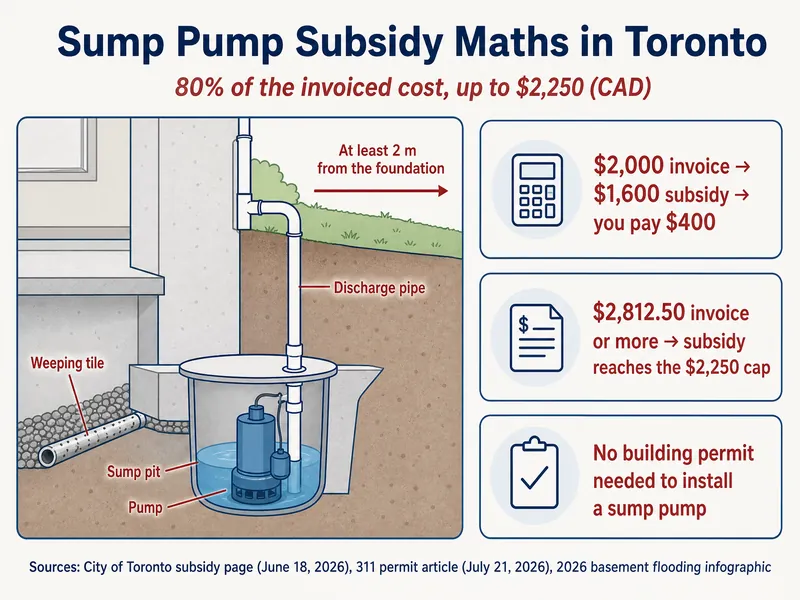
Sump pump installation cost in Toronto depends mostly on whether a pit already exists; the City refunds 80% of the invoice up to $2,250, and no building permit is needed.
On this page
Key takeaways
- Toronto's subsidy program pays 80% of a sump pump invoice, to a maximum of $2,250 for one pump, on work finished from November 12, 2025 (page modified June 18, 2026).
- The $2,250 ceiling kicks in once the bill hits $2,812.50; below it, the subsidy is simply 80% of the bill.
- The City's 311 permit list (modified July 21, 2026) lists sump pumps among jobs that need no building permit.
- To claim, you send photos of the pump and its exterior discharge pipe taken after installation, plus an itemized invoice marked paid in full.
- The City's 2026 infographic says sump discharge pipes should send water at least 2 m from the foundation without harming neighbouring properties.
- A battery backup earns a separate subsidy of up to $300 if the contractor lists it as its own invoice line.
Sump pump numbers from the City (CAD, as of October 2026)
- $2,250Most the City pays toward one sump pump (80% of the invoice)City of Toronto
- $1,750Sump pump cap for work finished before Nov 12, 2025City of Toronto
- $0Building permit fee, because Toronto requires no permit to install a sump pumpCity of Toronto 311
- 2 mHow far from the house the City wants sump discharge to landCity flood-readiness infographic, 2026
How much does sump pump installation cost?
No public body publishes an installed price for a sump pump in Toronto, so this guide gives no range. Prices quoted online come from contractors and vary with the job. What is fixed is the City's side: a subsidy of 80% of the invoice up to $2,250 for one pump, no permit fee, and a two-year window to apply.
For comparison, the City does publish an average for backwater valves ($3,800, in a 2025 Toronto Water staff report), and the backwater valve installation cost guide works through that example. For a sump pump, get two or three written quotes that break the work into the parts listed below, and check the arithmetic in the subsidy section against each one.
What does a sump pump installation include?
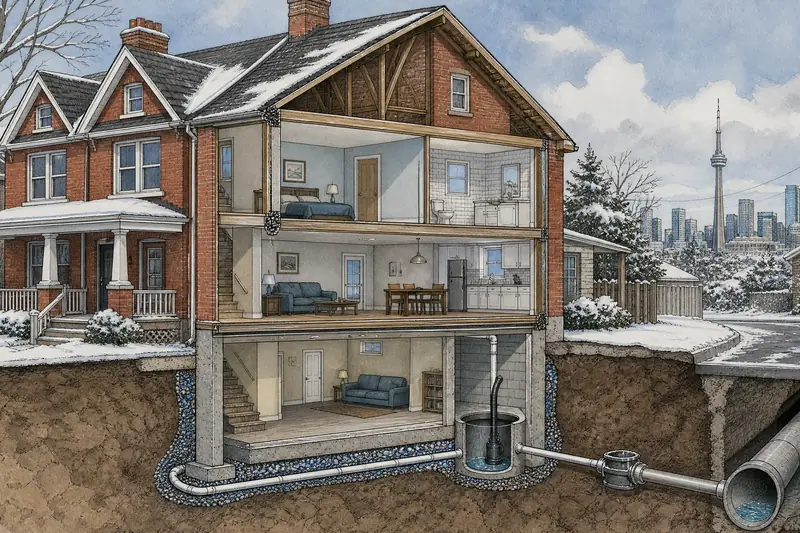
A full installation usually has five parts: the pit, the pump, the connection to the weeping tile, the discharge line to the outside, and an alarm. The City's subsidy covers "the pump and its alarm"; the program page does not break the rest down, so ask how your quote treats each item.
- The pit (sump). A liner set into a hole cut through the basement slab, where groundwater collects.
- The weeping tile connection. Toronto's Sewers By-law, Chapter 681, defines weeping tile as a perforated pipe around the building that carries groundwater to a sump pump "for disposal on the surface of the ground" or to a private connection.
- The pump. Usually a submersible electric pump with a float switch.
- The discharge line. Pipe from the pump, up and out through the wall, with a check valve, ending on your own property.
- Alarm and power. A high-water alarm, a suitable outlet and, often, a battery backup.
Where the weeping tile is still connected to the City sewer, a sump pump often comes with severing and capping that connection. That is a separate subsidy item, up to $400; the weeping tile guide covers it.
What drives sump pump cost up?
The biggest jump is between replacing a pump in an existing pit and creating a new pit from scratch. A swap reuses the liner, the discharge line and usually the wiring; a new installation means cutting concrete, digging, connecting to the weeping tile and running a new line through the foundation wall.
Other things that change a quote:
- Finished basements. Flooring, walls and built-ins near the pit location must be opened and restored.
- Weeping tile condition. If the tile is collapsed or clogged, or still tied into the sewer, there is more drain work. Toronto licenses people who do "weeping tile installing" as Drain Layers.
- Discharge route. A long run, or one that must avoid a driveway or a neighbour's lot, needs more pipe and planning.
- Electrical work. A new dedicated outlet is electrical work for a licensed electrician.
- Pump and backup choice. Pump capacity, alarm type and a battery backup each add to the parts cost.
Labour is a large share. Job Bank publishes wages paid to Toronto plumbers, which are lower than a company's charge-out rate; the plumber cost guide explains the difference.
How much does the Toronto subsidy pay toward a sump pump?
The City pays 80% of the invoiced cost of the sump pump and its alarm, up to $2,250, for one pump per property. The cap is reached when the invoice hits $2,812.50, because 80% of $2,812.50 is $2,250.
| Invoiced cost | 80% of invoice | City subsidy (cap $2,250) | Homeowner's share |
|---|---|---|---|
| $1,200 (pump swap, example) | $960 | $960 | $240 |
| $2,000 | $1,600 | $1,600 | $400 |
| $2,812.50 | $2,250 | $2,250 | $562.50 |
| $4,000 | $3,200 | $2,250 | $1,750 |
These rows are arithmetic, not prices. The other rules apply as for every item in the Basement Flooding Protection Subsidy Program: registered owner of a one- to four-unit house, downspouts disconnected, front-yard paving within zoning, licensed contractor and subcontractors, no money owed to the City, and an application within two years. For the sump pump specifically, the City asks for photos of the installed pump and its exterior discharge pipe.
Where can the sump pump discharge go?
Onto your own property, away from the house, so the water soaks in rather than returning to the foundation or running onto a neighbour's lot. The City's 2026 infographic says to "extend downspouts and sump discharge pipes to direct water at least 2 m from foundation", and adds: "Ensure redirected water does not negatively impact neighbouring properties."
Chapter 681 sets the same principle for stormwater from a disconnected roof leader: it must not "accumulate at or near the building" and must not "adversely affect adjacent properties". The by-law also restricts discharging groundwater and other private water into City sewers without Toronto Water's approval, so do not assume a pump can be piped into a floor drain or laundry tub. Ask the installer where the line will end and whether it meets City rules. The downspout disconnection guide covers the related rules for roof water.
In winter, an outlet that freezes can back water up into the pit. Keep the end of the line clear of ice and snow and check it after cold snaps.
How long does a sump pump last?
No City, provincial or federal source gives a lifespan for sump pumps, and this guide does not invent one. Pump makers set their own warranty terms and maintenance schedules in each model's manual, and those are the figures to rely on for your pump.
What the public sources agree on is testing. The City's infographic says to "test your sump pump regularly to ensure it is functioning properly and ready before heavy rainfall occurs". The University of Waterloo's Intact Centre on Climate Adaptation includes testing the pump in its "maintain what you've got" step, at least twice per year. A simple test is to pour water into the pit until the float lifts and confirm the pump starts, empties the pit and stops.
A pump that runs often, cycles on and off rapidly, or will not start when the float rises needs attention before the next storm.
How we put this page together
This page uses the City of Toronto's subsidy page (modified June 18, 2026), the 311 article on work that needs a permit (modified July 21, 2026), the City's 2026 basement flooding infographic, Municipal Code Chapter 681 (consolidated May 21, 2026), Toronto's Drain Layer licensing page and the University of Waterloo Intact Centre's flood protection guide, all read in October 2026. Amounts are Canadian dollars. Installed price ranges and pump lifespans are left out because only contractor websites publish them; the table shows subsidy arithmetic only.
Common questions
Does replacing an old sump pump qualify for the City subsidy?
The program subsidizes one sump pump per property as a lifetime maximum. If your property has never received a sump pump subsidy, a replacement installed by a licensed firm may qualify; if it has, a second pump subsidy is not available.
Which trades does a sump pump job involve?
The subsidy needs a contractor with a Toronto business licence. A new dedicated circuit or outlet is electrical work for a licensed electrician; pit and drain work is plumbing or drain work.
What photos does the City want for a sump pump claim?
Photos of the installed pump and of its exterior discharge pipe, taken after the work is done, along with the itemized electronic invoice marked paid in full.
Can the sump pump drain into the City sewer?
Chapter 681 restricts discharging private water, including groundwater, into City sewers without Toronto Water approval. The City's guidance is to discharge on your own property at least 2 m from the foundation.
Is the alarm included in the sump pump subsidy?
Yes. The City says the sump pump subsidy covers the pump and its alarm, up to the $2,250 cap.
Does the $2,250 include the battery backup?
No. A battery backup has its own cap of up to $300, and the contractor must list it separately on the invoice.
Related guides
More help: see our Toronto home water and plumbing guide.