
Softeners & filters
Water Softener vs Water Filter: What's the Difference?
Water softener vs water filter: a softener swaps out calcium and magnesium to stop scale, while a filter traps or adsorbs things such as chlorine taste, particles or lead. They solve different problems.
On this page
Key takeaways
- A softener targets hardness (calcium and magnesium) by ion exchange; a carbon filter targets taste, odour and, when certified, lead. Neither does the other's job.
- Toronto water averaged 119 mg/L hardness and 1.6 mg/L total chlorine residual (chloramines) in 2025 (City of Toronto).
- The City says softening systems are "usually not needed" in Toronto (tap water page).
- Health Canada: "it is not necessary to use drinking water treatment devices with municipally treated water", though people may choose them for taste (Chloramines, 2020).
- Standards differ: NSF/ANSI 44 for softeners, NSF/ANSI 42 for taste and odour (including chloramine), NSF/ANSI 53 for health claims such as lead.
- For lead, the City points to a filter that is "NSF-053 certified" at the tap (City of Toronto, Lead and Drinking Water).
People often shop for "a water treatment system" without knowing which problem they are trying to fix. In Toronto the two common complaints are white scale, which is a hardness problem, and a chlorine-like taste, which comes from the disinfectant the City keeps in the pipes. A softener addresses the first, a carbon filter the second, and a certified filter at the kitchen tap is the tool for lead.
Softener or filter: the Toronto numbers
- 119 mg/LAverage hardness in Toronto, 2025: the problem a softener targetsToronto Water analysis, 2025
- 1.6 mg/LAverage total chlorine residual (chloramines) in Toronto's distribution system, 2025Toronto Water analysis, 2025
- 33.5 mg/LToronto's 2025 calcium level, one of two hardness minerals a softener capturesToronto Water analysis, 2025
- 1.0 gpgHardness an NSF/ANSI 44 softener must reduce water to below (17.1 mg/L)Health Canada, 2025
What is the difference between a softener and a filter?
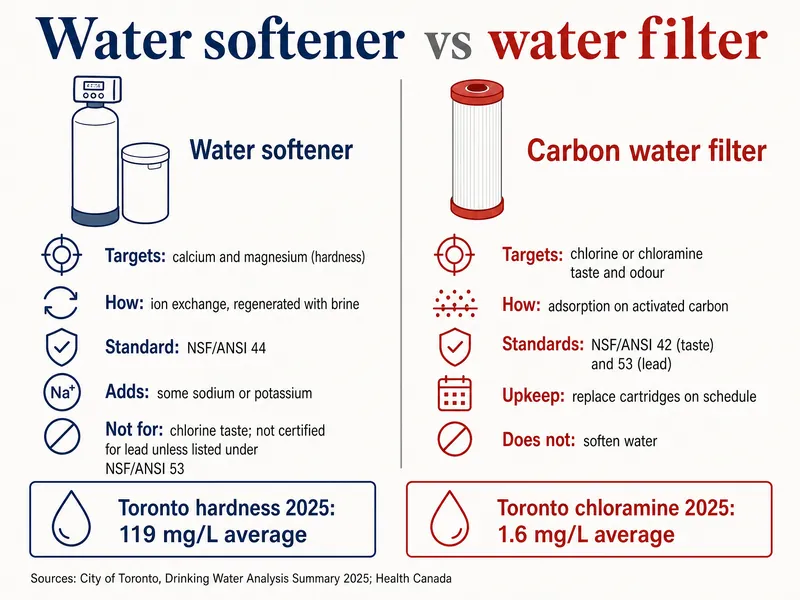
A softener exchanges dissolved minerals for sodium or potassium; a filter removes or reduces substances by trapping or adsorbing them. That difference in method decides what each can do. A softener changes the water's mineral balance but leaves taste, chlorine and most contaminants alone; an activated-carbon filter improves taste and odour but leaves calcium and magnesium in place.
Upkeep differs too. A softener needs salt or potassium chloride and regenerates itself, sending brine and rinse water to the drain. A filter has no regeneration; its cartridge or media loses capacity and must be replaced on the maker's schedule. Health Canada notes that devices "can lose removal capacity through usage and time, and need to be maintained and/or replaced".
What does a water softener remove?
A softener removes the calcium and magnesium that make water hard, and little else of note. Toronto's 2025 averages were 33.5 mg/L for calcium and 8.5 mg/L for magnesium. Health Canada's 2025 hardness document says a unit certified to NSF/ANSI 44 must reduce hardness to below 1.0 gpg (17.1 mg/L).
What it adds matters as much. Softened water picks up sodium from the resin, and Health Canada recommends that the most-used drinking tap bypass the softener. Penn State Extension's softening guide cautions that softeners will not necessarily deal with "the more serious drinking water contamination problems". The cycle is explained step by step on how a water softener works.
What does a water filter remove?
It depends on the filter type and its certification, which is why the standard on the listing matters more than the label on the box. Activated carbon is the common media for taste and odour. For chloramine, Health Canada's 2020 guideline describes an NSF/ANSI 42 test that brings roughly 3 mg/L down to half a milligram per litre or lower; the whole house filter guide goes through it.
For lead, the test is NSF/ANSI 53. Health Canada's 2019 lead document notes that lead-certified devices "are generally based on activated carbon adsorption technology" and that point-of-use units at the drinking tap are the preferred approach. Sediment filters, by contrast, catch particles only. None of these filters remove hardness.
| Feature | Water softener | Carbon water filter |
|---|---|---|
| Main target | Calcium and magnesium (hardness) | Taste and odour; lead if certified to NSF/ANSI 53 |
| How it works | Ion exchange, recharged with brine | Adsorption on activated carbon |
| Standard to ask for | NSF/ANSI 44 | NSF/ANSI 42 (aesthetic), NSF/ANSI 53 (health) |
| Changes to the water | Adds sodium or potassium | Reduces chloramine; no minerals added |
| Upkeep | Salt, regeneration water, valve settings | Cartridge or media replacement |
| Where installed | Main line, whole house | Whole house or a single tap |
Which one does Toronto water need?
Most Toronto homes need neither, according to both the City and Health Canada. The City's Tap Water in Toronto page (modified July 22, 2026) tells residents that hardness rarely matters at Toronto's mineral levels and that softening is seldom required. Health Canada's chloramine guideline adds that devices are generally not needed on municipal water, but may be an option when the taste is objectionable.
So the choice follows the complaint. Scale on fixtures points to hardness; the City suggests vinegar or a commercial hardness remover before any equipment, and the softener decision guide covers the rest. A chlorine-like taste points to a carbon filter, and the City adds that algae in a warm Lake Ontario can give an earthy or musty note toward the end of summer. Older houses, especially those from before the mid-1950s according to the City, can still be fed by a lead service pipe; that calls for a test and an NSF/ANSI 53 filter at the tap: see lead pipes in Toronto.
Can you use a softener and a filter together?
Yes. The two devices do different jobs and are often installed on the same main line. Where both are used, any filtering stage meant to protect the resin goes ahead of the softener, and Health Canada advises keeping the kitchen drinking tap on unsoftened water.
A softener maker's service manual, for example, says that where piping is clogged with iron "a separate iron filter unit should be installed ahead of the water softener". Health Canada's chloramine guidance also advises against stripping out the disinfectant residual, which means carbon-filtered water is best used fresh rather than kept in storage. The whole-house option is covered on whole house water filter.
How do costs and upkeep compare?
No public, primary source publishes Canadian prices for either device, so compare written, itemized quotes in CAD (as of October 2026). The cost pattern differs: a softener carries ongoing salt, water and electricity costs plus installation on the main line, while a filter's main ongoing cost is replacement cartridges or media.
The same Ontario rules protect buyers of both. Ontario restricts in-home selling of softeners, filters and treatment devices to cases where the buyer asked the business to visit, and every home-service contract carries a 10-day cooling-off period. The softener side is broken down on water softener cost.
How we put this page together
Drawn from the City of Toronto's 2025 drinking water results and tap water page, Health Canada's guideline documents on calcium and magnesium (2025), chloramines (2020) and lead (2019), the City's lead and drinking water page, Penn State Extension, a softener maker's service manual and Ontario's home-service contract rules, reviewed October 2026. No product prices, brand comparisons or filter performance claims beyond the certification tests Health Canada describes.
Common questions
Does a water filter soften water?
No. Carbon and sediment filters do not remove calcium and magnesium in any useful amount. Lowering hardness takes ion exchange, which is what an NSF/ANSI 44 softener does.
Does a softener remove chlorine taste?
Not reliably. Softening resin targets hardness ions. For the taste of the City's chloramine, a carbon filter certified to NSF/ANSI 42 for chloramine reduction is the matching tool.
Is a pitcher filter enough for lead?
Only if it is certified to NSF/ANSI 53 for lead reduction. The City advises a filter that is NSF-053 certified and replaced regularly, alongside running the cold tap after water sits.
Which should come first on the line, the filter or the softener?
Iron or sediment filtration usually goes ahead of a softener to protect the resin, per maker instructions. Follow the specific maker's installation guide for your equipment.
Will a filter stop kettle scale?
A carbon filter is not designed to remove hardness, so kettle scale will continue. Descaling with vinegar, as the City suggests for fixtures, is the low-cost answer.
Do aquarium owners need special treatment for Toronto water?
Yes. Health Canada's 2020 guideline flags chloraminated water for fish keepers, who must neutralize both chlorine and chloramine before the water goes into a tank.
Compare and decide


More help: see our guide to water and plumbing in Toronto homes.