
Lead & old pipes
Polybutylene Pipe and Galvanized Pipe: Identify and Replace
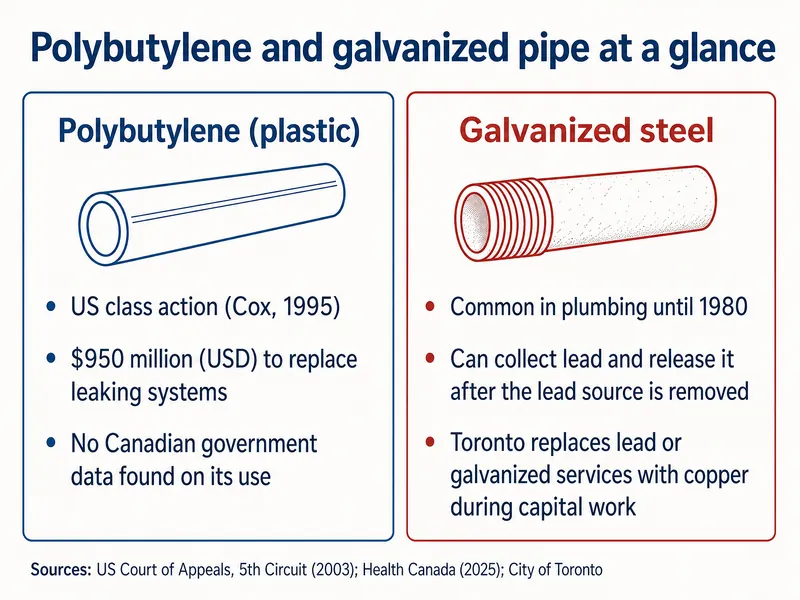
Polybutylene pipe is a plastic water pipe known mainly from a US$950 million American class-action settlement; galvanized steel pipe, common until 1980, can hold lead and release it later, according to Health Canada.
On this page
Key takeaways
- Polybutylene (PB) is a plastic water pipe. In the 1995 US Cox settlement, Shell and Hoechst agreed to contribute $950 million (USD) to replace leaking PB systems (US Court of Appeals, 5th Circuit).
- No Canadian government source on where or when polybutylene was used in Canada was found, so this guide gives no Canadian dates.
- Health Canada says galvanized steel "was commonly used in plumbing pipes" until 1980 (Health Canada, 2025).
- Galvanized iron plumbing "can accumulate lead via adsorption, releasing it even after the primary source of lead has been removed" (Health Canada, 2025).
- The City of Toronto treats a water service made of lead or galvanized steel as substandard and replaces it with copper during scheduled capital work.
- Toronto Water's low-pressure flow test is not done on lead or galvanized steel pipes (City of Toronto).
- $950MUS class-action settlement to replace leaking polybutylene systems (USD, 1995)US Court of Appeals, 5th Circuit, Richard v. Hoechst Celanese (2003)
- 1980Year until which galvanized steel was commonly used in plumbingHealth Canada, Guidance on Controlling Lead Corrosion (2025)
- 0.005 mg/LHealth Canada maximum acceptable concentration for lead in drinking waterHealth Canada (2019)
- mid-1950sToronto houses built before then may have a lead water service pipeCity of Toronto, Lead and Drinking Water
What is polybutylene pipe?
Polybutylene pipe is a flexible plastic water-supply pipe that became the subject of large class-action lawsuits in the United States. A 2003 decision of the US Court of Appeals for the Fifth Circuit, Richard v. Hoechst Celanese, describes claims about "inherently defective polybutylene ("PB") plumbing systems" and summarizes the earlier settlements.
The best known is the 1995 Cox settlement, approved by a Tennessee state court. According to the Fifth Circuit's opinion, it "required Shell and Hoechst to contribute $950 million to replace eligible consumers' leaking PB plumbing systems and to reimburse them for the property damage which the leaks had caused." That was an American settlement for American homes, and it does not create any claim route for a Toronto owner.
This guide found no Canadian government source on the years polybutylene was installed in Canada or on how often it failed here. Figures you see online for Canadian use come from contractors and are left out.
How do you identify polybutylene pipe?
The most reliable way to identify polybutylene pipe is the printing on the pipe, which normally names the material; look for "polybutylene" or the letters "PB" in the code. Colour is not reliable, because several kinds of plastic pipe come in similar colours.
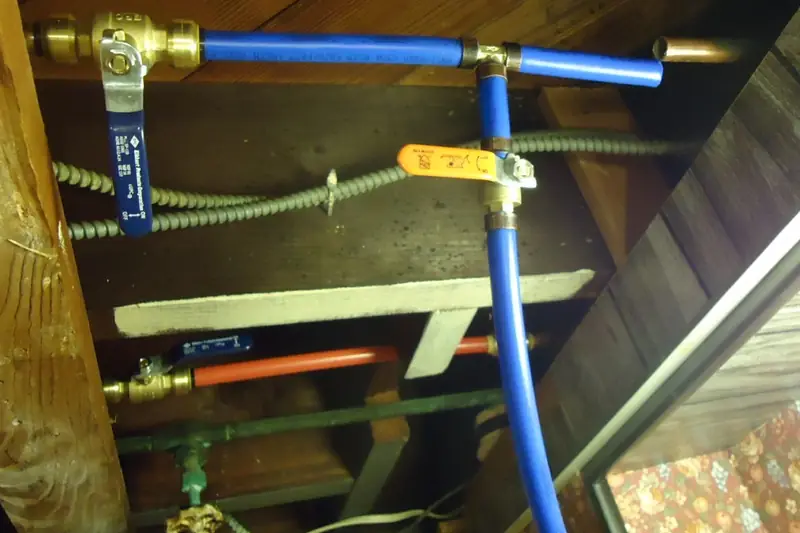
Look where pipe is exposed: beside the water heater, at the main shut-off valve near the water meter, under sinks and in an unfinished basement ceiling. Note the fittings too, and photograph the printing for a plumber or home inspector.
Polybutylene is easy to confuse with two other plastic systems. Modern PEX is usually red, blue or white and printed "PEX". Kitec is usually orange for hot and blue for cold, with an aluminium layer and brand names printed on it; see the Kitec plumbing guide. If the printing has worn off, a licensed plumber can identify the material.
What is galvanized pipe and why does it corrode?
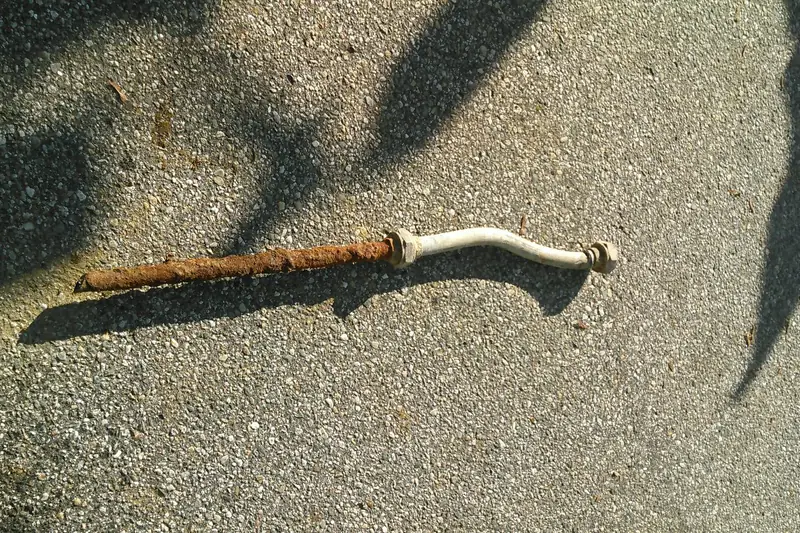
Galvanized pipe is steel pipe coated with zinc, joined with threaded fittings, and it was common in homes for decades: Health Canada's 2025 guidance on controlling lead corrosion says it "was commonly used in plumbing pipes and well components for plumbing systems until 1980".
Over decades the steel can corrode from the inside, and Health Canada's guidance refers to iron deposits forming within home plumbing. Deposits narrow the bore of a pipe, so old galvanized plumbing is one possible cause of weak flow. The low water pressure guide explains how to tell a pipe problem from a valve or aerator problem.
In Toronto, galvanized steel shows up both inside houses and in the buried water service. The City's Capital Water Service Replacement Program calls a service "substandard" if it is "made of lead or galvanized steel", and replaces lead or galvanized steel with copper pipes during scheduled capital construction. The City owns the street-side section of a service up to the lot line; the house side is the owner's.
Can galvanized pipe raise lead levels?
Yes, galvanized pipe can add lead to tap water, according to Health Canada. Its 2025 guidance says "Galvanized pipes can also be sources of cadmium and lead, since these materials are present as impurities", and that galvanized iron plumbing "can accumulate lead via adsorption, releasing it even after the primary source of lead has been removed."
The US Environmental Protection Agency's Science Advisory Board made the same point in 2011: lead "can accumulate in interior plumbing downstream from" a lead service line, "especially in galvanized pipes" (EPA SAB, 2011). For a Toronto house that once had a lead service, replacing only the service may not end lead release if galvanized pipe remains inside.
Health Canada's maximum acceptable concentration for lead is 0.005 mg/L. The only way to know whether your water contains lead is to test it: the City offers free lead testing for homes built before the mid-1950s. For health questions, the City points residents to Toronto Public Health; speak with your doctor about your own situation. The lead pipes guide covers testing and the City's filter advice.
| Material | What official sources say | Toronto program that applies |
|---|---|---|
| Polybutylene | US court record of a $950 million (USD) replacement settlement, 1995 | None found |
| Galvanized steel | Health Canada: common until 1980; can hold and release lead | Capital Water Service Replacement (City side, during capital work) |
| Lead service pipe | City: possible in houses built before the mid-1950s | Priority Lead Water Service Replacement Program; free lead testing |
| Kitec | Settlement administrator: closed to claims January 9, 2020 | None |
Do insurers ask about polybutylene and galvanized pipe?
Some insurers may ask about pipe materials on an application or at renewal, but no regulator or insurer rule on polybutylene or galvanized pipe was found for this guide. Ask your own insurer or broker what they ask and why, and check how your policy treats escape of water.
Guidance from the Insurance Bureau of Canada explains that coverage depends on the type of water damage and the coverage you bought. Keeping records of any pipe inspection or replacement, with the building permit and invoices, makes those conversations easier and helps when you sell.
What are the replacement options?
The replacement options are to repipe inside the house, to replace the buried water service, or both, and each has its own rules in Toronto.
- Inside the house. PEX and copper are the common choices. Changing a plumbing system needs a City building permit; the plumbing permit guide lists the 2026 fees, starting at the $214.79 minimum.
- The buried service, private side. Replacing buried water service piping for a single-family house carries a $214.79 flat permit fee in 2026. If the service is lead, the City's Priority Lead Water Service Replacement Program aims to replace the City-owned portion within 12 weeks once you commit to replacing your side; the private side is the owner's cost.
- The buried service, City side. Galvanized and lead services on the City side are replaced with copper during scheduled capital work. Contact 311 to ask about your street.
Use a plumber listed on the Skilled Trades Ontario Public Register, from a business with a City of Toronto Plumbing Contractor licence, and get written, itemized quotes. The Toronto lead pipe replacement guide covers the service-pipe process in more detail.
How we put this page together
The guide draws on the US Court of Appeals for the Fifth Circuit opinion in Richard v. Hoechst Celanese (December 19, 2003); Health Canada's Guidance on Sampling and Mitigation Measures for Controlling Lead Corrosion (February 2025) and lead guideline (2019); the US EPA Science Advisory Board report EPA-SAB-11-015 (2011); and City of Toronto pages on lead, capital service replacement, the Priority Lead program and low water pressure, all checked in October 2026. Left out: polybutylene years of use in Canada, failure rates, insurer rules and contractor price ranges, none of which a primary source supports.
Common questions
Is polybutylene pipe common in Toronto?
No Canadian government source measures how common it is. If your home was built or renovated with plastic supply pipe, read the printing on the pipe or ask a plumber to identify it.
Can a Toronto owner join the US polybutylene settlement?
The 1995 Cox settlement was approved by a Tennessee court for US consumers. Nothing in the court record suggests a route for Canadian homes, and this guide found no Canadian equivalent.
Does galvanized pipe always mean lead in the water?
No. Health Canada says galvanized pipe can hold lead and release it, but only testing tells you what is in your water. Homes built before the mid-1950s can get a free City test kit through 311.
Why will the City not run a flow test on galvanized pipe?
The City's low-pressure page says tests are not done on lead or galvanized steel pipes, and owners with those pipes are advised to contact a plumber.
Is galvanized pipe the same as lead pipe?
No. Lead pipe is soft, grey and scratches easily, according to the City. Galvanized pipe is zinc-coated steel with threaded joints and is much harder.
Does replacing galvanized pipe need a permit in Toronto?
Changing a plumbing system needs a permit under the City's 311 permit list, and buried service work has its own flat fee. Toronto Building decides for each project.
Related guides
More help: see our Toronto home water and plumbing guide.