
Softeners & filters
Do You Need a Water Softener in Toronto?
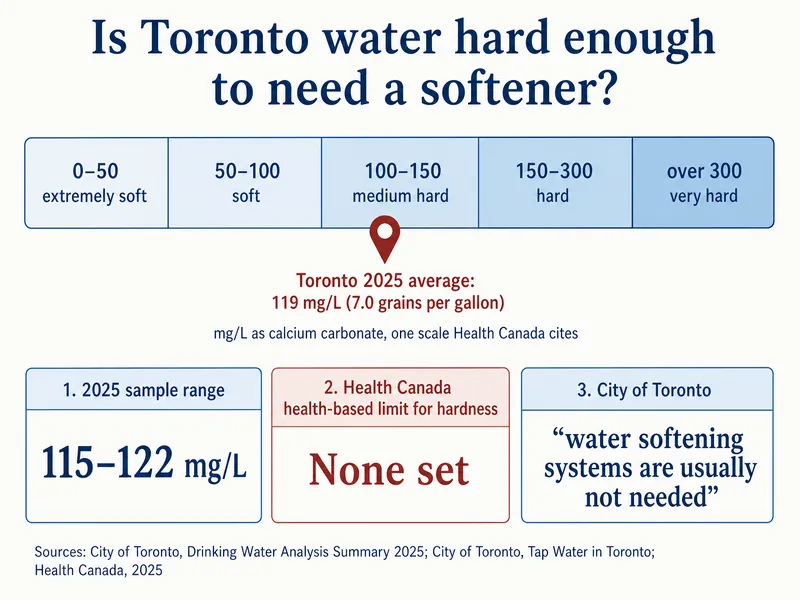
A water softener in Toronto is usually not needed, the City says: its 2025 average hardness was 119 mg/L (7.0 grains per gallon), medium hard on a scale Health Canada cites.
On this page
Key takeaways
- Toronto's water averaged 119 mg/L of hardness (7.0 gpg) in 2025, with samples between 115 and 122 mg/L (the City's 2025 water analysis table).
- In the City's words, softening systems "are usually not needed" for Toronto homes (City tap water page, modified July 22, 2026).
- Health Canada has no health-based value for hardness; 119 mg/L sits in the 100–150 mg/L "medium hard" band of one scale it cites.
- Health Canada calls hardness above 200 mg/L "poor" and above 500 mg/L unacceptable for many domestic purposes; Toronto is well below both.
- A sodium-based softener adds sodium; Health Canada advises that the kitchen tap bypass the softener.
- In Ontario, water softeners cannot be sold door to door unless you invited the seller, and every such contract comes with a 10-day cooling-off period.
Toronto draws its water from Lake Ontario, and the City measures hardness all year at its four treatment plants and across the distribution system. The short answer for most houses is that a softener is optional, not necessary. This page sets out what the City and Health Canada actually say, when softening can still be a reasonable choice, and what to weigh before signing anything.
Toronto hardness at a glance
- 119 mg/LAverage hardness of Toronto tap water, 2025 (7.0 grains per gallon)City of Toronto, 2025 water analysis
- 115–122 mg/LLowest and highest hardness results across 119 samples in 2025City of Toronto, 2025 water analysis
- 200 mg/LHardness above which Health Canada describes supplies as "poor" (tolerated by consumers)Health Canada, Calcium and Magnesium guideline document, 2025
- 10 daysCooling-off period on Ontario home-service contracts, including water softenersGovernment of Ontario
Does Toronto water need a water softener?
For most homes, no. The City of Toronto's 2025 summary puts the average hardness at 119 mg/L as calcium carbonate, or 7.0 grains per gallon (gpg) using the usual 17.1 mg/L conversion. The same table lists an average of 33.5 mg/L of calcium and 8.5 mg/L of magnesium, the two minerals that make up hardness.
On the scale Health Canada cites in its 2025 calcium and magnesium document, 100–150 mg/L is "medium hard", 150–300 mg/L is "hard" and anything over 300 mg/L is "very hard". Toronto sits in the lower half of the medium band. The same document says supplies above 500 mg/L "may require softening"; it draws no such line for water like Toronto's. For the full measurement story, see Toronto water hardness.
What does the City of Toronto say about softeners?
Toronto's position is that hardness worries few owners and softening is rarely needed. The City's tap water page page explains that Lake Ontario water "contains relatively low levels of these minerals". For white crust on taps and shower heads, the City's suggestion is simple: remove the deposits "with vinegar or a commercial hardness remover".
The City does not test, approve or recommend any treatment device. Health Canada takes a similar line on municipal water in general: in its chloramines guideline (2020) it states that "it is not necessary to use drinking water treatment devices with municipally treated water", while accepting that some people choose them for taste or other reasons.
When does a softener make sense in Toronto?
A softener can still be a reasonable personal choice when the cost of scale bothers you more than the cost and upkeep of the unit. Hardness is about convenience and equipment, not safety, so the decision belongs to the homeowner. Common reasons people give include:
- Scale on fixtures and glass. White spots on glass, dishes and chrome are what most people notice, and the City's own answer for them is vinegar.
- Water heaters and boilers. Health Canada notes that hard water forms "scale on the inside of hot water–bearing pipes and water heating appliances". Natural Resources Canada's Water Heater Guide calls water quality "the single most important factor affecting the life of the water heater". Owners of tankless heaters should follow the maker's descaling instructions; see tankless water heater cost.
- A well or a harder GTA supply. Homes on wells in York, Durham or north Peel can see 186–345 mg/L, far above the city. Compare areas on GTA water hardness by city.
If none of these apply, a vinegar soak and a regular descaling routine cost far less than a softener.
What are the downsides of a water softener?
The main trade-offs are added sodium, salt and water use, and ongoing upkeep. Health Canada's 2025 document cautions that sodium ion exchange can raise sodium in drinking water to undesirable levels, and potassium units can do the same with potassium. It recommends leaving the most-used drinking tap, usually in the kitchen, on unsoftened water. People told to limit sodium should check with their doctor.
Regeneration also flushes brine and rinse water down the drain, and Health Canada notes that spent regeneration solutions raise environmental concerns. A softener does nothing for taste, chlorine or lead: Penn State Extension notes that water softeners "will not necessarily remove any of the more serious drinking water contamination problems". How the unit works is covered in how a water softener works.
What does a water softener cost to run?
No government or standards body publishes Canadian prices for buying, installing or running a softener, so this guide does not print a range. What can be said is what drives the bill: the unit and its capacity, installation by a licensed plumber, salt or potassium chloride, the water used in regeneration, electricity for the control valve, and occasional service. The water softener cost page explains each item and what a written, itemized quote should show, in CAD and as of October 2026.
One rule applies to every buyer in Ontario. The province's door-to-door sales rules (updated June 19, 2026) list water softeners, water filters and water treatment devices among products that cannot be sold at your door unless you contacted the business first. A contract made in breach "will be considered void", and you have a 10-day cooling-off period from the day you receive the written copy.
| Option | What it does about hardness | Upkeep |
|---|---|---|
| Do nothing | Nothing; at 119 mg/L the City sees no general need to soften | Wipe and descale fixtures |
| Vinegar or hardness remover | Removes visible deposits on taps and shower heads | Repeat as scale returns |
| Descaling the water heater | Removes scale inside the heater per the maker's manual | Interval set by the maker |
| Salt-based softener (NSF/ANSI 44) | Health Canada: certified units reduce hardness below 1.0 gpg | Salt, regeneration water, service |
| Carbon filter | None; targets taste, odour and, if certified, lead | Cartridge changes |
What are the alternatives to a softener?
The alternatives are to live with moderate hardness, clean scale where it shows, and look after the water heater. For most Toronto houses that is enough, because the water is in the medium band and the City sees no need for softening. Where taste is the real complaint, a carbon filter is a different tool for a different job; water softener vs water filter explains the difference.
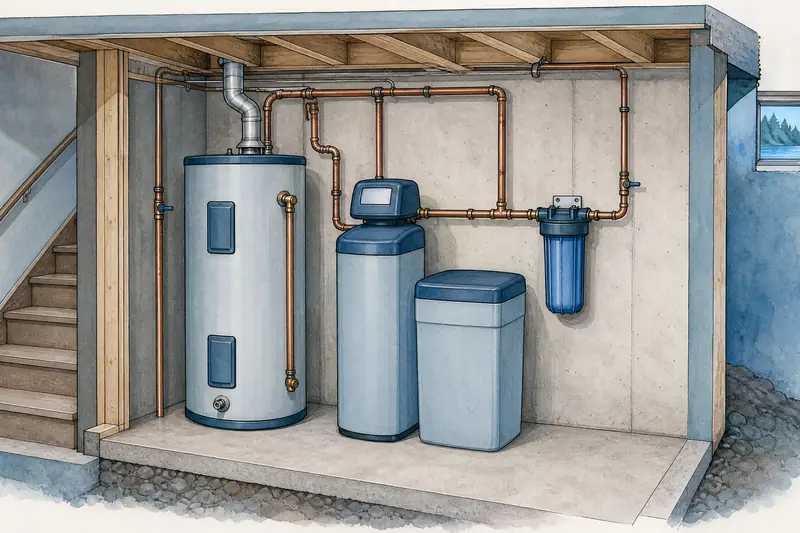
If you do buy a softener, Health Canada points to units certified to NSF/ANSI 44, which must leave less than 1.0 gpg of hardness (17.1 mg/L), and recommends bypassing the kitchen tap. Ask for the certification listing, the hardness the unit is set for (7 gpg in Toronto) and the salt setting in writing.
How we put this page together
Built from the City's 2025 water analysis table and its tap water page (modified July 22, 2026), Health Canada's 2025 calcium and magnesium document and 2020 chloramines document, Natural Resources Canada's Water Heater Guide, Penn State Extension's water softening guide and Ontario's door-to-door sales page, all reviewed in October 2026. Not included: purchase, installation, salt and water-use figures (no primary source publishes them for Canada), sodium-per-grain ratios, and any health claim about hard water beyond Health Canada's statement that it sets no health-based limit.
Common questions
Where does Toronto water sit on Health Canada's hardness scale?
On one scale cited by Health Canada it counts as medium hard. The 2025 average was 119 mg/L as calcium carbonate (7.0 gpg), in the 100–150 mg/L band. It is not "very hard", which starts above 300 mg/L on that scale.
Does hardness change from one Toronto neighbourhood to another?
The City publishes one system-wide figure, not neighbourhood results. Across 119 samples in 2025 the results ranged from 115 to 122 mg/L, a narrow spread.
Is hard water bad for my health?
Health Canada found too little evidence to set a health-based value for hardness, calcium or magnesium. Questions about a specific condition belong with your doctor or Toronto Public Health.
Will a softener stop scale in my water heater?
Softened water forms less scale because calcium and magnesium are swapped out. Whether that is worth it for your heater depends on the maker's guidance; follow its descaling schedule either way.
Is softened water fine to drink?
Health Canada advises that the most-used drinking tap, usually the kitchen, bypass a sodium or potassium softener. If you follow a low-sodium diet, ask your doctor first.
A salesperson came to the door offering a free water test. Is that allowed?
Ontario law bars door-to-door contracts for water softeners and water treatment devices unless you initiated the contact. A contract made in breach is void, and you can keep the goods without obligation.
Does adding a softener need a permit?
Toronto Building's 311 list requires a permit to install or modify plumbing systems but does not name softeners either way. Ask Toronto Building or a licensed plumber before work starts; see the plumbing permit guide.
Related guides

More help: see our Toronto water and plumbing guide.