
Lead & old pipes
Lead Pipes in Toronto: Check Your Home
Lead pipes in Toronto may be present in homes built before the mid-1950s, the City says; it offers free lead testing through 311 and advises flushing, cold water and an NSF-053 filter until the pipe is replaced.
On this page
Key takeaways
- The City's Lead & Drinking Water page (modified June 11, 2025) says a house built before the mid-1950s may have a lead water service pipe; buildings with more than six units do not.
- About 13,664 City-owned lead water services remained at the end of 2025, down from an estimated 65,000 in 2007, per the City's 2025 lead mitigation report.
- Free lead testing is open to residents of pre-mid-1950s homes: register through 311, and results arrive by mail within 30 days of the lab receiving the sample.
- Health Canada's maximum for total lead is 0.005 mg/L (2019); Ontario's legal standard is 0.010 mg/L.
- The City advises running the cold tap for at least five minutes after water sits, using cold water for drinking and cooking, and using an NSF-053 certified filter.
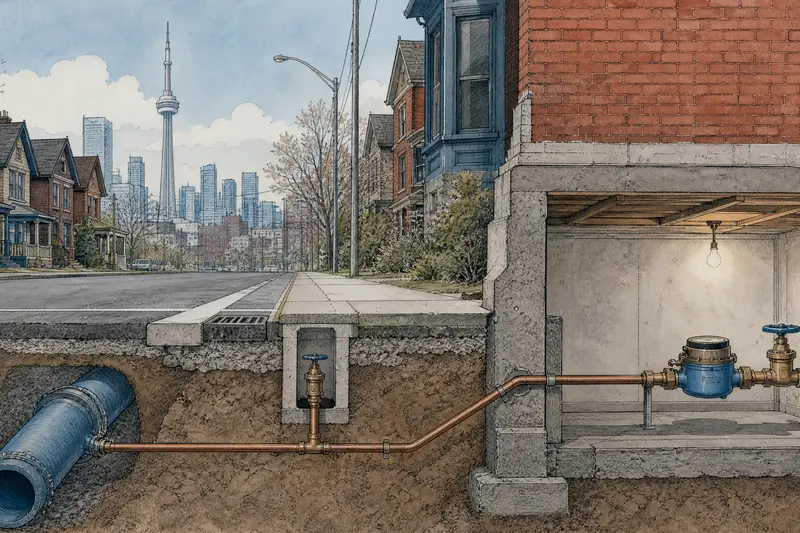
- Ownership splits at the property line: the City owns the stretch under the street, the homeowner owns the stretch inside the lot.
Lead in Toronto by the numbers
- 13,664Estimated City-owned lead water services left at the end of 2025City of Toronto, Annual Lead Mitigation Report 2025
- 0.005 mg/LHealth Canada's maximum acceptable concentration for total lead, 2019Health Canada
- 0.010 mg/LOntario's lead standard in O. Reg. 169/03, Schedule 2Government of Ontario
- 30 daysTime for lead test results to arrive by mail after the lab receives a sampleCity of Toronto, lead testing
Which Toronto homes have lead pipes?
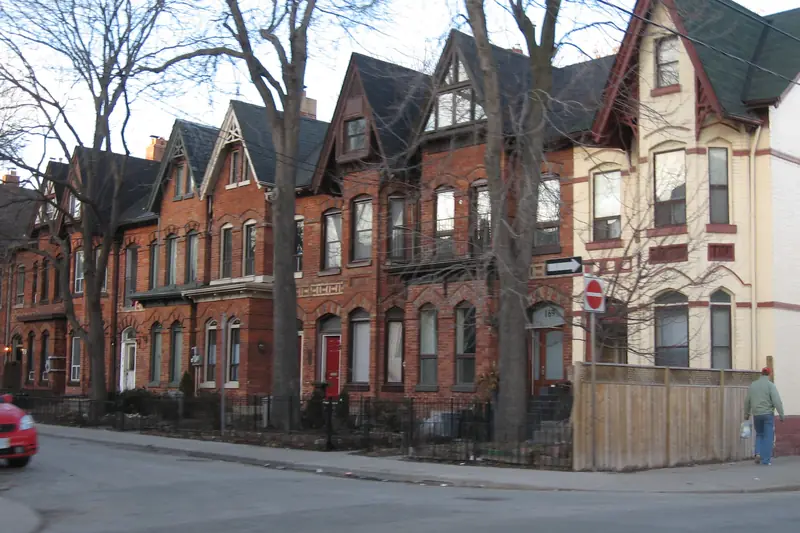
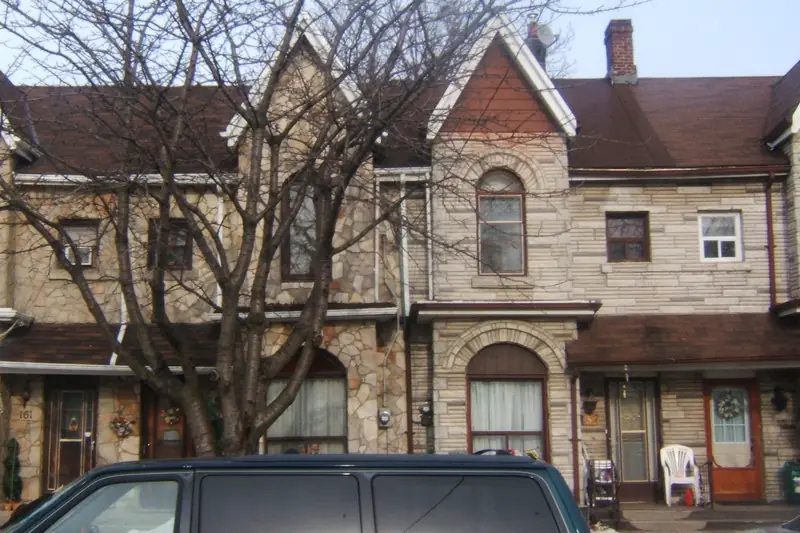
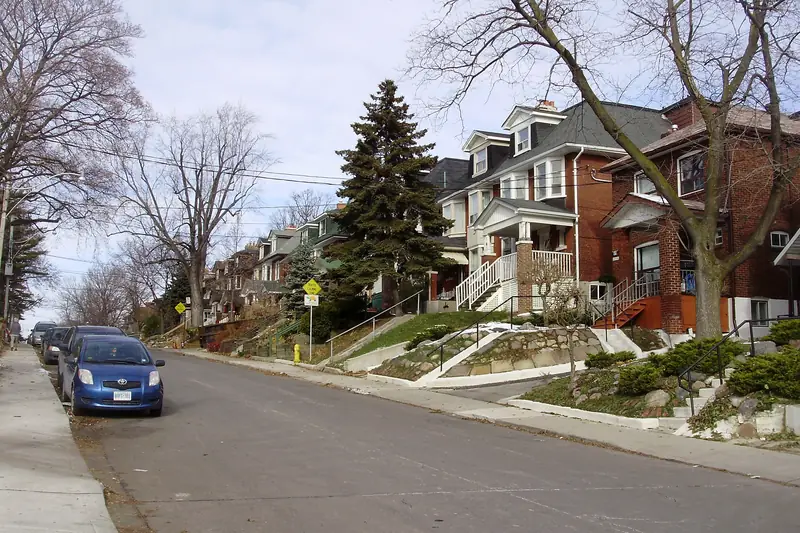
Houses built before the mid-1950s are the ones that may have a lead water service pipe, according to the City's Lead & Drinking Water page. Apartment buildings and other buildings with more than six units do not have lead service pipes, whatever their age. That points most of the risk at older detached, semi-detached and row houses in neighbourhoods built up before the 1950s.
The service pipe is not the only possible source. The City also names lead solder used to join pipes before 1990 and leaded-brass fixtures such as taps and valves. Its 2025 lead mitigation report adds that water leaving the City's treatment plants does not contain lead; lead enters as these older materials corrode.
The number of lead services is shrinking. The City estimated about 65,000 City-owned lead services in 2007, revised that to 38,000 in 2014, and put the remaining figure at roughly 13,664 at the end of 2025, according to the Annual Lead Mitigation Report 2025. Those counts cover the City's side only; the private side of a property can still be lead after the City side has been changed.
How can you tell if your service pipe is lead?
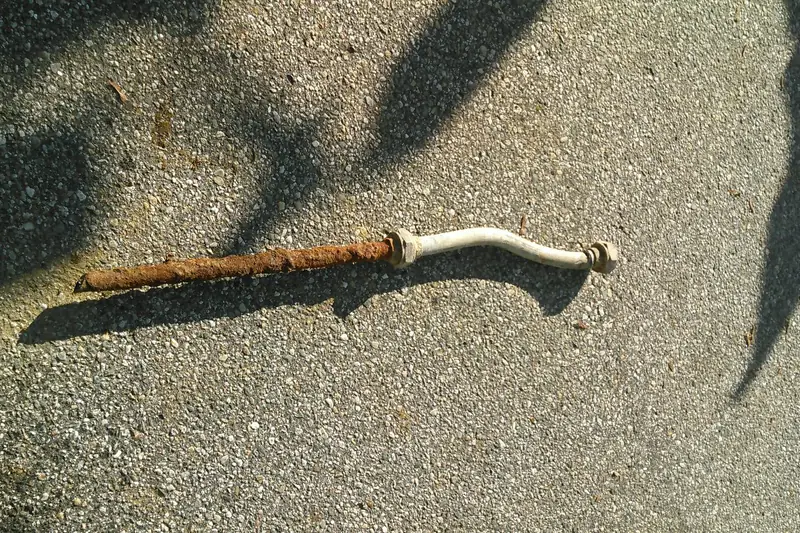
Look at the pipe that comes through the basement wall or floor and into your water meter. The City says it may be lead if "it is grey, scratches easily and does not sound hollow when you tap it." Copper is a reddish-brown metal, and a pipe that matches the City's description deserves a closer look.
The City lists three other ways to find out. Check property records, ask a licensed plumber, or contact 311 for a City records check on the public side, which "may take up to 30 business days." Renters can ask the property owner. The pipe's appearance only tells you about the section you can see; water testing is the only way to know whether there is lead in the water itself.
How do you get free lead testing in Toronto?
Register by contacting 311, collect a kit from a Toronto Public Health location, take the sample at home and drop it off. The City's lead testing page (modified June 16, 2026) says testing is "free of charge" for residents of homes built before the mid-1950s. Pickup and drop-off locations and hours are listed on that page.
Each kit contains a sampling container and instructions; follow them exactly. You are notified "by regular mail" within 30 days of the sample reaching the Toronto Water laboratory. The City's report notes that residents whose results show any level of lead receive an information package encouraging them to act.
What is the safe limit for lead in drinking water?
Health Canada's maximum acceptable concentration (MAC) for total lead is 0.005 mg/L, or 5 micrograms per litre, set on March 8, 2019. Its guideline document explains that "current science cannot identify a level under which lead is no longer associated with adverse health effects", so levels should be kept "as low as reasonably achievable". In other words, the MAC is a ceiling, not a level Health Canada calls safe.
Ontario's legal standard is higher. O. Reg. 169/03, Schedule 2, sets 0.010 mg/L, and that is the number printed in Toronto's yearly analysis table. The City's lead report says Ontario's environment ministry is considering adopting the lower 5 ppb limit.
| Measure | Figure | Source |
|---|---|---|
| Health Canada MAC (total lead) | 0.005 mg/L (5 ppb) | Health Canada, 2019 |
| Ontario standard | 0.010 mg/L (10 ppb) | O. Reg. 169/03, Schedule 2 |
| Toronto system samples, 2025 maximum | 0.0068 mg/L (average 0.00034) | City analysis summary, 2025 |
| Regulated home and business sampling, 2025 | None of 29 sites above 10 ppb; one residential sample above 5 ppb | City lead report, 2025 |
| Same sampling, 2008 | 52% of samples from 100 sites above 10 ppb | City lead report, 2025 |
The drop since 2008 follows corrosion control. Since December 2014 the City has added phosphate at all four plants, which forms a coating inside pipes and household plumbing to reduce how much lead reaches the tap. How to read those rows in the City's table is covered in the Toronto water quality report guide.
How can you reduce lead exposure now?
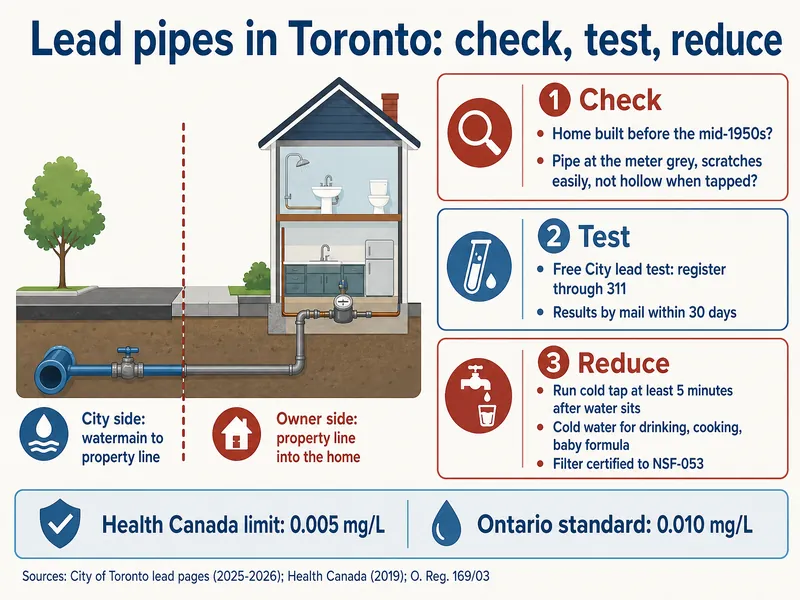
The City's advice comes down to three habits: flush, use cold water, and filter. After water has sat in the pipes for a few hours, run the cold tap "for at least five minutes" to draw fresh water from the watermain. Use cold water for drinking, cooking and preparing baby formula, because lead dissolves more readily into hot water. Use a filter certified to NSF-053 for lead removal, and replace the cartridge on the maker's schedule.
The City names pregnant people, infants (especially those fed formula made with tap water) and children under six as most at risk, and suggests an NSF-053 filter on the tap used most for drinking and cooking. Until a filter is in place, it says bottled water or ready-to-feed formula can be used, and that breastfeeding should continue. For anything about your own family's health, ask Toronto Public Health or your doctor.
Health Canada's filter guide says to look for a certification mark and a claim of lead reduction tested against NSF/ANSI Standard 53. The certification matters more than the filter's shape; the reverse osmosis in Toronto page covers one type of under-sink system. Some households qualify for help: low-income homes judged high-risk can claim $100 a year toward an NSF-053 tap filter, and the eligibility rules are on the lead pipe replacement page.
Who is responsible for which part of the pipe?
The City owns the service pipe "from the watermain on the street up to the property line"; the part from the property line into the home is private property and the homeowner's responsibility. A full lead replacement therefore has two owners and two bills, and the City's side and your side can be replaced at different times.
The City replaces its side through three routes listed in its lead report: the Priority Lead Water Service Replacement Program, for owners who agree to replace their own section; the Capital Water Service Replacement Program, during planned watermain, road or sewer work; and emergency replacement, for a broken service or one delivering less than seven litres a minute. Toronto Public Health's stated preference is for the public and private sections to be done together. The steps, timelines and costs are on the Toronto lead pipe replacement page.
If you are also unsure about galvanized steel or other old materials inside the house, see polybutylene and galvanized pipes. Knowing where your main shut-off is helps for any pipe work; the shut-off guide explains it.
How we put this page together
This page relies on the City's main lead page (last modified in June 2025), its lead testing page (modified June 16, 2026), the Annual Lead Mitigation Report 2025, the City's 2025 drinking water analysis summary, Health Canada's lead guideline (March 2019) and filter guide, and Ontario's O. Reg. 169/03; all checked in October 2026. It repeats the City's and Health Canada's advice without adding to it. Left out: medical advice, contractor price lists for lead replacement, and any claim about whether lead pipes are banned in Canada, which this guide could not confirm from a primary source.
Common questions
Does a Toronto house built in 1960 have lead pipes?
The City links lead service pipes to homes built before the mid-1950s, so a 1960 house is less likely to have one. It can still contain lead solder, which the City says was used before 1990, or leaded-brass fixtures. A free test is limited to pre-mid-1950s homes; others can use an accredited lab.
Do Toronto condos have lead pipes?
The City says buildings with more than six units do not have lead service pipes, regardless of age. Older fixtures inside a unit can still contain leaded brass. Ask your property manager if you have concerns about a building's plumbing.
Can you tell lead pipe by the colour?
Partly. The City describes a lead pipe as grey, easily scratched and not hollow-sounding when tapped. A 311 records check, a licensed plumber or a water test gives a firmer answer.
Is a home inspection enough to find a lead service?
An inspector can describe the pipe where it enters the meter, and the City accepts a home inspector's report as proof of private-side replacement in one program option. It cannot tell you the material under the lawn or the lead level in your water. Pair it with the City's free test.
Does a water softener or pitcher filter remove lead?
Trust a device with lead only when its label shows NSF/ANSI 53 testing plus a lead-reduction claim, which is what Health Canada tells buyers to look for. A softener is sold to deal with hardness, so check its certification rather than assuming. The City's own advice names NSF-053 filters.
What happens if the City finds lead during road work?
Under the Capital Water Service Replacement Program, the City replaces substandard lead or galvanized steel services with copper during planned construction. That covers the City-owned portion. The private side remains the owner's responsibility.
Are lead test results in Toronto public?
The City posts results from its non-regulated testing program on its Open Data website, from 2011 onward, according to its 2025 lead report. Regulated sampling results are posted on the City's website. Individual results come to you by mail.
Related guides
More help: see our Toronto water and plumbing guide.