
Lead & old pipes
Toronto Lead Pipe Replacement: How the City Program Works
Toronto lead pipe replacement is split in two: the City replaces its section of a lead water service, on a priority basis if you commit to replacing yours, and the private section from the property line in is the homeowner's cost.
On this page
Key takeaways
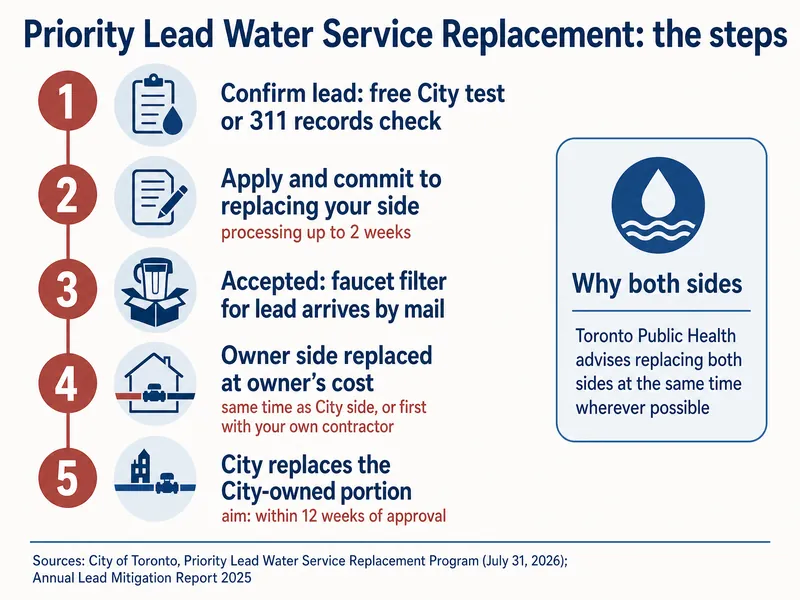
- Under the Priority Lead Water Service Replacement Program (modified July 31, 2026), the City "aims to replace the City-owned portion" within 12 weeks of approval.
- The same page states that the cost of replacing the private side "is the homeowner's responsibility"; it describes no City financing for that work.
- Applications may take up to two weeks to process, and accepted applicants first receive a faucet filter for lead removal by mail.
- Toronto Public Health advises replacing both sides at the same time wherever possible, according to the City's 2025 lead mitigation report.
- The City completed 206 priority-program replacements in 2025, alongside 141 emergency replacements and a capital-works count still under review.
- An annual $100 rebate toward an NSF-053 faucet filter is available to high-risk, low-income households.
Lead replacement in numbers
- 12 weeksCity's target for replacing its portion after a priority application is approvedCity of Toronto
- 206Priority Lead program replacements completed in 2025City of Toronto, Annual Lead Mitigation Report 2025
- $100Annual rebate toward an NSF-053 faucet filter for high-risk, low-income residentsCity of Toronto, Annual Lead Mitigation Report 2025
- $214.79Toronto permit fee for single-family water service buried piping, from Jan 1, 2026City of Toronto, building permit fees
How does Toronto lead pipe replacement work?
A lead water service has two owners, so Toronto lead pipe replacement happens in two parts. The City owns the pipe from the watermain to the property line; you own it from the property line into the house. The City replaces its section through one of three routes, and you arrange and pay for yours.
The three City routes are listed in the Annual Lead Mitigation Report 2025:
| Route | When the City replaces its side | What the owner does | 2025 count |
|---|---|---|---|
| Priority Lead Water Service Replacement Program | After you apply and commit to replacing your side; target within 12 weeks of approval | Replaces the private side at own cost | 206 |
| Capital Water Service Replacement Program | During planned watermain, road or sewer work | Private side stays the owner's responsibility | Under review (1,068 in 2024) |
| Emergency replacement | When the pipe is broken or flow is under 7 litres a minute | Private side stays the owner's responsibility | 141 (City estimate) |
If you are not sure your service is lead yet, start with the lead pipes in Toronto page, which covers the visual check, the 311 records check and free testing.
What is the Priority Lead Water Service Replacement Program?
It is the City's route for owners who want their lead service replaced sooner than scheduled road work would bring. The program page says residents "who commit to replacing their portion of the pipe can apply to have the City replace its side on a priority basis." The City links lead services to homes built before the mid-1950s.
The page offers two ways to apply:
- Option One: both sides are replaced at the same time. You contact the contractor the City uses for its side about your side as well, and submit the application form by mail.
- Option Two: you hire your own contractor to replace your side first, then apply, attaching "proof that the private side has been replaced", such as an invoice from a contractor or licensed plumber, or a home inspector's report.
After you apply, the City sends a letter confirming whether its portion is lead. If it is, you first receive a faucet filter for lead removal, which you can use right away, and then a letter with the construction schedule and the contractor's contact details. The page adds that "the City is not responsible for work completed on private property."
What does the private-side replacement involve?
The private side is the run of pipe from the property line, under the front yard, through the foundation wall and up to the water meter. Replacing it means installing a new service pipe connected to the City's side at one end and to your meter at the other, with water off to the house while the work is done (the shut-off guide explains the main valve).
No primary source publishes a Toronto price range for this work, so this guide does not print one. What drives the price is specific to each lot:
- Length and depth of the run. The City's design standard for new services calls for 1.8 to 2 metres of cover, so the pipe is deep enough to avoid frost; older services vary.
- What sits above it. A lawn, a paved driveway, a porch, front steps or mature trees all change how the pipe can be reached and what must be restored.
- Entry into the basement. Finished walls, the location of the meter and the condition of the foundation affect the inside work.
- Timing with the City side. Doing both sides together under Option One avoids a second dig at the property line.
- Permit and inspection. Toronto's fee schedule prices single-family water service buried piping at a flat $214.79 (from Jan 1, 2026), and the City's minimum fee is also $214.79. Ask Toronto Building whether your job needs a permit; the plumbing permit guide explains the process.
Get at least two written, itemized quotes that list the pipe material, the method, permit fees and every item of restoration. Confirm the business holds a City of Toronto Plumbing Contractor licence and that the plumber appears on the Skilled Trades Ontario public register, since plumbing is a compulsory trade in Ontario. The plumber cost page explains what goes into a plumbing invoice.
How long does replacement take?
From first question to finished pipe, the City's own timelines add up to a few months. A 311 records check on the City side "may take up to 30 business days"; free lead test results arrive by mail within 30 days of the lab receiving the sample; a priority application may take up to two weeks to process; and once approved, the City aims to replace its section within 12 weeks.
Your side's timing depends on which option you choose. Under Option Two it happens before you apply, so the clock starts after your contractor finishes. Under Option One both sides follow the construction schedule in the City's letter. The faucet filter arrives early in the process, so households can reduce exposure while they wait.
Why replace both sides of the pipe?
Because lead can come from either section, and from plumbing downstream of it. Toronto Public Health advises "that both the public and private sides of the lead water service should be replaced at the same time wherever possible", according to the City's 2025 lead report, which also notes TPH's view that it is desirable to remove as much lead from the system as possible.
Older pipe inside the house matters too. A 2011 review by the US EPA's Science Advisory Board found that lead from a service line can build up inside a home's own pipes, and singled out galvanized pipe as a place where it collects. Health Canada's 2025 corrosion guidance says galvanized iron plumbing "can accumulate lead via adsorption, releasing it even after the primary source of lead has been removed", and that galvanized steel was commonly used in plumbing until 1980.
That is why the City's Capital Water Service Replacement Program treats both lead and galvanized steel services as substandard and replaces them with copper. If your house has galvanized pipe indoors, the polybutylene and galvanized pipes page covers what to look for.
What help is there with filters and costs?
The City's help is in-kind and targeted: filters, a rebate and free testing, but no payment toward the private-side pipe. Three filter routes are listed in the City's 2025 report: a free NSF-053 faucet filter mailed to accepted Priority Lead applicants, a free filter after the City replaces its section of a lead pipe, and an annual $100 rebate toward an NSF-053 faucet-mounted filter for high-risk, low-income residents.
The City's Lead & Drinking Water page sets the rebate rules. Applicants must have lead pipes and meet all three conditions: a child under six or a pregnant person lives in the home; the home is a single-family house, duplex or triplex; and household income is under $50,000. Free lead testing is open to anyone in a home built before the mid-1950s.
For the pipe itself, the priority program page states that the private-side cost is the homeowner's and describes no City financing. If you read elsewhere about City financing for lead pipes, check the current program page before relying on it. All amounts on this page are in Canadian dollars, as of October 2026.
How we put this page together
This page is based on the City of Toronto's Priority Lead Water Service Replacement Program page (modified July 31, 2026), main lead page, Capital Water Service Replacement Program page, Annual Lead Mitigation Report 2025, building permit fee page (fees effective Jan 1, 2026), the City's July 2026 design standard for sewers and watermains, Skilled Trades Ontario, the US EPA Science Advisory Board's 2011 review and Health Canada's 2025 corrosion guidance; all checked in October 2026. Left out: private-side replacement price ranges, which only contractors publish, contractor names or rankings, and any financing program the City does not currently list.
Common questions
Does the City of Toronto pay to replace lead pipes?
The City replaces the portion it owns, from the watermain to the property line. The priority program page says the cost of the private side is the homeowner's responsibility. It does not describe any City payment or financing for the private side.
Can you replace only your side of a lead pipe in Toronto?
Yes. Under Option Two you hire your own contractor to replace your side first, then apply to the priority program with proof such as an invoice or a home inspector's report. Toronto Public Health still advises replacing both sides at the same time wherever possible.
Do you need a permit to replace a water service in Toronto?
Toronto's fee schedule includes a flat $214.79 fee for single-family water service buried piping, and the minimum permit fee is also $214.79. The City's 311 permit list does not mention water service replacement either way, so ask Toronto Building before work starts.
What if the City replaces its side during road work and yours is still lead?
Under the Capital program the City replaces its section with copper during planned construction. Your section remains lead until you replace it. Plan the private side as soon as you can, since TPH prefers both sides done together.
Can a homeowner replace a lead service pipe themselves?
Plumbing is a compulsory trade in Ontario, and Toronto licenses businesses that contract plumbing work. Whether an owner may do any of the work, and what permit applies, is a question for Toronto Building before anything is dug. The connection at the property line also meets the City-owned pipe.
Who qualifies for the $100 lead filter rebate?
Homes with lead pipes where a child under six or a pregnant person lives, in a single-family house, duplex or triplex, with household income under $50,000. All three conditions must be met. Details are on the City's lead page.
Does a new water service fix lead in the whole house?
It removes the main source, but the City names lead solder used before 1990 and leaded-brass fixtures as other sources. Health Canada notes galvanized pipe can keep releasing lead it has absorbed. A follow-up test through 311 shows where things stand.
Related guides
More help: see our guide to water and plumbing in Toronto homes.