
Basement flooding
Sump Pump Battery Backup: How It Works
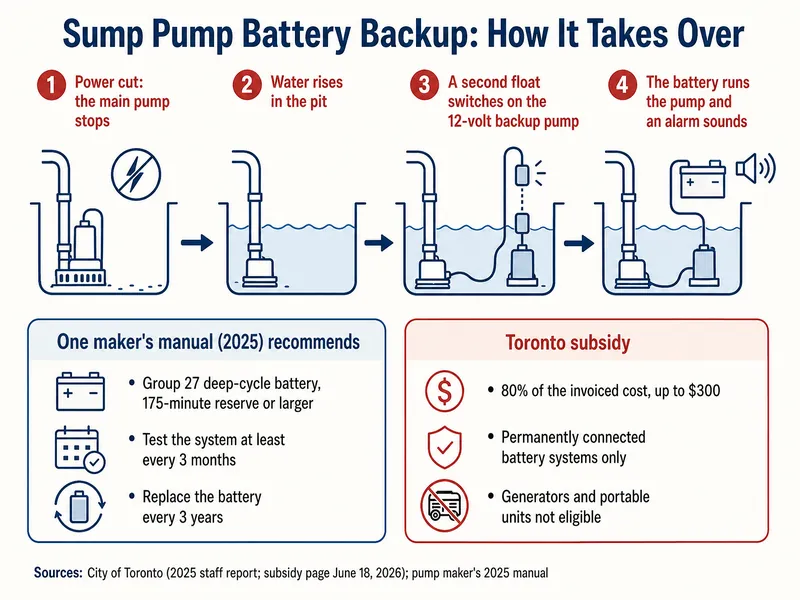
A sump pump battery backup is a second, 12-volt pump and battery that keeps the pit draining when the power fails; Toronto now pays 80% of its invoiced cost, up to $300.
On this page
Key takeaways
- Toronto added a battery backup subsidy in 2026: 80% of the invoice up to $300 on jobs finished from mid-November 2025 (City of Toronto).
- Only battery systems permanently connected to the sump pump qualify; generators, inverters and portable units do not, according to a Toronto Water staff report.
- Homeowners whose sump pump was subsidized earlier can still claim for a battery added later.
- Zoeller's 2025 manual for its 12-volt backup rates continuous running at 6.5 hours with the recommended battery, and recommends replacing that battery every 3 years (Zoeller FM3256).
- The same manual asks for a group 27 deep-cycle battery with at least 175 minutes of reserve capacity, and a system test at least every 3 months.
- The Insurance Bureau of Canada lists a "sump pump with a battery backup" among its flood-protection tips.
Battery backup figures (as of October 2026)
- $300Most the City pays toward a sump pump battery backup (80% of the invoice)City of Toronto
- 6.5 hoursContinuous running time one maker rates for its 12-volt backup with the recommended batteryZoeller manual FM3256 (2025)
- 3 yearsBattery replacement interval in that maker's manualZoeller manual FM3256 (2025)
- 3 daysTime a completely drained battery may need to recharge fully, per the same manualZoeller manual FM3256 (2025)
What is a sump pump battery backup?
It is a second pump, running on a 12-volt battery, that sits in the same pit as your main pump and runs when the main pump loses power or fails. A controller keeps the battery charged from a household outlet, switches the backup pump on through its own float, and sounds an alarm when it runs.
Zoeller describes its system as "a backup to your primary sump pump", designed to protect against flooding "during power outages or primary pump failure". Its 2025 manual lists a DC pump rated at 11 US gallons per minute at 10 feet of head (113 L/min at 3 m) on a 12.7-volt battery, a charger that tops the battery up when power returns, and alarms for faults such as an unplugged pump or float.
A battery backup is not a generator, and Toronto treats the two differently for subsidy purposes. It also does not replace the main pump; the sump pump installation cost guide covers the primary system.
Do you need a battery backup sump pump?
If your basement depends on a sump pump to stay dry, a backup is what keeps it pumping during the power cuts that often come with severe storms. Toronto Water's 2025 report on the subsidy program says battery backup provides extra protection "in cases when there is a loss of power during severe storms", which is why Council added it to the Basement Flooding Protection Subsidy Program.
Three public sources recommend one. The Insurance Bureau of Canada lists "install a sump pump with a battery backup". The University of Waterloo's Intact Centre puts "Install backup sump pump and battery" in its over-$250 contractor tier in its three-step home flood guide. The City subsidizes it.
A backup matters most where the pit fills quickly in wet weather, where the basement is finished, and where nobody is home to notice a failure. If your house has no sump pump at all, the question is first whether you need a sump pump; a backup only protects a pit that already exists.
How long will a backup battery run?
Hours, not days, and the exact number depends on the battery, the height the water must be lifted and how fast water enters the pit. Makers publish run times for continuous pumping, which is the worst case; in real storms the pump cycles on and off, so a charge lasts longer.
| Manual | Battery | Lift (head) | Published run time |
|---|---|---|---|
| Zoeller FM3256 (2025) | Recommended battery (group 27, 175-min reserve or larger) | Not stated with this figure | 6.5 hours |
| Zoeller FM3256 (2025) | 100+ amp-hour deep-cycle | 8 ft (2.4 m) | About 7.5 hours or more |
| A second maker's battery backup (2020 manual, model now discontinued) | 40 amp-hour AGM | 10 ft (3 m) | About 5 hours (4,800 US gal per charge) |
Zoeller notes that "in most installations, the pump runs intermittently and the battery life is extended accordingly", and that actual times "will vary depending on static head, volume of water entering the pit, and the condition of the battery". A second maker's battery backup manual adds that once its first low-battery warning sounds, about 2 hours or less of pumping remain, and possibly as little as 15 minutes.
After a long outage, plan for recharging. Zoeller says a completely drained battery "may require up to 3 days for full recharge", so a second storm soon after the first may find the battery only part-charged.
Which battery types are used?
Most residential backups use 12-volt deep-cycle lead-acid batteries, either flooded ("wet cell") or sealed AGM (absorbent glass mat). Both manuals reviewed here allow those two and warn against the others.
- Flooded deep-cycle. Zoeller recommends a BCI group 27 deep-cycle battery with 175 minutes of reserve capacity or more. Its water level must be checked monthly.
- AGM. Sealed and maintenance-free. Zoeller says "do NOT use a 'maintenance-free' battery unless it is an AGM battery"; the second maker's unit was "designed to work with a deep cycle sealed maintenance free lead-acid AGM battery".
- Not recommended: gel and sealed flooded batteries (second maker), and car batteries, which that maker says "will be quickly ruined by the repeated charge/discharge cycling". That manual also says its unit is not designed for lithium-ion batteries.
Charging lead-acid batteries can give off gas. Zoeller suggests keeping the battery as far as possible from a carbon monoxide detector, or venting it outside, to avoid false alarms, and says the electrical circuit should be installed by a qualified, licensed electrician. Follow the manual for the system you buy, since chargers are matched to particular battery types.
How do you test and maintain a battery backup?
Test it by cutting power to the main pump and controller, filling the pit until the backup's float lifts, and confirming the backup pump runs, the alarm sounds and the pit empties. Zoeller's manual gives this procedure and says to inspect and test the system at least every 3 months.
Routine care, from the same manual:
- Check the battery and its connections at least once a month; keep the terminals free of corrosion.
- For wet-cell batteries, check the water level monthly.
- Replace the battery every 3 years.
- After any test or outage, confirm the charger shows the battery recharging and then ready.
The City's 2026 infographic asks owners to "test your sump pump regularly", and the Intact Centre's guide puts pump testing in the step to do at least twice a year. Testing before spring thaw and before the summer storm season covers the periods when Toronto basements are most at risk.
Does the Toronto subsidy cover a battery backup?
Yes. On jobs finished since November 12, 2025, Toronto refunds four-fifths of what a battery backup was invoiced, to a $300 limit. Any invoice of $375 or more reaches that cap. The backup has its own cap on top of the $2,250 sump pump subsidy.
Conditions from the City's program page and the 2025 staff report:
- The system must be a battery backup permanently connected to the sump pump. Backup generators, inverters and portable systems are not eligible.
- If it is installed together with a sump pump, the contractor must list each component separately on the invoice.
- If your sump pump was subsidized in the past, you can apply for a battery added later to that existing pump.
- The usual program rules apply: a licensed contractor with a Toronto business licence, downspouts disconnected, an itemized electronic invoice marked paid in full, and an application within two years.
A backup pump does not stop sewer water coming up through floor drains; that is the job of a backwater valve. Ask your insurer whether it treats either device as a factor in your sewer backup coverage.
How we put this page together
Sources: Toronto's subsidy page (modified June 18, 2026), the Toronto Water staff report of October 22, 2025, the City's 2026 basement flooding infographic, the Intact Centre's home flood protection guide, the Insurance Bureau of Canada's water damage page, and two maker manuals read in full: Zoeller FM3256 (2025) and a second maker's battery backup manual (2020, a discontinued model cited for its battery guidance). All were checked in October 2026. Run times are the makers' own published figures, not tests. Installed prices, battery prices and water-powered backups were left out because no primary source covers them for Toronto.
Common questions
Will a car battery work in a sump pump backup?
Only as a short-term stopgap. One maker's manual says a car battery may need recharging after 1 to 2 hours of continuous use and is quickly ruined by repeated charge and discharge cycles; use the deep-cycle type the maker specifies.
Can a battery backup be added to an existing sump pit?
Usually, if the pit has room for a second pump and float. Toronto's subsidy explicitly allows a battery added later to an existing, previously subsidized sump pump.
Is a portable generator eligible for Toronto's $300 subsidy?
No. The staff report says generator-based and portable systems, including inverter and tailgating generators, are not covered; only battery backups permanently connected to the sump pump qualify.
How do you know when the backup battery is getting weak?
A weak battery may still charge but hold less energy, which shows up as shorter pumping time. Zoeller says that can only be detected by reduced run time or professional load testing, and recommends replacing the battery every 3 years.
Does the backup run while the power is on?
It can. Zoeller's system is also designed for a failed primary pump, so the backup float switches it on whenever water rises above the main pump's level, power or not.
Why does the alarm sound during a test?
Backup controllers sound an alarm whenever the backup pump runs, so you know the main pump is not keeping up. Silence it, finish the test, then reset the controller as the manual describes.
Related guides
More help: see our Toronto home water guide.