
Costs & permits
Plumbing Permit in Toronto: When and How to Apply
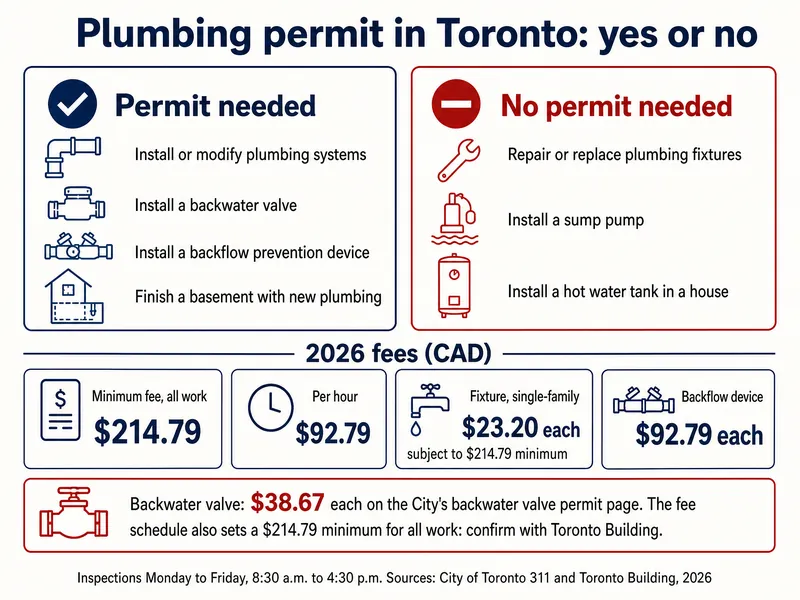
A plumbing permit in Toronto is needed to install or modify a plumbing system, a backwater valve or a backflow preventer; fixture repairs, sump pumps and house water tanks are exempt, and 2026 fees start at $214.79.
On this page
Key takeaways
- The City's 311 permit article (modified July 21, 2026) lists installing or modifying plumbing systems, backwater valves and backflow prevention devices as permit work.
- No permit is needed for "repairing and replacing plumbing fixtures", installing a sump pump or installing a hot water tank in a house.
- 2026 fees under Municipal Code Chapter 441: a $214.79 minimum for all work, $23.20 for each fixture in a single-family house (subject to that minimum), $92.79 per backflow prevention device, and $38.67 per backwater valve as listed on the City's valve permit page (City of Toronto).
- The owner or the owner's authorized agent applies, under the Ontario Building Code (2024), Division C.
- Inspections are booked online with the permit number and run Monday to Friday, 8:30 a.m. to 4:30 p.m.
- The Basement Flooding Protection Subsidy Program requires a building permit and an inspection before a backwater valve is covered.
2026 Toronto plumbing permit fees (CAD)
- $214.79Minimum fee for all permit workCity of Toronto, Building Permit Fees (Chapter 441)
- $23.20Per plumbing fixture, single-family houseCity of Toronto, Building Permit Fees
- $38.67Per backwater valve, as listed on the City's valve permit page; the $214.79 minimum may applyCity of Toronto, Backwater Valve permit guide
- $92.79Per backflow prevention device, and per hour of examination or inspectionCity of Toronto, Building Permit Fees
When do you need a plumbing permit in Toronto?
You need a plumbing permit in Toronto whenever you install or modify a plumbing system, according to the City's 311 article on when a building permit is needed. The same list names three specific jobs: installing a backwater valve, installing a backflow prevention device, and finishing a basement where the work installs or modifies plumbing.
The rule comes from Ontario's Building Code Act, 1992, which says no one may construct a building without a permit and counts plumbing as part of a building. The Act defines plumbing as "a drainage system, a venting system and a water system or parts thereof", so new drains, vents and water piping are all covered.
Read against that list, Toronto jobs likely to need a permit include adding a bathroom, moving a kitchen sink to a new location, a Kitec replacement or other repipe, a backwater valve, and replacing buried water service or drain piping. The fee schedule prices buried water service and drain work separately, so check with Toronto Building before that work starts. The City's list is not exhaustive, and Toronto Building decides in each case.
Which plumbing jobs do not need a permit?
Three common jobs do not need a plumbing permit in Toronto, according to the 311 article: "Repairing and replacing plumbing fixtures", installing a sump pump, and installing hot water tanks in a house.
- Fixtures. Swapping a toilet, sink, faucet or tub for a new one in the same place is a fixture replacement.
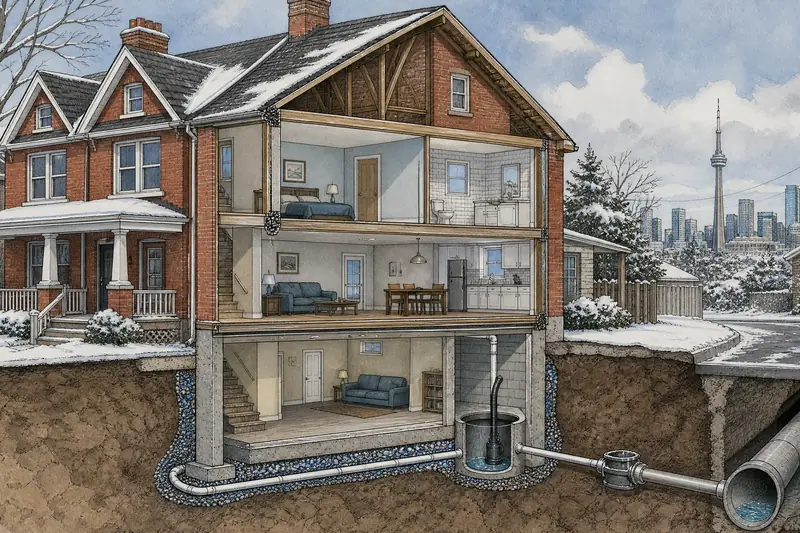
- Sump pumps. The article says "A building permit is not required to install a sump pump." The sump pump cost guide covers the City subsidy, which has its own photo requirements.
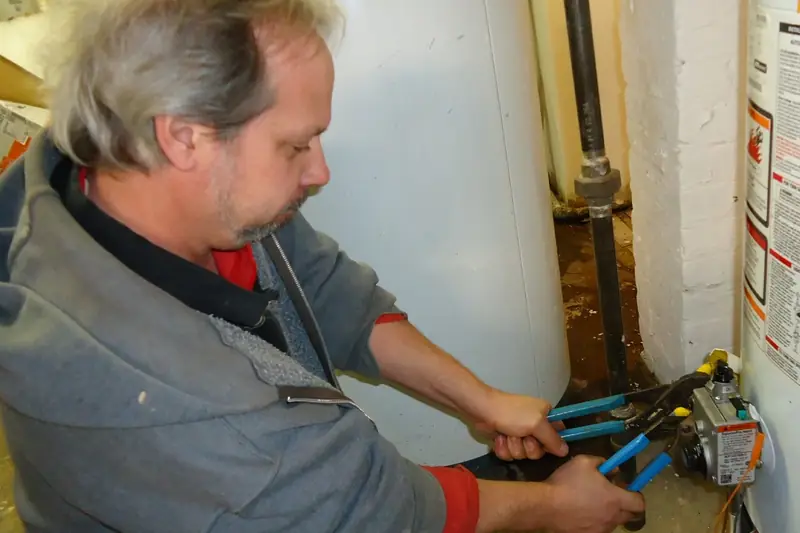
- Water heaters. No building permit is needed to install a hot water tank in a house, but gas connections must be made by a TSSA-registered contractor using certified gas technicians.
Basement finishing in a house needs no permit only when it does not include new plumbing, structural changes or an additional dwelling unit. Zoning by-laws still apply even when no permit is needed.
Who can apply for a plumbing permit?
The property owner or the owner's authorized agent can apply for a plumbing permit, as set out in the Ontario Building Code (2024), Division C, Article 1.3.1.2. In practice the agent is often the plumber or a designer, but the owner can apply directly.
Whoever applies, the work itself must be done by qualified people. Plumbing is a compulsory trade in Ontario, so the person doing it needs a Certificate of Qualification, a provisional certificate or a registered training agreement, which you can check on the Skilled Trades Ontario Public Register. A business that contracts plumbing work in Toronto needs a City Plumbing Contractor licence, and drain work needs a Drain Layer licence.
For a stand-alone plumbing or drain permit, the City's application guide (modified August 18, 2026) asks for:
- A site plan or key plan showing where the work is.
- Plans showing the plumbing layout and fixtures on each floor.
- The Application to Construct or Demolish form.
- A Plumbing Data Sheet.
- Schedule 1 designer information, where the designer is not an engineer or architect.
A backwater valve in a house with one or two dwelling units is simpler: the City's backwater valve permit guide says no plans are required.
How much does a plumbing permit cost?
A plumbing permit in Toronto costs at least $214.79 in 2026, because the City's fee schedule under Municipal Code Chapter 441 sets that minimum "for all work". Above the minimum, the fee depends on what is being installed. All amounts are in Canadian dollars, effective January 1, 2026.
| Work | Fee | Notes |
|---|---|---|
| Minimum fee | $214.79 | Applies to all permit work |
| Plumbing fixtures, equipment, roof drains (single-family house) | $23.20 each | $30.94 each in other buildings; subject to the minimum |
| Water service, sanitary and storm buried piping (single-family house) | $214.79 flat | |
| Repair, replacement or additions of buried plumbing and drainage piping (single-family house) | $214.79 flat | |
| Backwater valves, manholes, catch basins, interceptors, sumps with pumps | $38.67 each | Also on the backwater valve permit page; the $214.79 minimum may apply, so confirm with Toronto Building |
| Backflow prevention devices requiring testing | $92.79 each | |
| Examination and inspection | $92.79 per hour |
Some worked examples, as arithmetic only: a new bathroom with three fixtures in a house is 3 × $23.20 = $69.60, so the $214.79 minimum is charged. A whole-house repipe counting 10 fixtures is $232.00, just above the minimum. A single backwater valve is listed at $38.67 on the valve permit page, but the schedule's $214.79 minimum names no exemption for valves, and the minimum-fee exemptions in Municipal Code Chapter 363 (s. 363-4.10) cover reports, copying and similar services, not backwater valves. Toronto Building calculates the real fee when it reviews the application, so confirm it before you budget.
What happens at a plumbing inspection?
A plumbing inspection is a site visit by a City building inspector to check that the work matches the permit and the Ontario Building Code. Covered pipe cannot be seen, so the timing of each visit matters. Permit holders book, cancel or reschedule inspections online with the permit number and the name of the person who will meet the inspector.
The City's inspection page says inspections are conducted Monday to Friday from 8:30 a.m. to 4:30 p.m. Plan the job so that walls and trenches stay open until the inspector has seen the work.
For subsidy work, the inspection matters twice. The Basement Flooding Protection Subsidy Program requires a building permit and an inspection before a backwater valve is covered, and the permit guide includes a Consent to Enter form so Toronto Water can check eligibility. Missing the inspection can cost the subsidy.
What if work was done without a permit?
If plumbing work was done without a required permit, the decision on what happens next belongs to Toronto Building, not to this guide. The Building Code Act makes a permit a legal requirement before construction, and the City's inspectors can only approve work they are able to see.
Practical steps for an owner who finds unpermitted work, for example after buying a house:
- Ask the seller or previous owner for any permit, inspection record or invoice.
- Contact Toronto Building to ask whether a permit is on file for the address and what it would need to approve the work now.
- Expect that an inspector may need walls or floors opened to see covered pipes.
- Keep records, because insurers, lenders and future buyers may ask about past work.
A missing permit can also block a City subsidy, since the backwater valve subsidy depends on a permit and an inspection. For the cost side of hiring, see the plumber cost guide.
How we put this page together
Sources: the City of Toronto 311 article on when a building permit is needed (modified July 21, 2026), the building permit fee schedule under Municipal Code Chapter 441 (effective January 1, 2026; modified June 19, 2026), the stand-alone plumbing and drain permit guide (modified August 18, 2026), the backwater valve permit guide (modified July 14, 2026), the request-an-inspection page, the Building Code Act, 1992, the Ontario Building Code (2024) Division C, the Plumbing Contractor licence page and Skilled Trades Ontario, all checked in October 2026. Left out: legal advice on unpermitted work, penalties not stated by the City, and contractor permit-service fees.
Common questions
Does replacing a toilet or faucet need a permit in Toronto?
No. The City's 311 article lists "repairing and replacing plumbing fixtures" as work that does not need a building permit. Moving a fixture to a new location, or adding one, changes the plumbing system and does.
Is the backwater valve permit free?
No. The City's backwater valve permit page lists $38.67 per valve, effective January 1, 2026, and the fee schedule also sets a $214.79 minimum for all work, so ask Toronto Building which applies. Claims online that the permit is free are wrong either way.
Can a homeowner do their own plumbing and get the permit?
The owner can apply for the permit. Whether an owner may do the plumbing work personally is a question for Toronto Building and Skilled Trades Ontario, since plumbing is a compulsory trade in Ontario.
How long does a permit application take?
The City pages checked for this guide do not give a standard review time for a stand-alone plumbing permit. Ask Toronto Building when you apply, and allow for it in the schedule.
Does a laundry room or wet bar need a permit?
Adding a laundry tub, washer box or bar sink adds fixtures and piping, which is a modification of the plumbing system. The City's list says that work needs a permit.
Does a condo renovation need a plumbing permit?
Plumbing changes in a condo unit follow the same permit rules, and the condominium corporation will usually have its own approval process as well. Ask management before applying.
Is a permit needed to replace the water service pipe?
The 311 list does not mention it either way, but the fee schedule sets a $214.79 flat fee for a single-family house's buried water service piping. Check with Toronto Building before work starts.
Related guides
More help: see our guide to water and plumbing in Toronto homes.