
Basement flooding
Backwater Valve Installation Cost and the Toronto Subsidy
Backwater valve installation cost in Toronto averaged about $3,800 (CAD) in a 2025 City staff estimate; the City now refunds 80% of the invoice up to $1,600 per valve, before permit fees.
On this page
Key takeaways
- A Toronto Water staff report (October 22, 2025) put the typical market price of installing a backwater valve at approximately $3,800.
- The City subsidy covers four-fifths of each valve's invoice, to a ceiling of $1,600 per valve and two valves per property, for jobs finished since November 12, 2025.
- On a $3,800 invoice the subsidy is $1,600 and the homeowner's share is $2,200, before the permit.
- The standalone drain permit is listed at $38.67 per valve (2026) on the City's valve page, yet the fee schedule's $214.79 minimum for all work may apply; either way, pages calling it free are wrong.
- Staff found average costs of eligible flood-protection work rose about 19% since 2013, which is why the cap went from $1,250 to $1,600.
- The installer must hold a current Toronto business licence, or the City refuses the subsidy.
Cost figures from the City (CAD, as of October 2026)
- $3,800Approximate average market price of one backwater valve installationToronto Water staff report, Oct 2025
- 42%Share of that average the old $1,250 cap coveredToronto Water staff report, Oct 2025
- $1,600New per-valve subsidy cap, up to two valvesCity of Toronto
- $38.67Permit fee per backwater valve on the City's valve page, from Jan 1, 2026; check it against the $214.79 minimumToronto Building
How much does backwater valve installation cost?
The only primary-source figure for Toronto is the City's: in October 2025 Toronto Water staff told a Council committee that one installation averages roughly $3,800 on the market. That is an average across past subsidy invoices, not a price any particular firm will charge, and your quote may be higher or lower.
This guide does not repeat the price ranges found on contractor websites, because none of them is published by a public body and they vary widely. What can be said with confidence is how the City's subsidy and permit fee change the number you pay, and what makes one house cost more than another. Get written, itemized quotes from licensed firms for your own house.
What drives the installation cost?
Most of the cost is labour and concrete work, not the valve itself, because the valve sits on the main drain under the basement floor. The factors that move a quote are the ones that make that job longer or harder:
- Depth and location of the drain. A drain that is deep, or runs under a finished room, stairs or a mechanical room, takes more digging and restoration.
- Floor finish. Cutting through tile, hardwood or a finished floor and putting it back adds work that bare concrete does not.
- Pipe material and condition. Old clay or cast iron pipe may need more repair at the joint than plastic pipe. Some quotes include a camera inspection first.
- One valve or two. Houses with a separate storm connection may need a second valve. The City's staff report gives 1950s and 1960s houses as an example.
- Extras. Valve alarms, access sleeves, and any related plumbing changes found during the job.
- Paperwork. Who pulls the permit, books the inspection and prepares the subsidy invoice.
A plumber's wage is only part of a quote. The plumber cost guide explains why a company's charge-out rate is higher than the hourly wage Job Bank reports for Toronto plumbers.
How much does the City subsidy cover?
The Basement Flooding Protection Subsidy Program refunds four-fifths of what each valve was invoiced, never more than $1,600 a valve and never more than two valves per property. Those terms apply to jobs finished from November 12, 2025 onward; older jobs falls under the old cap of $1,250 for one valve.
| Invoiced cost | 80% of invoice | Subsidy (cap $1,600) | Homeowner's share |
|---|---|---|---|
| $1,500 | $1,200 | $1,200 | $300 |
| $2,000 | $1,600 | $1,600 | $400 |
| $3,800 (City average) | $3,040 | $1,600 | $2,200 |
| $5,000 | $4,000 | $1,600 | $3,400 |
The cap is reached at an invoice of exactly $2,000. Above that, every extra dollar on the invoice comes out of your pocket. The City's staff report expected the new caps to cover about 53% of the cost to homeowners on average, compared with 41% in 2025 under the old amounts.
What does the permit cost?
A backwater valve needs a Toronto building permit. Its permit page lists $38.67 per valve as of January 1, 2026, while Municipal Code Chapter 441 also charges a $214.79 minimum on every permit, so get the amount confirmed by Toronto Building before budgeting. Houses with one or two units use Toronto Building's online standalone drain application, and need no drawings.
Some websites still say the permit is free or quote older fees. The City's fee schedule (modified June 19, 2026) lists backwater valves at $38.67 each and, separately, a $214.79 minimum fee "for all work" with no exemption stated. Ask whether your quote includes the fee and who applies for it; the plumbing permit guide explains the process. The subsidy also requires the valve to pass a City inspection before it is covered, so the timing of the inspection matters for the schedule.
How do you work out your share after the subsidy?
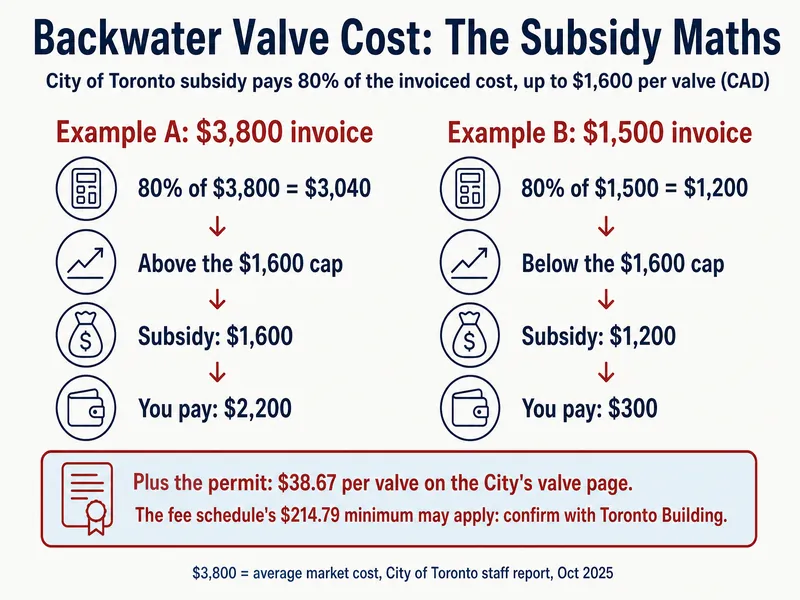
Multiply the invoice by 0.8, compare the result with $1,600, and take the smaller number as the subsidy; your share is the invoice minus the subsidy, plus any permit fee billed separately. For two valves, do the sum for each valve separately, with each capped at $1,600.
Worked example at the City's average: $3,800 × 0.8 = $3,040. That is more than $1,600, so the subsidy is $1,600. The homeowner's share is $3,800 − $1,600 = $2,200 before permit fees: $38.67 if the valve page's per-valve fee applies, or $214.79 if the schedule's minimum does, unless the fee is already on the invoice.
Keep in mind the conditions that can reduce the subsidy to zero: the installer and any subcontractors need a valid City of Toronto business licence, downspouts must be disconnected, front-yard paving must meet zoning, and the invoice must be itemized, electronic and marked paid in full. Funding is first-come, first-served and subject to Council's annual budget. You have two years after the work to apply.
What should a backwater valve quote include?
A written quote should list each part of the job and its price, so you can compare firms and so the final invoice meets the City's subsidy rules. Ask for:
- The valve type, confirmed as a normally open design, which the Ontario Building Code requires in a building drain.
- Where the valve will go, and whether your house needs a second one.
- Concrete cutting, excavation, backfill and floor restoration, each listed.
- The permit, who applies, and who books the inspection.
- Any alarm, access cover and cleaning instructions.
- The firm's Toronto business licence and the plumber's certificate, which you can check on the Skilled Trades Ontario public register.
- An itemized, electronic final invoice with names and addresses of everyone who worked on the job.
The Insurance Bureau of Canada notes that some insurers may offer incentives for backwater valves; ask your own insurer rather than assuming a discount. See the backwater valve guide for how the device works and how to maintain it.
How we put this page together
Cost figures here come only from the City of Toronto: Toronto Water's October 22, 2025 committee report for the $3,800 average and coverage percentages, the subsidy page (modified June 18, 2026) for caps and conditions, and Toronto Building's backwater valve page (modified July 14, 2026) and fee schedule (modified June 19, 2026) for the permit. All were checked in October 2026; amounts are CAD. Contractor price ranges, forum posts and AI-search summaries were deliberately left out. The table rows other than $3,800 are arithmetic examples, not observed prices.
Common questions
Is the $3,800 figure what a backwater valve will cost me?
No. It is the City staff's approximate average across the market in 2025. Your price depends on the house, the drain and the floor, so compare itemized written quotes.
Does the subsidy pay for the permit fee?
The City pays its share on the eligible work shown on the invoice. Whether a permit fee billed on the contractor's invoice counts is a question for the City's program staff; the safe assumption is to budget the permit fee yourself and to ask Toronto Building whether it is $38.67 or the $214.79 minimum.
At what invoice amount does the subsidy reach its cap?
At $2,000 per valve. 80% of $2,000 is $1,600, the maximum, so a higher invoice does not raise the subsidy.
Why did backwater valve subsidies go up in 2026?
Toronto Water reported that costs of eligible work rose about 19% since 2013 and the subsidy's share of invoices fell to 41% in 2025. Council raised the valve cap 28%, to $1,600.
Is a second backwater valve worth budgeting for?
Only if your house has more than one sewer connection. The City now subsidizes a second valve for that case, so ask the plumber, or a subsidized home plumbing assessment, to check.
Is a valve installed in 2024 still eligible?
Jobs finished before that November 2025 date fall under the old $1,250 cap and a one-year application window, so a 2024 job is most likely past its deadline.
Related guides
More help: see our Toronto Home Water Guide home page.