
Toronto Water and Plumbing FAQ
This Toronto water and plumbing FAQ gives short, sourced answers to the ten questions homeowners ask most, from hardness and lead pipes to flooding subsidies, frozen pipes and rented water heaters.
On this page
- Is Toronto tap water hard?
- Is Toronto tap water safe to drink?
- Do you need a water softener in Toronto?
- How do you know if you have a lead pipe?
- What does the City pay toward a backwater valve?
- Do you need a permit for a backwater valve?
- Is sewer backup covered by home insurance?
- How do you thaw a frozen pipe safely?
- Where is your main water shut-off valve?
- Can you buy out a rented water heater?
Key takeaways
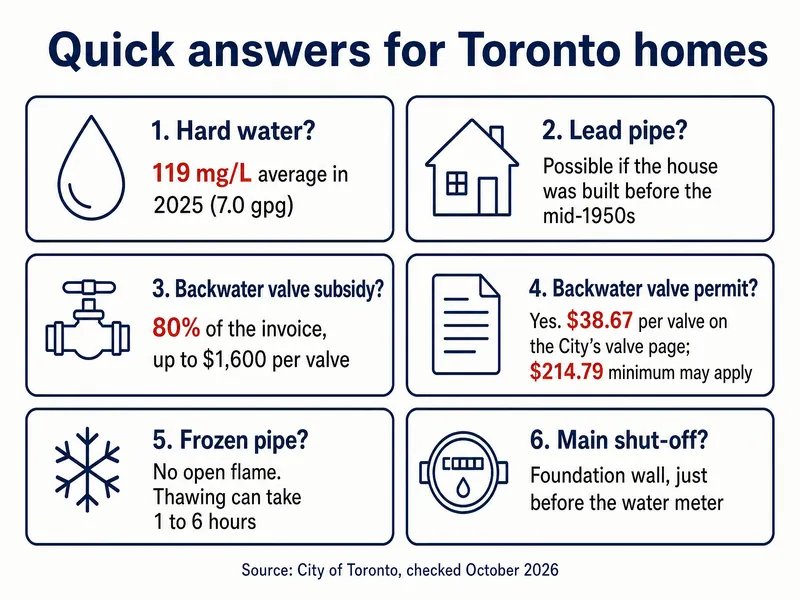
- Hardness: 119 mg/L on average in 2025, or 7.0 grains per gallon, per the City of Toronto's annual analysis summary.
- Safety: the City's own wording is that "Toronto's tap water is safe to drink"; lead, where present, comes from household and service pipes.
- Lead pipes: possible in houses built before the mid-1950s; the City offers older homes a free test kit through 311.
- Backwater valves: the City reimburses 80% of the bill, at most $1,600 a valve, and the City's valve permit page lists $38.67 a valve in 2026 (the general $214.79 minimum may apply instead).
- Insurance: the Insurance Bureau of Canada says sewer backup cover is optional, not standard.
- Frozen pipes and rentals: no open flame when thawing, and rented water heaters can be bought out on terms set by each contract.
The FAQ in four numbers
- 7.0 gpgToronto's 2025 average hardness in grains per gallon (119 mg/L ÷ 17.1)City of Toronto, Drinking Water Analysis Summary 2025
- $38.67Listed fee for each backwater valve permit, Jan 1, 2026; the general $214.79 minimum could apply insteadCity of Toronto, Backwater Valve permit page
- 1–6 hoursHow long the City says thawing a frozen pipe can takeCity of Toronto
- 30 business daysLongest a 311 check of City records on a lead service pipe may takeCity of Toronto, Lead & Drinking Water
Is Toronto tap water hard?
Yes, moderately: Toronto tap water averaged 119 mg/L of hardness, measured as calcium carbonate, in the City's 2025 Drinking Water Analysis Summary. That is 7.0 grains per gallon, and the 119 samples ranged only from 115 to 122 mg/L, so the figure is much the same across the city.
On one scale Health Canada cites, 100 to 150 mg/L is "medium hard". Health Canada sets no health-based value for hardness; it treats hardness as an operational matter of scale and corrosion. The Toronto water hardness guide explains the conversion and how Toronto compares with Peel, York and Durham.
Is Toronto tap water safe to drink?
The City's Tap Water in Toronto page (modified July 22, 2026) states: "Toronto's tap water is safe to drink." Water is drawn from Lake Ontario and treated at four plants, and the City's yearly testing tops 20,000 tests inside the plants plus 15,000 on water sampled out in the pipe network.
One caution comes from inside the house rather than the treatment plant: older homes can have a lead service pipe or lead in plumbing, which the City's tests at the plant cannot see. If your house is old, read the lead question below and the Toronto tap water guide. For health questions about your own situation, Toronto Public Health or your doctor is the right contact.
Do you need a water softener in Toronto?
Most Toronto homes do not, according to the City, whose tap water page says softening systems "are usually not needed". Some owners still choose one for scale on fixtures or in a water heater; that is a preference, not a health requirement.
If you install one, Health Canada recommends leaving a commonly used drinking tap, typically the kitchen one, unsoftened, because softening by sodium ion exchange can add sodium. Ontario rules also matter when buying: since March 1, 2018, water softeners cannot be sold door to door unless you initiated contact. The softener decision guide goes further.
How do you know if you have a lead pipe?
You may have a lead service pipe if your house is older than the mid-1950s, by the City's account, and the City's signs of a lead pipe are a grey colour, a soft surface that scratches easily, and a solid rather than hollow sound when you tap it. Only a water test tells you whether lead is in your water.
The City offers free lead testing for homes built before the mid-1950s: register through 311 for a kit, and results come by mail within 30 days of the sample arriving. A 311 records check on your service may take up to 30 business days. Health Canada's guideline for lead is 0.005 mg/L, set in 2019, and it advises keeping levels as low as reasonably achievable. The lead pipes guide covers the City's replacement program and filter advice.
What does the City pay toward a backwater valve?
The City pays 80% of the invoiced cost of a backwater valve, up to $1,600 per valve and up to two valves per property, for work completed on or after November 12, 2025 (Basement Flooding Protection Subsidy Program, modified June 18, 2026). Earlier work keeps the old $1,250 cap.
The maths matters: a $1,500 invoice earns $1,200, not $1,600. The City's October 2025 staff report put the average market cost of a backwater valve installation at about $3,800; 80% of that is $3,040, above the cap, so the subsidy is $1,600. Eligibility needs a permit and inspection, a contractor with a City business licence, paid itemized invoices and disconnected downspouts. Details are in the backwater valve guide.
Do you need a permit for a backwater valve?
Yes, you do. For one- and two-unit houses, Toronto Building issues a standalone drain permit for the valve, and its backwater valve page lists $38.67 for each one from January 1, 2026. The City's general fee schedule adds a $214.79 minimum charge for any permit, so have Toronto Building confirm the amount. No drawings are needed for one- and two-unit houses, and you can apply online.
The permit is also part of the subsidy: the valve must be inspected before it is covered. Ontario's Building Code requires the valve in a building drain to be a "normally open" type, and Toronto's permit page says a valve designed to be normally closed is prohibited in a building drain or sewer. See the plumbing permit guide for other work that needs a permit.
| Question | Short answer | Main source |
|---|---|---|
| Is Toronto water hard? | Medium hard, 119 mg/L (7.0 gpg) in 2025 | City of Toronto |
| Is tap water safe? | The City says it is safe to drink | City of Toronto |
| Need a softener? | Usually not, the City says | City of Toronto |
| Lead pipe? | Possible if built before the mid-1950s; test to know | City of Toronto |
| Backwater valve subsidy? | Four-fifths of the bill, capped at $1,600 each, two maximum | City of Toronto |
| Backwater valve permit? | Yes; $38.67 per valve listed, $214.79 minimum may apply | Toronto Building |
| Sewer backup insurance? | Optional coverage, not standard | Insurance Bureau of Canada |
| Thawing a pipe? | Heat gently, no open flame, 1 to 6 hours | City of Toronto |
| Main shut-off valve? | Foundation wall, just before the meter | City of Toronto |
| Rental buyout? | Yes, on your contract's terms | Enercare, Reliance, Ontario |
Is sewer backup covered by home insurance?
Not by a standard policy, in most cases. The Insurance Bureau of Canada says damage from sewers and drains backing up is "typically not covered by a standard policy", while "optional sewer backup is offered by most insurers". Overland flooding is a separate, also optional, coverage.
Only your own policy wording answers the question for your home, so read it and ask your insurer or broker. IBC adds that some insurers may offer incentives for backwater valves or sump pumps; ask rather than assume. After a flood, the City's flood claims page tells residents to contact 311 so Toronto Water can investigate. The sewer backup insurance guide has the detail.
How do you thaw a frozen pipe safely?
Open the basement cold water tap, then apply gentle heat (the City lists warm towels, a heating pad or a hair dryer), never a blowtorch, propane heater or any open flame, the City says on its frozen pipes page (modified October 19, 2026). Thawing can take one to six hours.
Thawing a private service pipe is the owner's responsibility under Toronto Municipal Code Chapter 851. If 311 staff find the frozen section is on private property, they will advise you to contact a plumber. If a pipe has split, close the main valve before it thaws. The frozen pipes guide covers prevention too.
Where is your main water shut-off valve?
Look in the basement: the City places it on the foundation wall at the point the water pipe enters, ahead of the meter. The City calls it the main water supply valve or "stop and waste valve" and asks owners to find and label it before they need it.
If it will not close, contact 311: Toronto Water can shut off the City's curb stop at the property line. A $110.13 City fee (2026) covers turning water off and on, with no fee when the leak is on City pipe. Step-by-step help is in how to shut off water to your house.
Can you buy out a rented water heater?
Yes, rental contracts in Ontario generally let you buy the tank, at a price set by the contract and the tank's age. Enercare publishes yearly buyout tables; its 2026 table lists a CV40 gas tank at $1,804 in its first year and every model at $100 once it is 15 years old or more. One Reliance agreement uses a depreciated value with 30 days' written notice.
Enercare itself cautions that for tanks eight years old or more, buying out may cost more than continuing to rent, since repairs become yours. Natural Resources Canada's view is that renting costs more than buying over a water heater's whole life. The water heater rental buyout guide covers return fees and Ontario's consumer rules.
How we put this page together
These answers summarize the site's guides and the primary sources linked in each: City of Toronto pages and reports (checked October 26, 2026, with modified dates given where the City shows them), Health Canada, the Insurance Bureau of Canada, Natural Resources Canada and Enercare's published buyout table. Left out: contractor prices, insurer-specific promises and any health guidance beyond Health Canada and Toronto Public Health; check the full list of guides for detail.
More help: see our Toronto home water and plumbing guide.