
Tap water
Toronto Water Hardness: How Hard Is Toronto Water?
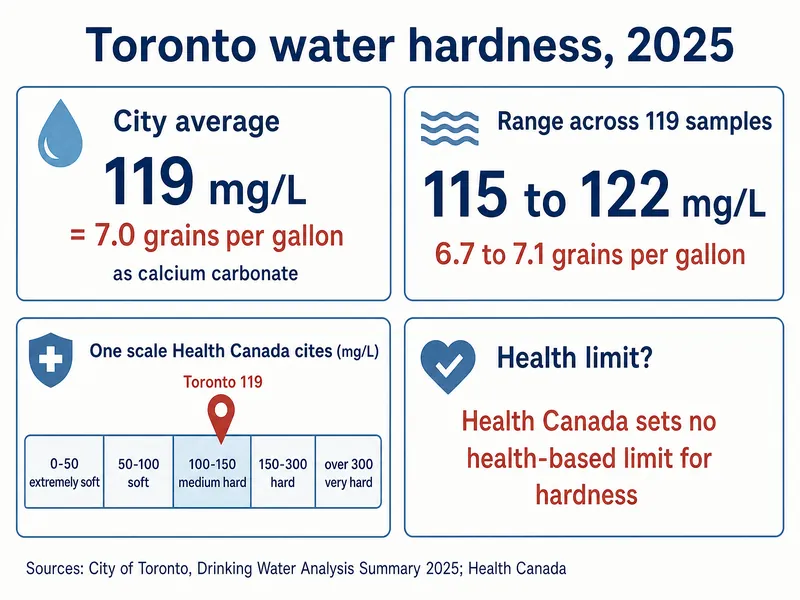
Toronto water hardness averaged 119 mg/L as calcium carbonate (about 7.0 grains per gallon) in the City's 2025 tests: medium hard, and the City says softening is usually not needed.

On this page
Key takeaways
- Toronto Water's summary of 2025 test results reports an average hardness of 119 mg/L as calcium carbonate, from 119 samples.
- 119 mg/L is 7.0 grains per gallon (gpg), dividing by 17.1 for each grain; the 2025 samples ranged from 115 to 122 mg/L (6.7 to 7.1 gpg).
- A hardness scale quoted in Health Canada guidance labels 100 to 150 mg/L "medium hard", so Toronto sits in the lower half of that band.
- Health Canada has found no need for a health-based hardness value; it calls 80 to 100 mg/L "an acceptable balance between corrosion and incrustation".
- The City's Tap Water in Toronto page, last changed July 22, 2026, tells most homeowners hardness is "not a concern" and adds that softening is "usually not needed".
- Lake Ontario systems across the GTA report about 119 to 130 mg/L; communities on wells report far higher figures.
Toronto hardness in numbers
- 119 mg/LAverage Toronto water hardness (as CaCO3), 2025Toronto Water, 2025 test summary
- 7.0 gpgThe same average in grains per gallon (119 ÷ 17.1)Arithmetic on the City of Toronto 2025 figure
- 115–122 mg/LLowest and highest of the 119 hardness samples in 2025Toronto Water, 2025 test summary
- 80–100 mg/LRange Health Canada describes as a balance between corrosion and scale (not a safety limit)Health Canada, Operational Parameters
How hard is Toronto water?
Toronto water is medium hard: the City's 2025 testing found an average of 119 mg/L of hardness, measured as calcium carbonate. That figure comes from the City's annual analysis summary for 2025, which covers all four treatment plants and the distribution system from January 1 to December 31, 2025.
Hardness is mostly dissolved calcium and magnesium. The same summary lists calcium at an average of 33.5 mg/L and magnesium at 8.5 mg/L, and the City calculates hardness from those two minerals. All of it comes from the lake: Toronto's water is drawn from Lake Ontario, which the City calls "a high-quality source".
The City's own reading of the number is short. Its Tap Water in Toronto page concludes that for most homeowners hardness is "not a concern", and that softening systems are "usually not needed". For a fuller picture of what else is in the water, see the Toronto tap water guide.
What does 119 mg/L mean in grains per gallon?
119 mg/L equals 7.0 grains per gallon. Water-softener makers and test kits often use grains per gallon (gpg), while the City and Health Canada use milligrams per litre as calcium carbonate. One US grain per US gallon is 17.1 mg/L, so divide the City's figure by 17.1.
| Toronto figure | mg/L as CaCO3 | Grains per gallon |
|---|---|---|
| 2025 average | 119 | 7.0 |
| 2025 lowest sample | 115 | 6.7 |
| 2025 highest sample | 122 | 7.1 |
Some sites quote Toronto in "ppm". For hardness in water, one part per million and one milligram per litre are treated as the same number, so 119 ppm and 119 mg/L describe the same water. What matters is the "as calcium carbonate" part, which is how every Canadian report expresses hardness.
Does water hardness vary across Toronto?
Very little, based on what the City publishes. The 2025 summary gives one system-wide hardness figure, with 119 samples ranging from 115 to 122 mg/L, a spread of about 0.4 gpg from top to bottom. The City does not publish separate hardness figures by neighbourhood or by treatment plant in that summary, so a claim that Scarborough or Etobicoke water is "harder" is not something the City's numbers support.
The narrow range makes sense given the source. Toronto's four plants, R.C. Harris, R.L. Clark, F.J. Horgan and Island, all draw from the same lake. If your water feels different from a friend's across town, plumbing inside the house (a softener, a filter, an old water heater) is the more likely reason than the City supply.
How does Toronto compare with nearby cities?
Toronto is at the soft end of the GTA. Systems that draw from Lake Ontario report similar numbers: the Region of Peel lists South Peel water at 120 to 130 mg/L for 2025, York Region lists Markham, Richmond Hill and Vaughan at 126 to 128 mg/L for the second quarter of 2026, and Durham Region lists its lakeshore system at 125 mg/L.
Towns on wells are a different story. York Region's own table shows Stouffville at 318 mg/L, and Durham Region lists Sunderland at 345 mg/L. As York Region puts it, groundwater "is usually harder than surface water". The full side-by-side table, with each region's own source, is on the GTA water hardness by city page.
Is hard water a health concern?
No health-based limit exists for hardness in Canada. Health Canada's Operational Parameters guidance says there is "insufficient evidence to support the need" for a health-based value or maximum for hardness. It treats hardness as an operational matter: levels "greater than 200 mg/L are considered poor but have been tolerated by consumers", and levels above 500 mg/L "may require softening".
Toronto's 119 mg/L sits well below the 200 mg/L line Health Canada calls poor. The City's 2025 table shows an "80-100" figure in its operational guideline column for hardness; Health Canada describes that band as "an acceptable balance between corrosion and incrustation", not as a safety threshold. Questions about skin, hair or other health effects are for Toronto Public Health or a doctor; this guide does not go beyond what Health Canada says.
What does hard water do to pipes and appliances?
Hard water leaves scale when it is heated. The Region of Peel's 2025 report, describing Lake Ontario water much like Toronto's, explains that "upon heating, hard water tends to form scale deposits or a white film and can form excessive scum with regular soaps." That is the chalky crust on a kettle element, the spots on glassware and the film around a showerhead.
Heat is the key factor, so water heaters feel it most. Natural Resources Canada's Water Heater Guide states that "water quality is the single most important factor affecting the life of the water heater." Tankless heaters have small heat exchangers, and makers publish descaling steps in their manuals; the tankless water heater cost page covers that.
Softer is not automatically better for pipes. Peel's report adds that "soft water may result in accelerated corrosion of water pipes", which is why Health Canada frames 80 to 100 mg/L as a balance rather than a target to get below.
How can you test your own water hardness?
For a house on City water, the City's own figure is the best starting point: 119 mg/L, or 7.0 gpg. You can confirm it with a hardness test strip or a drop-count kit from a hardware store, run on a cold tap that does not pass through any softener or filter. Expect a reading close to 7 gpg; strips report in broad colour steps, so treat the result as approximate rather than exact.
Testing is more useful if you already have a softener. A reading at the kitchen tap well below the City's number shows the softener is working, and a reading close to 7 gpg on softened water suggests it needs attention. The how a water softener works page explains regeneration, and do you need a water softener in Toronto weighs the decision against the City's advice. To read the source table yourself, use the Toronto water quality report guide.
If you are thinking about buying equipment, remember Ontario's rules: since March 1, 2018, businesses may not sell water softeners or filters door to door unless you started the contact, according to Ontario's consumer protection page. The water softener cost page explains what a written quote should list.
How we put this page together
Sources for this page: Toronto Water's 2025 results table (published June 2026), the City's tap water page (revised July 22, 2026), Health Canada's Operational Parameters guidance on calcium, magnesium and hardness, the Region of Peel's 2025 South Peel water quality report, York Region and Durham Region hardness pages, and Natural Resources Canada's Water Heater Guide; all checked in October 2026. Conversions use 17.1 mg/L per grain per gallon. Left out: neighbourhood-by-neighbourhood hardness claims (the City publishes none), health claims about skin and hair, softener running costs, and figures that only retailers or contractors publish.
Common questions
Is Toronto water hard or soft?
Toronto's 2025 average of 119 mg/L falls in the 100 to 150 mg/L "medium hard" band of a scale Health Canada cites, so it is moderately hard rather than very hard. The City does not treat hardness as something most homeowners need to worry about.
What is Toronto's water hardness in ppm?
About 119 ppm, because for hardness one part per million equals one milligram per litre. The 2025 samples ranged from 115 to 122. In grains per gallon that is roughly 6.7 to 7.1.
Has Toronto water hardness changed in recent years?
The City publishes a new analysis summary each year, and the 2025 average was 119 mg/L. Lake Ontario's mineral content moves slowly, so large year-to-year swings are not expected. Check the newest summary on toronto.ca for the current figure.
Do Toronto condos have softer water than houses?
The City supplies the same water to both. A building may treat its water after the meter, so ask your property manager whether the building runs a softener or filter. Without one, the tap water carries the City's figure of about 7 gpg.
What softener hardness setting should a Toronto home use?
Softener makers ask for incoming hardness in grains per gallon. The City's 2025 data give 7.0 gpg on average, with a highest sample of 7.1 gpg. Follow the maker's manual for any extra allowance, since that varies by model.
Why does my kettle scale up if Toronto water is only medium hard?
Any water with calcium in it leaves scale when it is boiled repeatedly, and Toronto's water contains about 33.5 mg/L of calcium. A kettle concentrates those minerals over hundreds of boils. Regular descaling with a kettle cleaner or vinegar, as the kettle maker directs, deals with it.
Is Toronto water harder than Mississauga's?
Slightly softer, going by each body's own reports. Toronto averaged 119 mg/L in 2025, while the Region of Peel lists South Peel water at 120 to 130 mg/L for the same year. Both come from Lake Ontario, so the difference is small.
Related guides
More help: see our Toronto home water and plumbing guide.