
Costs & permits
Plumber Cost in Toronto: Rates, Fees and Quotes
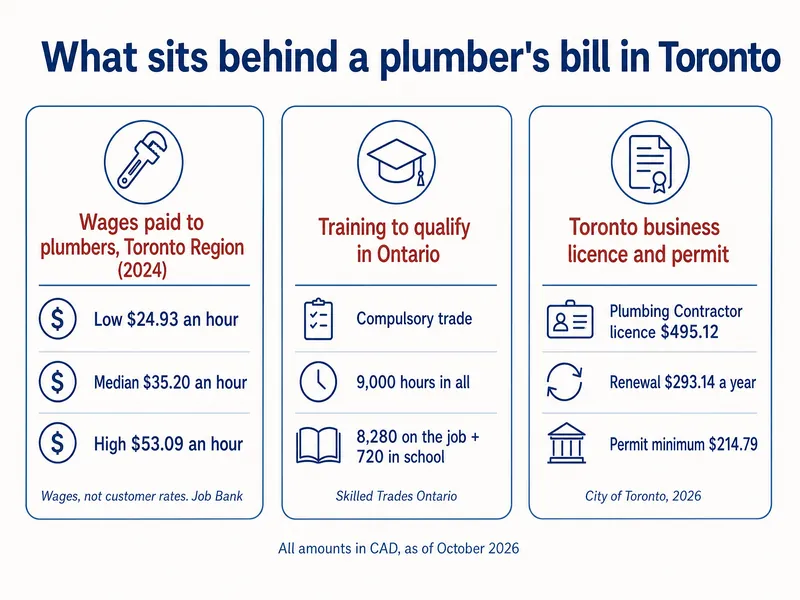
Plumber cost in Toronto has no official rate card: Job Bank puts the median plumber wage in the Toronto Region at $35.20 an hour (2024), and a company's charge-out rate is higher because it covers overhead.
On this page
Key takeaways
- Plumbers in the Toronto Region earned $24.93 (low), $35.20 (median) and $53.09 (high) an hour in 2024, according to Job Bank. Those are wages, not customer rates.
- No government or regulator publishes what Toronto plumbers charge customers, so this guide gives no hourly, call-out or emergency rate.
- Plumbing is a compulsory trade in Ontario with 9,000 hours of training (8,280 on the job, 720 in school), per Skilled Trades Ontario.
- A Toronto Plumbing Contractor licence costs $495.12 to obtain and $293.14 to renew in 2026 (City of Toronto).
- Permit fees are separate from the plumber's bill: the 2026 minimum is $214.79.
- Since March 1, 2018, Ontario bans unsolicited door-to-door contracts for water heaters, water softeners and water filters (Ontario).
What can be stated about plumber costs (CAD)
- $35.20/hMedian wage paid to plumbers, Toronto Region, 2024Job Bank, Plumber (NOC 72300)
- 9,000 hTraining for an Ontario plumber (compulsory trade)Skilled Trades Ontario
- $495.12City of Toronto Plumbing Contractor licence, application plus licence feeCity of Toronto
- $214.79Minimum Toronto building permit fee, 2026City of Toronto, Building Permit Fees
How much does a plumber cost in Toronto?
How much a plumber costs in Toronto depends on the business, the job and the time of day, and no public body publishes a rate. Rates you see online come from plumbing companies themselves, so this guide leaves them out and shows instead what sits behind a bill. All amounts here are in Canadian dollars, as of October 2026.
The best public figure is what plumbers are paid. Job Bank, the federal labour-market service, reports wages for plumbers (NOC 72300) in the Toronto Region in 2024 of $24.93 an hour at the low end, $35.20 at the median and $53.09 at the high end. For Ontario as a whole (2023 to 2024) the figures were $20.00, $32.50 and $50.38.
A customer is never billed at the wage. The company's charge-out rate also has to cover the business's overhead: vehicles, tools, travel time, insurance, licences, office staff and time that cannot be billed. This guide does not apply a multiplier, because no public source sets one. The honest way to learn the price is to ask for a written, itemized quote.
How do plumber hourly rates work?
Plumber hourly rates usually combine a charge for labour time with separate charges for parts and materials, and many businesses add a minimum charge or a trip charge for coming to the house. How each business structures its price is its own choice, so ask before the visit.
Questions that make two rates comparable:
- Is there a minimum charge, and how much time does it include?
- Is travel time or a trip charge billed separately?
- Is time billed in full hours, half-hours or smaller steps?
- Are parts marked up, and will the invoice list each part?
- Is a second worker (an apprentice or helper) billed, and at what rate?
- Is HST included in the figure quoted?
A flat price for a defined job, such as replacing a specific fixture, shifts the risk of overruns to the business. An hourly price is common for diagnosis and repairs where the cause is unknown. Either way, the price should be in writing before work starts.
What do emergency and after-hours calls add?
Emergency and after-hours calls usually cost more than a weekday visit, but no public source sets or reports the premium in Toronto, so this guide gives no figure. Ask the business, before it sends anyone, what its evening, weekend and holiday rates are and whether a higher minimum applies.
You can often avoid paying emergency rates by stopping the damage yourself and booking the repair for regular hours. Close the main shut-off valve (the shut-off guide shows how), turn off power to any wet area, and open a cold tap to drain pressure. If pipes have frozen, the City's advice is to thaw them gently and never with an open flame; the frozen pipes guide has the steps.
Some problems are not the homeowner's to pay for. If the trouble is on the City side of the water service, such as a watermain break or a sudden loss of pressure across the street, contact 311 first: Toronto Water says staff arrive within 24 hours for a sudden pressure drop.
How do you check a plumber is licensed in Ontario?
Check the plumber by name on the Skilled Trades Ontario Public Register, because plumbing is a compulsory trade: anyone practising it must hold a Certificate of Qualification, a provisional certificate or a registered training agreement. Ask for the certificate number and match it to the register.
Then check the business. In Toronto, a business "engaged in the contracting and/or repairing of plumbing installations" needs a City Plumbing Contractor licence, and drain work needs a Drain Contractor licence held by a business with a licensed Drain Layer. Drain Layer licences cover work such as weeping tile installing and drain repair. The Basement Flooding Protection Subsidy Program denies funding if the contractor or a subcontractor lacks a valid City business licence.
Gas is a separate trade. Connecting a gas water heater or other fuel-fired appliance must be done by a TSSA-registered contractor using certified gas technicians, according to the Technical Standards and Safety Authority.
| Who | What to check | Where | Cost to the holder |
|---|---|---|---|
| Individual plumber | Certificate of Qualification (compulsory trade) | Skilled Trades Ontario Public Register | Set by Skilled Trades Ontario |
| Plumbing business in Toronto | Plumbing Contractor licence | City of Toronto, Municipal Licensing and Standards | $495.12 to obtain; $293.14 renewal |
| Drain business in Toronto | Drain Contractor licence, with a licensed Drain Layer | City of Toronto | Same application and licence fees as Plumbing Contractor |
| Gas appliance work | TSSA-registered contractor; certified gas technician | Technical Standards and Safety Authority | Set by TSSA |
How do you compare plumbing quotes?
Compare plumbing quotes on the same scope, in writing, from licensed businesses. Two quotes for "replace the water heater" or "fix the leak" can describe very different jobs.
- Scope. The quote should name the work, the parts and the materials, and say what is excluded (wall repair, disposal, permit).
- Price basis. Flat price or hourly; minimum charge; trip charge; HST.
- Permit. Whether a permit is needed, who applies and whether the fee is included.
- Warranty. Ask what the business warrants and for how long, separately from the maker's product warranty.
- Payment. Deposits and final payment, tied to completion and any final inspection.
For water heaters, softeners and filters, Ontario law adds protection. Since March 1, 2018, a business may not sign you up for one of these at your door unless you initiated the contact. The province says such a contract will be void, and the cooling-off period runs 10 days from when you receive your written copy (Ontario).
Which jobs need a permit as well?
Jobs that install or modify a plumbing system need a City of Toronto building permit as well as the plumber, and the permit fee is paid to the City. The 2026 schedule starts at a $214.79 minimum, charges $23.20 a fixture in a single-family house within that minimum, and the valve permit page lists $38.67 per backwater valve; Toronto Building can confirm which fee applies.
Repairing or replacing plumbing fixtures, installing a sump pump and installing a hot water tank in a house do not need a building permit, according to the City's 311 article. A repipe, a new bathroom, a backwater valve and buried water service or drain work do. The plumbing permit guide lists the fees and the inspection process.
For flood-protection work, the City's subsidy can offset part of the plumber's invoice: 80% of the invoiced cost up to $1,600 per backwater valve and $2,250 for a sump pump, for work done on or after November 12, 2025. The subsidy guide explains the rules.
How we put this page together
Checked for this guide in October 2026: Job Bank wage data for plumbers (NOC 72300, updated November 19, 2025), Skilled Trades Ontario's plumber trade page and Public Register, City of Toronto licence pages for Plumbing Contractor (modified June 3, 2026), Drain Contractor and Drain Layer, the building permit fee schedule (effective January 1, 2026), the City's 311 permit article, TSSA's guidance on fuel-appliance work and Ontario's door-to-door sales rules. Left out: every customer hourly, call-out or emergency rate (only plumbing companies publish them), any wage-to-rate multiplier, and contractor rankings.
Common questions
What is the average hourly rate for a plumber in Toronto?
No public body reports what Toronto plumbers charge customers. Job Bank reports what they are paid: a median wage of $35.20 an hour in the Toronto Region in 2024. Charge-out rates are higher.
Why is a plumber's rate higher than the wage?
The rate pays for the business as well as the worker: vehicles, tools, insurance, licences, travel and unbilled time. This guide does not estimate the gap, because no public source does.
Is HST charged on plumbing work?
Ask each business whether its price includes HST, and check the invoice shows it as a separate line so quotes can be compared on the same basis.
Can an apprentice do plumbing work?
An apprentice working under a registered training agreement can practise the trade, which is how the 8,280 on-the-job hours are earned. Ask who will do the work and who supervises.
Does a plumber need a City licence to work in Toronto?
A business that contracts or repairs plumbing in Toronto needs a Plumbing Contractor licence. The individual plumber also needs Ontario certification, checked on the Skilled Trades Ontario Public Register.
Who pays for a leak between the street and the house?
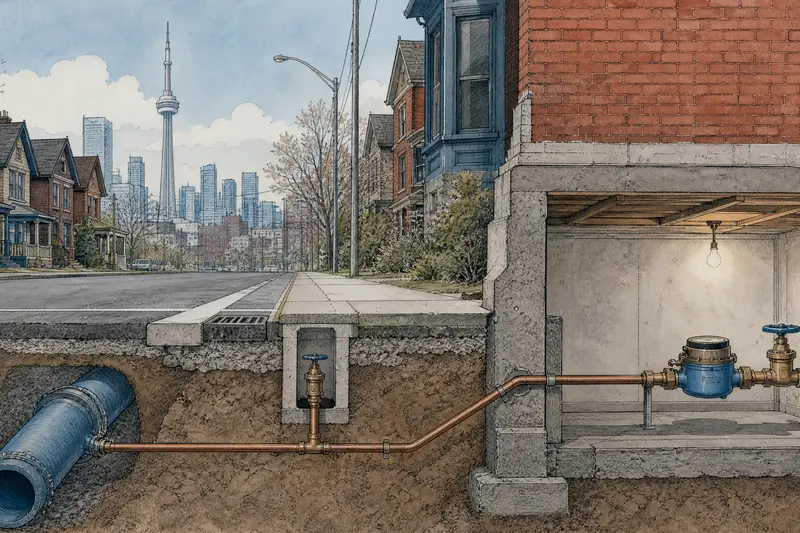
The service pipe is split at the lot line: the street-side section belongs to the City, the house-side section to the owner. Contact 311 if the leak may be on the City side.
Is a deposit normal?
Practices vary by business and job. Keep any deposit modest, get it in writing, and tie the final payment to finished work and any final inspection.
Related guides
More help: see our Toronto Home Water Guide home page.