
Softeners & filters
How Does a Water Softener Work?
How does a water softener work? Resin beads trade the calcium and magnesium in hard water for sodium or potassium, then a salt-brine rinse recharges the beads during regeneration.
On this page
Key takeaways
- A softener uses ion exchange: resin holds sodium (or potassium) and releases it as it captures calcium and magnesium (Penn State Extension).
- Toronto's water carried about 33.5 mg/L calcium and 8.5 mg/L magnesium in 2025, for a hardness of 119 mg/L (7.0 gpg) (City of Toronto).
- A typical downflow regeneration runs backwash, brine draw and slow rinse, rapid rinse, brine refill (a softener maker's service manual).
- Units certified to NSF/ANSI 44 must reduce hardness to below 1.0 gpg (17.1 mg/L), according to Health Canada.
- Softened water gains sodium or potassium; Health Canada advises the kitchen tap bypass the softener.
- Sizing multiplies hardness by daily water use: at 7.0 gpg, every 100 US gallons (379 L) carries 700 grains of hardness.
A water softener is a tank of plastic resin beads, a control valve on top, and a second tank holding salt and water. The chemistry is simple and has not changed in decades. What matters for a Toronto homeowner is how the cycle runs, how big the unit needs to be for 7 gpg water, and what softening adds to the water you drink.
The numbers behind softening
- 119 mg/LToronto's 2025 hardness average (7.0 gpg), the starting point for sizingCity of Toronto drinking water results
- 33.5 mg/LAverage calcium in Toronto water, 2025 (magnesium averaged 8.5 mg/L)City of Toronto drinking water results
- 1.0 gpgHardness a softener certified to NSF/ANSI 44 must get belowHealth Canada, 2025
- 14.8 mg/LAverage sodium already in Toronto tap water before any softening, 2025City of Toronto drinking water results
How does a water softener work, in short?
A water softener works by passing hard water through a bed of resin that swaps hardness minerals for sodium or potassium. Water enters through the control valve, flows down through the resin, and leaves through a riser tube with most of its calcium and magnesium removed. When the resin is loaded with hardness, the valve runs a regeneration that floods it with salt brine and flushes the captured minerals to the drain.
Penn State Extension's guide to water softening describes the process as filtering the water "through an exchange media known as resin or zeolite". Health Canada's 2025 hardness document calls softeners "the best available technology for the overall reduction of hardness, calcium and magnesium" at home.
What is ion exchange?
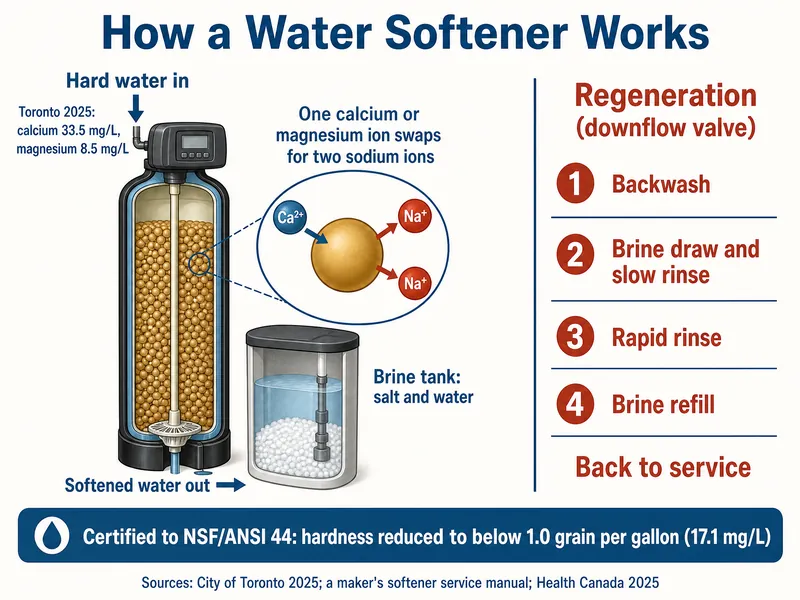
Ion exchange is a swap of charged particles between the water and the resin. Each resin bead carries fixed negative sites that hold loosely attached positive ions, sodium in a salt-based unit. Calcium and magnesium ions each carry a double positive charge and cling to those sites more strongly, so as hard water passes, they take the sites and push sodium into the water.
Because calcium and magnesium carry two charges and sodium only one, each hardness ion captured releases two sodium ions to keep the charges balanced. That is why softened water contains more sodium than the water that came in, and why the amount rises with the hardness removed. Units that regenerate with potassium chloride release potassium instead.
What happens during regeneration?
Regeneration is the cleaning and recharging cycle that restores the resin once its sodium is used up. A softener maker's service manual sets out the downflow start-up order as:
- Backwash. Water flows up through the bed to loosen it and carry sediment to the drain; at start-up the manual runs it "for 10 minutes or until the water runs clear".
- Brine draw and slow rinse. The valve draws salt brine from the brine tank through the resin. The high sodium concentration pushes calcium and magnesium off the beads, then a slow rinse moves the spent brine out.
- Rapid rinse. Fresh water flushes leftover brine and settles the bed, run at start-up "for 5 minutes or until the water runs clear".
- Brine refill. Water returns to the brine tank to dissolve salt for the next cycle.
The same manual notes that "if the unit is a filter or upflow, the cycle step order may change", so read your own model's guide. Health Canada adds that softeners "typically use sodium chloride or potassium chloride as regeneration brines" and that spent regeneration solutions raise environmental concerns.
What are the parts of a water softener?
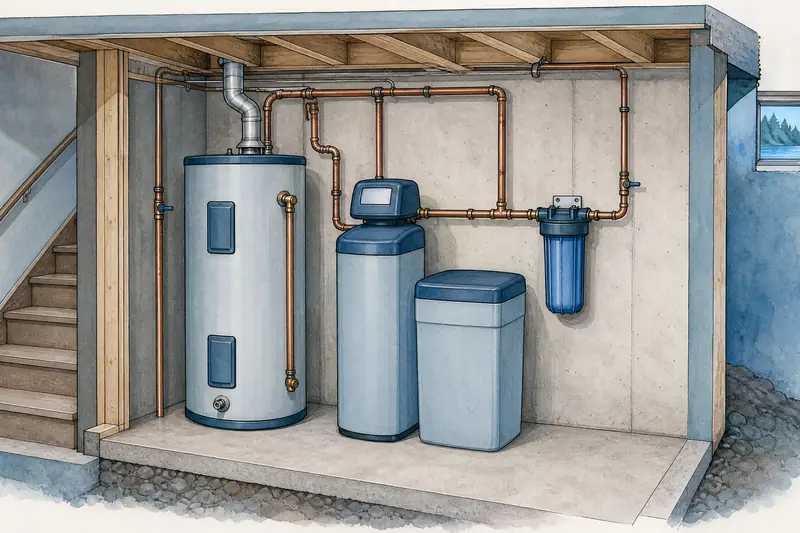
A residential softener has four main parts: the resin (mineral) tank, the control valve, the brine tank and a bypass valve. The resin tank holds the bed and a distributor tube that collects softened water at the bottom. The control valve on top directs flow during service and each regeneration step, and is set by timer, by day of the week, or by metered water use.
The brine tank stores salt and water and contains a float or air-check valve so the softener draws brine without pulling air. The bypass valve lets you isolate the unit for service while water keeps flowing to the house. The maker's installation notes ask for a bypass valve where one is not built in, a drain close by, inlet pressure no higher than 125 psi (8.6 bar), water no hotter than 43 °C, and no exposure to freezing.
| Part | What it does | What to check |
|---|---|---|
| Resin tank | Holds the ion-exchange beads that capture hardness | Resin fouling, especially with iron in the water |
| Control valve | Runs service and regeneration steps on a timer or water meter | Hardness and salt settings, clock after a power cut |
| Brine tank | Stores salt and makes brine | Salt kept above the water level, per the maker's troubleshooting notes |
| Bypass valve | Routes water around the softener | Position after service; kitchen-tap bypass for drinking |
| Drain line | Carries backwash and rinse water away | Secured at the drain so it cannot back up |
How is softener capacity sized?
Softener capacity is sized from the grains of hardness the household sends through it each day. Multiply daily water use in US gallons by the hardness in grains per gallon: at Toronto's 7.0 gpg, each 100 US gallons (379 L) carries 700 grains. A household that uses 600 L a day (about 158 US gallons) therefore loads the resin with about 1,110 grains daily, or roughly 7,800 grains a week.
Penn State Extension suggests measuring use at the hookups for each person or using guideline values, and works an example for a four-person household. A unit's rated capacity depends on the resin volume and the salt dose chosen, so compare the maker's rating at the salt setting you will actually use. Your own water bill gives household use in cubic metres (1 m³ is 1,000 L). The cost side of sizing is covered on water softener cost, and whether Toronto water needs softening at all is answered on do you need a water softener in Toronto.
Does softened water add sodium?
Yes. Softening by sodium ion exchange adds sodium in proportion to the hardness removed. Health Canada warns it "may introduce undesirably high levels of sodium into drinking water" and that potassium softening "may introduce undesirable levels of potassium". Its advice is to let the water you drink most, such as the kitchen tap, "bypass the softener".
Toronto water already averaged 14.8 mg/L of sodium in 2025 (range 13.1–29.9 mg/L), and softening adds to that figure. This guide does not print a per-grain sodium figure because the sources disagree on how to express it. If a doctor has told you to watch sodium, raise softened water with them or with Toronto Public Health. For how softening compares with filtration, see water softener vs water filter; the City's own hardness data is on Toronto water hardness.
How we put this page together
Written from a softener maker's service manual (2015 revision), Health Canada's March 2025 calcium and magnesium guideline document, Penn State Extension's water softening guide (updated September 8, 2025) and the City of Toronto's 2025 drinking water analysis table, reviewed October 2026. The sizing example is arithmetic on Toronto's 7.0 gpg and an assumed 600 L a day, not a measured household. Not included: resin capacity per cubic foot, salt-per-regeneration and sodium-per-grain figures, because sources state them differently.
Common questions
How often should a softener regenerate on Toronto water?
That depends on the unit's capacity, the salt setting and how much water the house uses. A metered valve regenerates when the programmed capacity is used; a timer valve runs on its schedule. Check the hardness value entered in the valve: about 7 gpg suits City water.
Does a water softener remove chlorine or lead?
No. Ion exchange targets hardness ions. Penn State Extension notes softeners "will not necessarily remove any of the more serious drinking water contamination problems"; lead calls for a filter certified to NSF/ANSI 53, as Health Canada's guide to finding a filter certified to reduce lead explains.
What does grains per gallon mean?
It is the older unit softener valves use for hardness. One grain per US gallon equals 17.1 mg/L as calcium carbonate, so Toronto's 119 mg/L average is 7.0 gpg. At that level the City's Tap Water in Toronto page says softening systems are "usually not needed", so a softener here is a comfort choice.
Can iron foul the resin?
Yes. That maker's manual lists iron in conditioned water and a fouled mineral bed among its troubleshooting causes, and says piping clogged with iron needs a separate iron filter ahead of the softener.
Why does the softener need a drain?
Every regeneration sends backwash, spent brine and rinse water to waste. The maker asks for a drain close to the unit and a residential drain line of at least 13 mm (1/2 in).
What does the bypass valve do?
It routes water around the softener so the house keeps running water during service or a fault. Health Canada separately suggests leaving the kitchen drinking tap unsoftened.
Do salt-free conditioners work the same way?
No. Salt-free devices skip ion exchange and regeneration, so the cycle on this page does not apply to them. For lowering hardness, Health Canada's 2025 document points to ion-exchange softeners certified to NSF/ANSI 44.
Keep reading

More help: see our Toronto Home Water Guide home page.