
Water heaters
Tankless Water Heater Cost: Unit, Install and Running
Tankless water heater cost in Toronto depends on the unit's size, gas line, venting and labour; no public source sets a fair installed price, but NRCan says certified units use about 30% less energy.
On this page
Key takeaways
- No government or regulator publishes an installed price for a tankless water heater in Toronto, so this guide shows what drives the quote instead of a range; ask for written, itemized quotes (as of October 2026, CAD).
- An ENERGY STAR certified tankless heater "uses 30% less energy, on average, than a storage tank type", according to Natural Resources Canada.
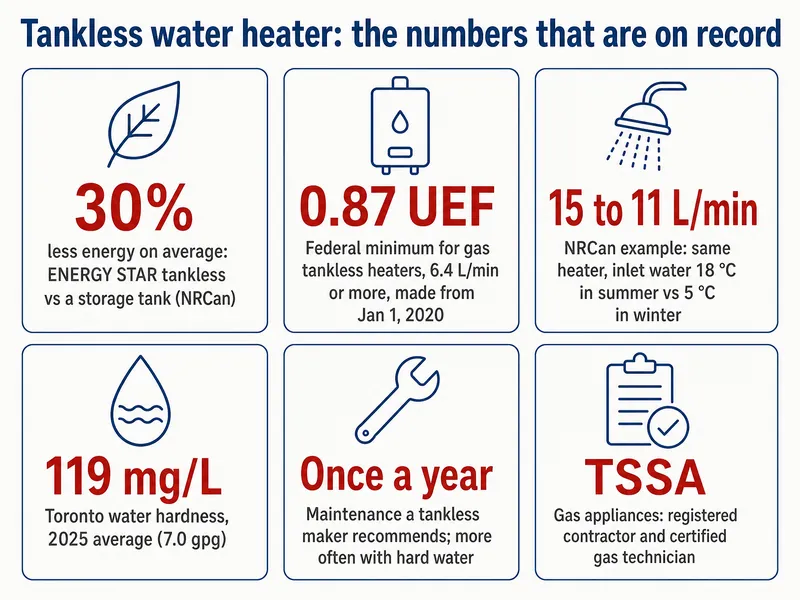
- Gas tankless heaters made from January 1, 2020 must meet a federal minimum uniform energy factor of 0.87 at 6.4 L/min or more (NRCan regulations).
- Enercare's 2026 buyout table lists rental tankless units at $4,135 to $5,443 in their first year, against $1,804 for a CV40 tank; these are buyout values, not install quotes.
- Toronto water averaged 119 mg/L hardness (7.0 gpg) in 2025; one tankless maker recommends yearly maintenance and more often with hard water.
- Gas appliance work needs a TSSA-registered contractor with certified gas technicians (TSSA).
Tankless figures from primary sources
- 30%Less energy on average for an ENERGY STAR tankless heater than a storage tankNatural Resources Canada
- 0.87Federal minimum uniform energy factor, gas tankless at 6.4 L/min or more, made from Jan 1, 2020Natural Resources Canada
- 5 °CHow cold incoming water can be in winter, which cuts a tankless unit's hot water flowNRCan, Water Heater Guide (2012)
- 119 mg/LToronto's average water hardness in 2025 (7.0 gpg)City of Toronto, Drinking Water Analysis Summary 2025
How much does a tankless water heater cost?
A tankless water heater's cost is the unit plus the installation work your house needs, and in Toronto that work varies more than the unit does. No City, provincial or federal source publishes an installed price for tankless heaters, and contractor price lists are not used on this site, so the only fair answer is a written quote for your home.
One published figure gives a sense of scale. Enercare's 2026 Water Heater Buyout Table lists what renters pay to buy out a unit in its first year: $4,135 to $5,443 (CAD) for the nine tankless models it lists, against $1,804 for a conventional vent CV40 tank and $2,430 for a PV40 power vent tank. A buyout value is not a purchase-and-install quote, but it shows tankless units sit well above conventional tanks.
A useful quote breaks the price into the unit (make, model and rated flow), venting, gas piping, condensate drain, electrical, water piping and valves, removal of the old tank, and any rental return charge. Ask for the model's uniform energy factor too, so you can compare efficiency on equal terms. NRCan's Water Heater Guide also suggests the contract list "cost of removing the old water heater" and "total cost of parts and labour, including taxes".
What drives tankless installation cost?
Tankless installation cost is driven mostly by four things: sizing, the gas supply, venting and where the unit can hang. A simple swap where gas, venting and power are already close by costs less than one that needs new runs through finished walls.
Sizing for Toronto winters. A tankless unit's output depends on how cold the incoming water is. NRCan notes winter intake water "may be as cold as 5°C", and gives an example of a heater that delivers 15 L/min at an 18 °C inlet but only about 11 L/min at 5 °C. Sizing for winter can push you to a larger unit.
Gas supply. Tankless gas heaters draw much more gas while running than a tank burner does. Navien's NPE-2 FAQ says ½-inch gas pipe "can be used ... as long as it is sized appropriately", and that pipe size, length and pressure drop all affect delivery. If the existing line or meter is too small, the quote grows.
Venting and condensate. NRCan says gas on-demand heaters are usually wall-mounted and vented through a side wall. Condensing models can use plastic venting (Navien lists PVC Schedule 40 among approved materials) but need a drain for acidic condensate.
Who does it. Gas work is regulated in Ontario. TSSA says fuel-fired appliances "must be maintained by TSSA-registered contractors", who must employ TSSA-certified gas technicians, and O. Reg. 212/01 bars anyone without the right certificate from installing a gas appliance. Water piping is plumbing work; see the plumber cost guide for how to check a licence.
| Option | How it heats | Efficiency on record | Venting | Enercare 2026 first-year buyout (CAD) |
|---|---|---|---|---|
| Gas tankless (on-demand) | Burner heats water only while a tap runs | ENERGY STAR models use 30% less energy than a storage tank on average; federal minimum UEF 0.87 | Side wall, often plastic pipe on condensing models | $4,135 to $5,443 |
| Conventional vent gas tank (CV40) | Burner keeps a storage tank hot | 2011 NRCan listings averaged EF 0.62 for gas storage tanks | Chimney | $1,804 |
| Power vent gas tank (PV40) | Same tank, fan-driven exhaust | Varies by model | Side wall | $2,430 |
| Electric tank (Electric 40) | Elements keep the tank hot | Look for low standby loss (NRCan) | None | $2,131 |
Does a tankless water heater save money to run?
A tankless water heater uses less energy than a tank, but no primary source turns that into a dollar saving for a Toronto home. NRCan's ENERGY STAR page says a certified tankless unit "uses 30% less energy, on average, than a storage tank type", mostly because it avoids the standby loss of keeping a tank hot.
NRCan's older guide shows the gap in efficiency ratings: gas tankless heaters averaged an energy factor of 0.85 against 0.62 for gas storage tanks, based on its September 2011 listings. The federal rules have tightened since; tankless units made from January 1, 2020 must reach a uniform energy factor of at least 0.86 below 6.4 L/min and 0.87 at 6.4 L/min or more.
Your actual bill depends on how much hot water the household uses (NRCan's guide puts the average at 75 L of hot water per person per day), gas prices, and the price you paid. NRCan calls running costs the "second price tag" and says they outweigh what you pay up front, so compare lifetime running cost, not only the sticker. This guide does not estimate a payback period.
How long does a tankless water heater last?
How long a tankless water heater lasts depends heavily on water quality and maintenance, and no Canadian government source gives a lifespan in years. NRCan's Water Heater Guide says "water quality is the single most important factor affecting the life of the water heater", and that warranty length is not always a good measure of reliability.
Maker warranties are the best guide for a specific model; read the warranty's conditions on water quality and maintenance before buying. Navien's maintenance advice (November 2024) says "annual maintenance is recommended" and warns that damage done during owner maintenance "may void your warranty".
For comparison, NRCan's water heater infographic suggests that a water heater more than 10 years old is a candidate for replacement with an ENERGY STAR certified model; it does not give a separate figure for tankless units.
Does Toronto's hard water affect tankless heaters?
Toronto's hard water can leave scale in a tankless heater's heat exchanger, so plan for regular descaling. The City's 2025 Drinking Water Analysis Summary reports an average hardness of 119 mg/L as calcium carbonate (7.0 grains per gallon), which is medium hard on one scale Health Canada cites; see the Toronto water hardness guide.
Navien says yearly maintenance "removes mineral deposits collected on heat exchangers", that "if you have hard water, you may need to perform maintenance more often", and that an anti-scale or softener system can reduce buildup. The flush itself circulates a descaling solution through the unit with a small pump, so isolation valves on the water lines make it easier.
The City's view is that hardness "is not a concern for most homeowners" and softening is "usually not needed". Whether a softener makes sense for one appliance is a separate decision; see do you need a water softener in Toronto.
Tankless or tank: which suits your home?
A tankless heater suits homes that want lower standby energy use, unlimited back-to-back hot water at a steady flow and a wall-mounted unit, while a tank suits homes that need many fixtures running at once or want a lower upfront price. Neither choice is right for every Toronto house.
Tankless makes the most sense when the gas line and a side-wall vent route are easy, the household is willing to descale yearly, and the winter flow rate covers your peak use. A tank may be simpler where gas capacity is limited, a chimney already vents the old tank, or several showers run at once.
If you rent your current tank, read the water heater rental buyout guide first: return charges and contract notice periods affect the timing. The federal Canada Greener Homes Grant is closed and did not cover tankless or non-heat-pump storage heaters, per NRCan; check your gas utility for any current program, which this guide could not verify.
How we put this page together
This page is based on NRCan's ENERGY STAR tankless page (modified 2025-03-19), its gas-fired instantaneous water heater regulations, its Water Heater Guide (revised October 2012) and the closed Greener Homes Grant page; Enercare's 2026 Water Heater Buyout Table; Navien's NPE-2 FAQ and maintenance page; TSSA; and the City of Toronto's 2025 Drinking Water Analysis Summary, all checked October 26, 2026. Left out: installed-cost ranges, payback years and lifespans in years (no primary source publishes them for Toronto), Enbridge rebate eligibility (not verified) and forum anecdotes.
Common questions
Is a tankless water heater worth it in Toronto?
It depends on your gas supply, venting route, hot water use and willingness to descale yearly. NRCan says certified units use about 30% less energy than a tank on average, but no public source calculates a payback for Toronto homes.
Can a tankless heater use the existing gas line?
Sometimes. Navien says ½-inch pipe can work if it is sized appropriately for length and pressure; a TSSA-registered contractor checks the line and meter capacity against the unit's input.
Does a tankless water heater need a permit in Toronto?
Toronto's 311 guidance says a building permit is not required to install hot water tanks in a house, but new or altered plumbing can need one. Ask Toronto Building about your specific work, and see the plumbing permit guide.
Why does a tankless heater give less hot water in winter?
Incoming water is colder, so the burner must raise it further. NRCan's example shows a unit falling from 15 L/min with 18 °C inlet water to about 11 L/min at 5 °C.
Is there a federal rebate for tankless water heaters?
The Canada Greener Homes Grant is closed, and tankless heaters were not eligible for it. This guide could not verify any current utility rebate, so ask your gas utility directly.
What efficiency rating should a tankless heater have?
Gas tankless units made from January 1, 2020 must meet a uniform energy factor of at least 0.87 at 6.4 L/min or more. ENERGY STAR certified models are listed on NRCan's site; compare the UEF on each quote.
Can you rent a tankless water heater in Ontario?
Yes; Enercare's 2026 buyout table lists several tankless models on rental contracts. Read the contract's buyout and return terms before signing, as covered in the rental buyout guide.
Related guides
More help: see our Toronto water and plumbing guide.