
Lead & old pipes
Kitec Plumbing Replacement Cost in Toronto Homes
Kitec plumbing replacement cost depends on how much pipe runs through the home, how hard it is to reach and what walls must be repaired; no public body publishes a Toronto price range, but the City's 2026 permit fees are fixed.
On this page
Key takeaways
- No government, regulator or court source publishes a price range for replacing Kitec in Toronto, so this guide gives none; the cost is set by your home and the written quotes you get.
- The Kitec class-action settlement closed to claims on January 9, 2020 (settlement administrator), so the owner pays for replacement.
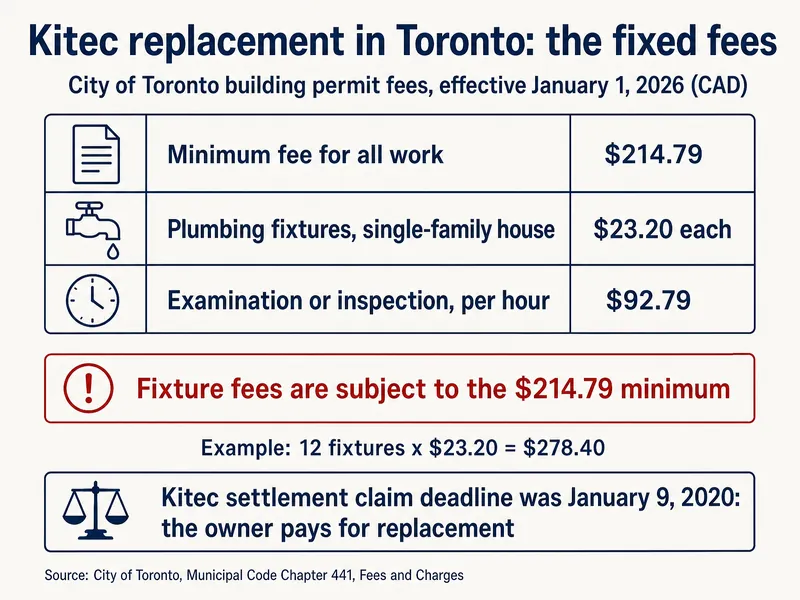
- Toronto's building permit fees for 2026 start at a $214.79 minimum, with plumbing fixtures in a single-family house at $23.20 each.
- Replacing water piping is a change to the plumbing system, which the City's 311 permit list says needs a permit.
- A business doing plumbing work in Toronto needs a City Plumbing Contractor licence ($495.12 to obtain in 2026); the plumber needs a Certificate of Qualification from Skilled Trades Ontario.
- Plumbers in the Toronto Region earned a median wage of $35.20 an hour in 2024 (Job Bank); a company's charge-out rate is higher.
Fixed costs you can check (CAD, 2026)
- $214.79Minimum City of Toronto building permit fee, any workCity of Toronto, Building Permit Fees
- $23.20Permit fee per plumbing fixture, single-family house (subject to the minimum)City of Toronto, Building Permit Fees
- $92.79Hourly examination and inspection feeCity of Toronto, Building Permit Fees
- Jan 9, 2020Kitec settlement claim deadline (closed)Kitec settlement administrator
What does Kitec plumbing replacement cost?
Kitec plumbing replacement cost has no published benchmark in Toronto: no City, provincial or court source gives a price range, and contractor websites that quote ranges are not a reliable guide to your home. What can be stated is the fixed part (the permit fee) and the things that move the rest of the price up or down.
All amounts on this page are in Canadian dollars and are as of October 2026. Anything else you see quoted online for a whole-house or per-suite repipe comes from a contractor, not a public source, and may not match a Toronto house with plaster walls or a condo with shared risers.
The practical answer is to get two or three written, itemized quotes from licensed plumbing businesses after each has looked at the home. Quotes vary by home, and the details below show why.
What drives Kitec replacement cost?
Five things drive most of the price of a Kitec repipe: how much pipe there is, how many fixtures it serves, how hard it is to reach, how much finish has to be repaired, and what else is connected to it.
- Length of pipe and number of fixtures. Every sink, toilet, tub, shower, appliance and outdoor tap needs a new line. A bungalow with one bathroom has far less than a three-storey semi with a basement suite.
- Access. Pipe in an unfinished basement ceiling is quick to reach. Pipe inside finished walls and ceilings means openings, and older Toronto houses often have plaster that is slower to cut and patch than drywall.
- Finish repair. Patching, taping, painting and replacing tile or cabinets are often quoted separately, or left out entirely. Ask who does the repair and whether it is in the price.
- Connected equipment. The water heater, a hydronic boiler, a water softener or a whole-house filter may need new connections.
- Permit and inspection. The City's fee is fixed (see below), but the plumber's time to apply and be on site for inspections is part of the quote.
The rate a company charges per hour also matters. Job Bank reports that plumbers in the Toronto Region earned between $24.93 and $53.09 an hour in 2024, with a median of $35.20. Those are wages paid to plumbers, not what customers are charged: a company's rate also covers overhead, travel, insurance and licensing. The plumber cost guide explains how that works.
Is replacement different in a condo?
Yes, replacement in a condo usually involves the condominium corporation as well as the owner. Pipes may run through common elements, shared walls or risers, and the building's declaration decides which parts belong to the unit and which to the corporation. Ask the property manager before getting quotes.
Tarion's Registrar Bulletin 18 tells builders converting buildings into condos to check for Kitec, which it says was typically installed between 1995 and 2008. In an existing building, the corporation may already have a replacement program, an approved contractor list for work that touches common elements, or rules on working hours, water shut-downs and fire separations. All of those affect the price and the schedule.
In a condo the building's own permit and inspection arrangements also apply. Confirm with management whether the corporation or the owner applies for any permit, and who pays for restoring common areas.
PEX or copper: which replacement pipe?
PEX plastic pipe and copper pipe are the two common choices for replacing Kitec, and the choice usually comes down to the house, the plumber's methods and the owner's preference. PEX comes in long flexible runs, which can mean fewer openings in finished walls. Copper is rigid and joined with soldered or pressed fittings.
There is no City subsidy or rule in Toronto that favours one over the other for private piping inside a house. The City itself uses copper when it replaces substandard lead or galvanized steel water service pipes during capital work, according to its Capital Water Service Replacement Program, but that is the buried service pipe, not the piping inside your walls.
Whichever material is chosen, ask the plumber to follow the maker's installation instructions and to name the material and fitting system on the quote, so you can compare like with like.
| Item on the quote | Why it matters | Who sets the figure |
|---|---|---|
| Pipe material and fitting system | Lets you compare quotes on the same basis | The plumber |
| Number of fixtures and appliances reconnected | Sets the scope and the per-fixture permit count | The plumber; permit fee by the City |
| Building permit and inspections | Required for changes to a plumbing system | City of Toronto, Chapter 441 fees |
| Wall, ceiling and finish repair | Often excluded or quoted separately | The plumber or a separate trade |
| Water heater, boiler or treatment connections | Hidden extra if left out | The plumber (gas work needs a TSSA-registered contractor) |
Do you need a permit to replace Kitec?
Yes, replacing Kitec normally needs a City of Toronto building permit, because the City's 311 article lists work to "install or modify" plumbing systems as permit work. Only "repairing and replacing plumbing fixtures" is listed as not needing one, and a repipe goes beyond fixtures. Toronto Building has the final say for each project.
The 2026 fee schedule, under Municipal Code Chapter 441, sets a minimum fee of $214.79 for any work and charges $23.20 per plumbing fixture in a single-family house. As an illustration only, a permit counting 12 fixtures would be 12 × $23.20 = $278.40, which is above the minimum, so the minimum would not apply; with 8 fixtures the arithmetic gives $185.60, so the $214.79 minimum would be charged. Toronto Building calculates the actual fee.
The owner or the owner's authorized agent, usually the plumber, can apply. The plumbing permit guide covers the documents, the online application and inspection booking.
How do you compare Kitec quotes?
Compare Kitec quotes line by line, after confirming each business is licensed. A short checklist:
- Licences. Check the plumber on the Skilled Trades Ontario Public Register (plumbing is a compulsory trade in Ontario). The business needs a City of Toronto Plumbing Contractor licence.
- Scope. Every quote should cover the same fixtures, the same material and the same connections.
- Permit. Ask whether the permit and inspections are included, and who applies.
- Repairs. Get in writing who opens and closes walls and ceilings, and to what finish.
- Timing and water outages. Ask how many days the water will be off, and for how long each day.
- Payment. Avoid paying the full amount before work and the final inspection are done.
Be wary of anyone offering to recover money from the Kitec settlement for you: the administrator's site says the claim deadline has passed and payments have been issued. For the background on identifying the pipe, see the Kitec plumbing guide.
How we put this page together
What this guide checked, in October 2026: the City of Toronto building permit fee schedule (effective January 1, 2026; page modified June 19, 2026), the City's 311 permit article (modified July 21, 2026), the Plumbing Contractor licence page (modified June 3, 2026), the Capital Water Service Replacement Program page, Job Bank wage data for plumbers (updated November 19, 2025), Skilled Trades Ontario, the Kitec settlement administrator's site and Tarion Registrar Bulletin 18. Left out: every repipe price range (only contractors publish them), per-suite condo costs, and any savings or payback claims.
Common questions
Why does this guide not give a price range for a Kitec repipe?
No public source publishes one for Toronto. The ranges online come from contractors selling the work, and a figure without your home's size, access and finish is not useful.
Is the permit fee charged per fixture or as a flat amount?
The 2026 schedule charges $23.20 per fixture in a single-family house, subject to the $214.79 minimum for all work. Interior repiping is counted by fixture, and Toronto Building confirms the count when it reviews the application.
Can the City help pay for Kitec replacement?
No City of Toronto subsidy for Kitec replacement was found. The City's Basement Flooding Protection Subsidy Program covers flood-protection devices, not water piping.
Does replacing Kitec raise a home's value?
No public source measures that. Keep the permit, the final inspection and the invoices, because a buyer, home inspector or insurer may ask for proof of replacement.
Can part of the Kitec be replaced and the rest left?
A plumber can tell you whether partial replacement makes sense in your home. Ask what connects to what, because new and old pipe have to be joined with compatible fittings.
Who pays when Kitec in a condo leaks into the unit below?
That depends on the condo's declaration, by-laws and the owners' insurance policies. Ask the property manager and your insurer; this guide does not give legal or insurance advice.
How long does a Kitec repipe take?
No public source gives a typical duration. Ask each plumber for a schedule that includes water-off times, inspections and wall repair.
Related guides
More help: see our Toronto home water and plumbing guide.