
Softeners & filters
Reverse Osmosis System: Do Toronto Homes Need One?
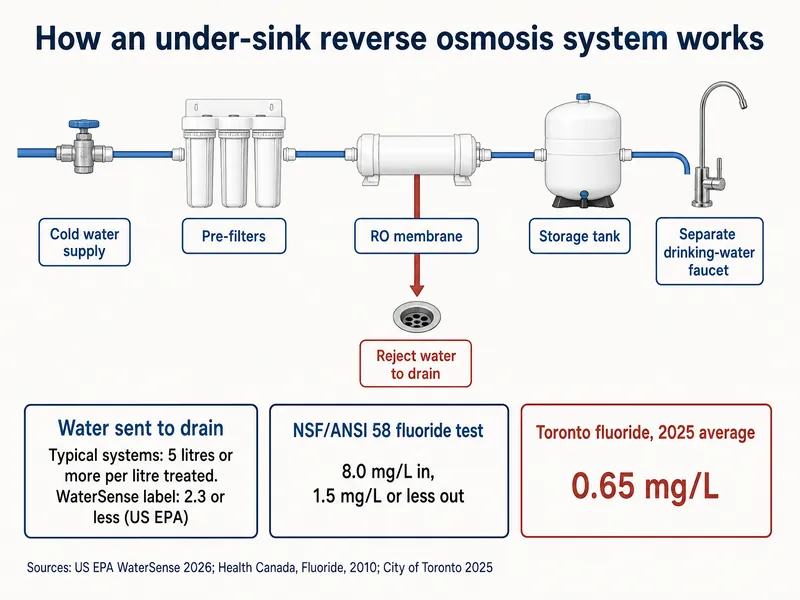
A reverse osmosis system pushes tap water through a fine membrane and sends the rejected share down the drain. Toronto homes rarely need one: Health Canada does not generally recommend extra treatment of municipal water.

On this page
Key takeaways
- Health Canada: "It is not generally recommended that drinking water treatment devices be used to provide additional treatment to municipally treated water" (Lead guideline, 2019).
- The US EPA says a typical under-sink RO unit sends 5 gallons or more of reject water down the drain for each gallon treated; WaterSense-labelled models must use 2.3 or less (EPA WaterSense, updated August 21, 2026).
- RO systems certified to NSF/ANSI 58 are meant for a single tap; Health Canada says RO water "may be corrosive to internal plumbing components".
- Toronto adds fluoride to reduce tooth decay; its 2025 mean was 0.65 mg/L, below Health Canada's 1.5 mg/L maximum (City of Toronto).
- Under NSF/ANSI 58, a unit claiming fluoride reduction must bring an 8.0 mg/L challenge down to 1.5 mg/L or less (Health Canada, Fluoride, 2010).
- Toronto's dissolved solids averaged 210 mg/L in 2025, well under the 500 mg/L in the City table's limit column.
Reverse osmosis is the most thorough treatment a homeowner can put under a kitchen sink, and also the most wasteful of water. On Toronto's treated Lake Ontario supply, neither Health Canada nor the City calls for it. This guide explains what an RO unit does, what it costs in water and upkeep, what it does to fluoride and lead, and how to read the certification before buying.
Reverse osmosis by the numbers
- 5 to 1Reject-to-treated water ratio of a typical point-of-use RO system, and often higherUS EPA WaterSense
- 2.3Most reject water a WaterSense-labelled RO system may send to drain per unit of treated waterUS EPA WaterSense
- 75%Minimum cut in dissolved solids (from a 750 mg/L challenge) for NSF/ANSI 58 certificationHealth Canada, Calcium and Magnesium, 2025
- 0.65 mg/LAverage fluoride in Toronto tap water, 2025City of Toronto, 2025 analysis summary
What does a reverse osmosis system remove?
A reverse osmosis system removes most dissolved minerals and salts, plus many other contaminants the unit is certified for, by forcing water through a semi-permeable membrane. Water pressure drives the treated share (the permeate) through the membrane into a small storage tank, while the remaining water carries the concentrated minerals to the drain. Most home units add sediment and carbon pre-filters to protect the membrane, and feed a separate faucet on the sink.
Health Canada's 2025 calcium and magnesium document gives the yardstick: a device certified to NSF/ANSI 58 must reduce an average influent of 750 mg/L of total dissolved solids by at least 75%. The same document says an RO system "should be able to remove hardness but there are no certified systems available" for that claim, and warns that hardness "would foul the membrane more quickly". RO is not a substitute for a softener on a whole house.
Does Toronto tap water need reverse osmosis?
No public body says it does. Health Canada's lead and fluoride guideline documents both state that treatment devices are not generally recommended for adding treatment to municipal water, and the City of Toronto's tap water page says "Toronto's tap water is safe to drink". The City treats more than one billion litres a day at four plants and runs more than 20,000 tests a year at those plants.
The 2025 numbers show why RO has little to work on. Dissolved solids averaged 210 mg/L against 500 mg/L in the table's limit column, sodium 14.8 mg/L, nitrate 0.34 mg/L and hardness 119 mg/L. People still buy RO for taste or personal preference, and that is their choice; it is not a fix for unsafe water. The full set of results is explained in the Toronto water quality report guide.
How much water does a reverse osmosis system waste?
A typical under-sink RO system sends five or more units of water to the drain for every unit it delivers, according to the US EPA's WaterSense program. The EPA adds that some inefficient units reach 10 to 1. Because these are ratios, they hold in litres too: 5 L or more down the drain for each litre in the glass.
Since November 2024, WaterSense has had a specification for point-of-use RO systems. Labelled models must send 2.3 units of water or less down the drain per unit of treated water, keep their membrane working for at least one year before replacement, meet a baseline dissolved-solids reduction, and be certified for any other contaminant claims. WaterSense is a US program, but the ratio is a useful benchmark when comparing models sold in Canada. Every litre to drain is metered and billed on a Toronto water account.
Does reverse osmosis remove fluoride and lead?
Yes, certified RO units can reduce both, but Toronto water is already low in each. Health Canada's fluoride guideline document (2010) says certified fluoride-reduction devices "rely on reverse osmosis and distillation", and that an NSF/ANSI 58 unit must cut fluoride from 8.0 mg/L to no more than 1.5 mg/L. The City adds fluoride "to reduce the risk of tooth decay"; Toronto's mean for 2025 was 0.65 mg/L, close to the 0.7 mg/L that Health Canada gives as optimal for fluoridation and under its 1.5 mg/L maximum. Removing it is a personal decision; questions about dental health belong with a dentist or Toronto Public Health.
For lead, Health Canada's 2019 document says RO systems certified to NSF/ANSI 58 "may also be certified for the reduction of lead", and that adsorption filters certified to NSF/ANSI 53 do the same job, generally with activated carbon. The City's advice for homes with a lead service pipe is a filter that is "NSF-053 certified", replaced regularly, alongside a free City lead test. If your house dates from before the mid-1950s, start with lead pipes in Toronto.
| Device | What it is certified to reduce | Toronto relevance |
|---|---|---|
| RO system, NSF/ANSI 58 | Dissolved solids (75% of a 750 mg/L challenge), fluoride if claimed, lead if claimed | Dissolved solids average 210 mg/L; not generally recommended on municipal water |
| Carbon filter, NSF/ANSI 53 | Lead and other health-effect claims | The City's named choice for lead pipes |
| Carbon filter, NSF/ANSI 42 | Chlorine or chloramine taste and odour | Chloramine averaged 1.6 mg/L in 2025 |
| Softener, NSF/ANSI 44 | Hardness to below 1.0 gpg | Hardness 119 mg/L; City says softening usually not needed |
| Distiller, NSF/ANSI 62 | Fluoride and other inorganics at one tap | Needs electrical energy input |
Which certification should an RO system have?
Look for a listing to NSF/ANSI 58, the reverse osmosis standard, from a certifier accredited by the Standards Council of Canada, and check each specific claim (fluoride, lead, dissolved solids) on that listing. Health Canada does not recommend brands but "strongly recommends" certified devices. Its 2019 lead document names CSA Group, NSF International, the Water Quality Association, UL, BNQ, IAPMO and Truesdail as accredited certifiers at the time.
Health Canada also explains why NSF/ANSI 58 units belong at one tap. "Water treated by an RO system may be corrosive to internal plumbing components", so certified units are "intended for POU installation only", and its 2025 document calls whole-house RO "generally not practical" at residential scale. Some homes may need pre-treatment "to reduce fouling and extend the service life of the membrane". Compare RO with simpler options on water softener vs water filter and whole house water filter.
What does an RO system cost to own?
No government or standards source publishes Canadian prices for RO units, installation or parts, so this guide gives none; get at least two written proposals with each part priced in Canadian dollars (October 2026 at the time of writing). Ownership costs come from four places: the unit and its faucet, installation with a drain connection under the sink, replacement pre-filters, post-filters and membranes on the maker's schedule, and the water sent to drain, which shows up on your bill.
Health Canada's fluoride document advises periodic testing by an accredited laboratory of the water going in and coming out, and checking component life against the manufacturer's recommendations. Ontario's consumer rules also apply: water treatment devices and filters are on the province's restricted door-to-door list, and home-service contracts carry a 10-day cooling-off period.
How we put this page together
This page relies on Health Canada's guideline documents for lead (2019), fluoride (2010) and calcium and magnesium (2025), the US EPA WaterSense page for point-of-use RO systems (updated August 21, 2026), the City's 2025 analysis summary and tap water page, the City's lead page and Ontario's door-to-door sales rules, read in October 2026. Left out: RO prices, membrane lifespans beyond the WaterSense minimum, remineralization claims and any health claim about fluoride beyond what Health Canada and the City state.
Common questions
Does RO water taste different from Toronto tap water?
With most dissolved minerals removed, the taste changes. Whether that is better is a matter of preference; Health Canada's guidance does not treat it as a health question.
Can an RO system feed the whole house?
Health Canada calls RO "generally not practical" for point-of-entry use at home, and notes RO water may be corrosive to plumbing. Certified NSF/ANSI 58 systems are meant for a single tap.
Does RO remove chloramine?
Some units include carbon pre-filters, and Health Canada notes RO may need pre-treatment to protect the membrane. Check the listing: a chloramine claim falls under NSF/ANSI 42.
Will RO leave water too low in fluoride for children's teeth?
Removing fluoride is a choice each household makes. For advice on children's dental health, ask a dentist or Toronto Public Health rather than relying on a device seller.
How often does the membrane need replacing?
It depends on the model and water use; follow the maker's schedule. WaterSense-labelled systems must show their membrane lasts at least one year before needing replacement.
Does the reject water add much to a Toronto water bill?
Every litre to drain passes through the water meter. A WaterSense-labelled unit sends less than half the reject water of a typical 5-to-1 system, so the ratio is worth checking.
Is RO useful during a boil water advisory?
Follow the City's instructions during any advisory. Do not assume a home treatment device makes water safe unless the City says it can be used.
Water treatment guides

More help: see our Toronto Home Water Guide home page.