
Winter & emergencies
How to Prevent Frozen Pipes in a Toronto Winter
How to prevent frozen pipes in Toronto: keep every space with plumbing at 8 °C or warmer, seal drafts, insulate exposed runs, drain outdoor taps, and on nights below −15 °C consider a pencil-thin trickle.
On this page
Key takeaways
- Toronto's frozen pipe advice (modified October 19, 2026) sets 8 °C as the floor for any area with water pipes, especially near the water meter.
- Below −15 °C at night, the City says you may choose to run a thin stream from vulnerable taps; that water is billed to you.
- At Toronto Pearson, an average January brings 14.2 days with a low under −10 °C and 2.6 under −20 °C (Environment and Climate Change Canada, 1981–2010).
- Under Municipal Code Chapter 851, owners must keep private water service pipes protected from freezing.
- The Insurance Bureau of Canada advises leaving the heat on and having someone check the home if you travel in the heating season, "even for a few days."
- Outdoor taps: disconnect hoses, close any separate indoor shut-off, and open the tap so trapped water drains.
How do you prevent frozen pipes?
You prevent frozen pipes by keeping cold air off them and warm air around them, before and during cold snaps. The City of Toronto splits its advice into two stages.
Before winter:
- Seal drafts around windows, doors, vents, wiring and the places pipes pass through walls.
- Insulate exposed pipes in basements, crawl spaces, garages and attics.
- Disconnect garden hoses and shut off and drain outdoor taps.
- Find the main water shut-off valve and make sure it turns (the shut-off guide explains the common valve types).
- If indoor pipes freeze often, get advice from a licensed plumber.
During a cold snap:
- Hold rooms with plumbing at 8 °C or more, and pay most attention to the meter area.
- Keep the garage door shut if pipes run through the garage.
- Keep the house heated overnight and while you are out; if you control the thermostat, nudge it up a degree or two at night.
- Open the doors of kitchen, bathroom and laundry cabinets so room air reaches the pipes.
Ontario's Building Code backs this up for new work: Article 7.3.5.3 of the 2024 Code requires piping that may face freezing conditions to be protected from its effects. Renters should report drafts to the landlord and find out who to reach after hours.
Which pipes freeze first?
Pipes freeze first where they sit closest to outside air: along exterior walls, where the water service enters through the foundation, in unheated garages and crawl spaces, under sinks on outside walls, and in attics. The City names exterior walls and the service entry as the first places to check when water stops.
The meter and the first metre or so of pipe inside the foundation wall get special mention because the service comes in from cold ground. On the City side, Toronto Water says its mains are buried "about 1.8 m deep, just below the frost line," and the City's design standard for new water services calls for at least 1.8 m of cover. Inside the house, though, the pipe rises through a basement wall that can be much colder than the room.
Toronto's two weather stations show why homes in the suburbs see more freezes than downtown. Over the 1981–2010 normals, Pearson averaged 38.9 days a year with a low under −10 °C, against 21.9 at the downtown station.
| Location | Why it is at risk | What helps |
|---|---|---|
| Pipe on an exterior wall | Cold seeps through the wall cavity | Seal drafts, open cabinet doors, insulate where reachable |
| Service entry and water meter | Pipe comes straight in from cold ground | Keep the area at 8 °C or more; seal gaps around the pipe |
| Unheated garage | Room can drop near outdoor temperature | Keep the door closed; insulate the pipe |
| Crawl space or attic | Little or no heat | Insulate pipes; seal vents and air leaks |
| Outdoor tap | Water sits in the part that passes through the wall | Shut the inside valve and drain the tap |
How should you insulate pipes?
Insulate pipes by fitting foam or fibreglass sleeves, or wrapping, along every exposed run in cold spaces, and sealing the air leaks around them first. The IBC's winter advice is to fit exposed pipes "with insulation sleeves or wrapping," and the City lists basements, crawl spaces, garages and attics as the places to start.
A few points make insulation work better:
- Seal before you wrap. Caulk or foam the gaps where pipes, wires and vents pass through outside walls; a sleeve cannot stop a draft blowing on the pipe.
- Cover joints and valves. Gaps at elbows and fittings are where ice often starts.
- Do not trap the pipe against the cold side. In an exterior wall, insulation should sit between the pipe and the outside, not between the pipe and the warm room.
- Electric heat cable is sold for problem pipes; follow the maker's instructions exactly, and have electrical connections done properly. If a pipe keeps freezing, ask a plumber about rerouting it to a warm interior wall.
Should you leave a tap dripping?
Leaving a tap running a little can help on the coldest nights, and the City puts a number on when: if the overnight low is heading below −15 °C, you may choose to let a stream about as thin as a pencil run from taps at risk. Moving water is harder to freeze, and an open tap relieves pressure if ice does form.
Two conditions come with that advice. The water passes through your meter, so it shows up on your utility bill. And drains must stay clear, because a slow drain plus a running tap can overflow a sink overnight.
A drip is a backup, not a fix. If a particular tap only keeps working when left running, the pipe behind it needs insulating, sealing or moving, which is cheaper than a burst. If a pipe does freeze anyway, follow the steps in the frozen pipes thawing guide.
How do you winterize outdoor taps?
Winterize outdoor taps in the fall, before the first fall frost (on average around October 16 at Pearson, 1981–2010): take off the hose, close the indoor shut-off that feeds the tap if there is one, then open the outdoor tap so the water left in the line can drain out.
- Remove hoses. A hose left on traps water in the tap body, where it can freeze and split the pipe inside the wall.
- Close the inside valve. If there is a separate shut-off for the outdoor line, it is often in the basement just inside the wall where the tap is.
- Drain it. Open the outside tap and leave it open over winter so expanding ice has room.
- Check frost-free taps too. Even these long-stem taps can split if a hose stays attached.
The City adds that tenants should ask the landlord who looks after outdoor taps and shut-off valves.
How do you protect pipes while you are away?
Protect pipes while you are away by keeping the heat on, having a trusted person check the home, and, for long absences or an empty house, shutting off the water and draining the lines. The City's advice is to keep the home warm when you are away, and the IBC says to leave the heat on and arrange a check even for a trip of a few days in the heating season.
Insurance is the reason to plan this carefully. The IBC says most policies "outline specific details on how often your home must be checked by a competent person," and that most policies exclude frozen pipe damage when a home is vacant; for a vacant home it advises shutting off the water and draining the lines. Read your own policy for the exact check interval before you leave.
A simple checklist before a winter trip:
- Set the thermostat to a steady temperature, not "off," and check the furnace has been serviced.
- Leave cabinet doors open on outside walls.
- Give your checker the location of the main shut-off and a way to reach you.
- For an extended or seasonal absence, shut off the main and open taps low in the house to drain; gas water heaters should be handled by a licensed gas technician.
If the house is empty all winter and something goes wrong on the street, see what happens in a water main break.
Toronto cold-weather numbers
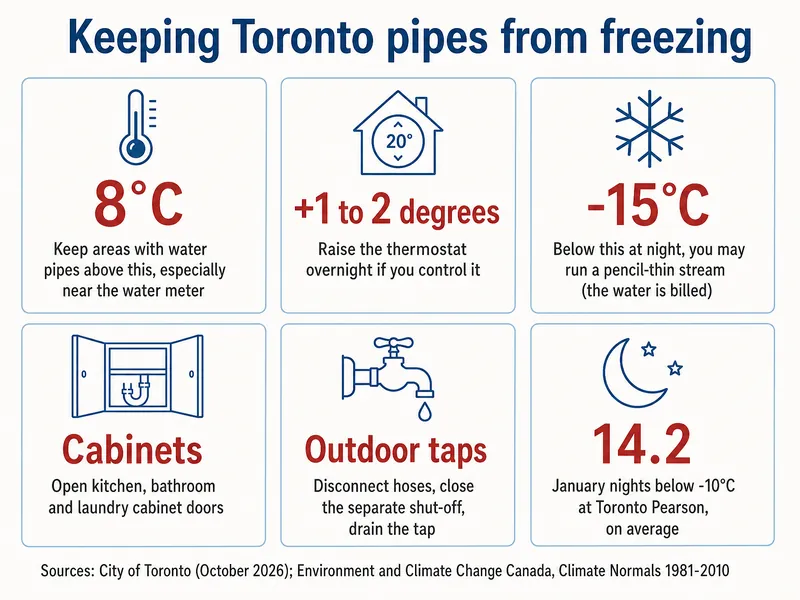
- 8 °CLowest temperature the City advises for areas with water pipesCity of Toronto, modified Oct 19, 2026
- −15 °COvernight low at which the City says a thin stream from at-risk taps is an optionCity of Toronto, modified Oct 19, 2026
- 14.2Average number of January days at Pearson when the low falls under −10 °CECCC climate normals, 1981–2010
- −9.4 °CAverage January daily low at Toronto PearsonECCC climate normals, 1981–2010
- 1.8 mApproximate depth of Toronto watermains, just below the frost lineCity of Toronto, modified Aug 26, 2026
How we put this page together
This guide uses the City of Toronto's frozen pipe page (modified October 19, 2026) and watermain page (modified August 26, 2026), Municipal Code Chapter 851, Part 7 of the 2024 Ontario Building Code, the Insurance Bureau of Canada's winter and extreme-cold pages, and Environment and Climate Change Canada's 1981–2010 normals for Toronto Pearson and the downtown station, checked October 2026. It leaves out product rankings, heating-cost estimates and newer climate normals that were not verified; insurance details depend on each policy.
Common questions
What indoor temperature stops pipes from freezing?
The City's line is 8 °C for any area with water pipes, especially near the meter. Living spaces are usually far warmer; the risk is in cold rooms, garages and wall cavities that sit below the room temperature.
Should the heat be turned down at night in winter?
If you control the thermostat, the City suggests raising it by a degree or two overnight during cold snaps rather than lowering it, because the coldest hours are before dawn.
Does letting a tap run cost a lot?
The City notes that the water is charged on your bill like any other use. A pencil-thin stream on a few very cold nights is a small amount compared with the cost of a burst pipe, but there is no need to run taps on milder nights.
Do condo owners need to worry about frozen pipes?
Condo units are usually heated on all sides, but pipes near balcony doors, exterior walls or unheated parking levels can still freeze. Check with the property manager about who maintains which pipes and shut-offs.
When should outdoor taps be shut off in Toronto?
Before the first frost. Pearson's average first fall frost is October 16 and downtown's is November 3 (1981–2010 normals), so October is a sensible time to drain them.
Is a house left empty in winter covered if pipes burst?
Often not without precautions. The IBC says most policies exclude frozen pipe damage in a vacant home and advises shutting off the water and draining the lines. Ask your insurer what its policy requires.
Who is responsible for keeping the water service from freezing?
The property owner, for the pipe from the property line into the home. Municipal Code Chapter 851 requires owners to protect private water service pipes from freezing.
Related guides
More help: see our Toronto home water and plumbing guide.