
Basement flooding
Basement Waterproofing Cost: Interior and Exterior Methods
Basement waterproofing cost in Toronto turns on method, access and depth; no public body publishes a price range, the City does not subsidize waterproofing itself, and its own advice puts $0 to $250 fixes first.
On this page
Key takeaways
- Toronto has no official basement waterproofing price: no government or standards body publishes one, so this page sets out what moves the cost rather than a range.
- The Ontario Building Code (2024) requires waterproofing, not just dampproofing, wherever hydrostatic pressure occurs (Article 9.13.3.1).
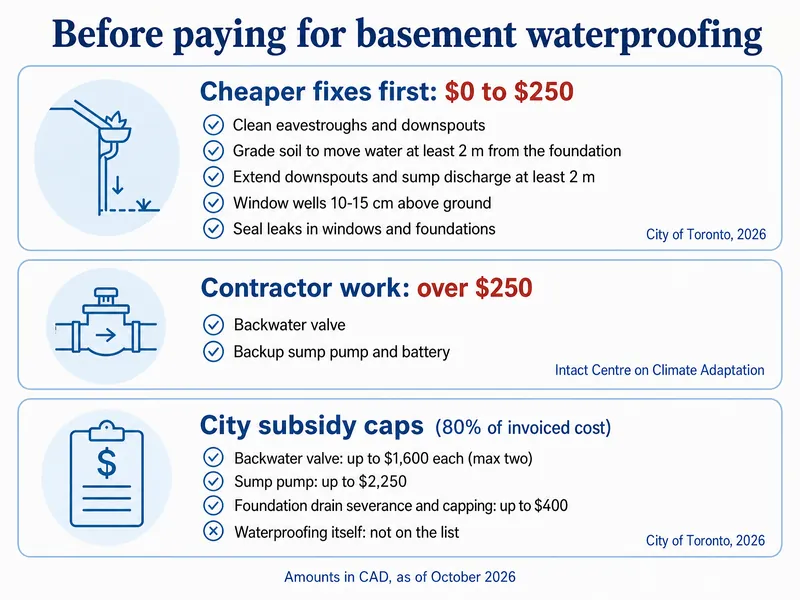
- The City's 2026 flood-readiness infographic lists $0 to $250 steps first: clean eavestroughs, grade soil and extend downspouts so water lands at least 2 m from the foundation.
- Waterproofing is not an item in the Basement Flooding Protection Subsidy Program; related devices are, up to $6,650 per property (as of October 2026).
- The July 15 to 16, 2024 Toronto-area floods caused more than $909 million in insured damage, according to the Insurance Bureau of Canada.
- Toronto Water's October 2025 report puts the average market cost of a backwater valve installation at about $3,800, the only City-published installed-cost figure for flood protection.
How much does basement waterproofing cost?
Basement waterproofing cost in Toronto has no official benchmark, and this guide does not reprint contractor price lists. The City, the Province and federal housing bodies publish rules and subsidy caps, not prices for membranes or interior drainage. Amounts on this page are in Canadian dollars (CAD), as of October 2026.
What does exist is one City figure for a related job. A Toronto Water staff report from October 22, 2025 puts the typical installed price of a backwater valve at "approximately $3,800" (its words: the "average market cost"). That is not a waterproofing price, but it shows the scale of contractor flood work and is the base for the subsidy arithmetic further down.
For waterproofing itself, the reliable path is two or three written, itemized quotes that describe the same method, the same length of wall and the same restoration. Quotes vary by home; comparing them line by line tells you more than any published average.
What is the difference between interior and exterior waterproofing?
Exterior waterproofing stops water at the outside face of the foundation; interior waterproofing collects water that has already come through and pumps it out. Both can be legitimate, but they solve slightly different problems and disturb different parts of the property.
The Building Code draws a line between two levels of protection. Dampproofing is the basic coating required on exterior foundation walls below ground wherever the outside ground is higher than the basement floor (Article 9.13.2.1). Waterproofing is required "where hydrostatic pressure occurs," meaning water is pressing against the wall or slab (9.13.3.1). A wall that is properly waterproofed does not also need dampproofing.
| Method | What it does | Where the work happens | Related City or Code item |
|---|---|---|---|
| Grading and downspout extensions | Moves surface water away before it reaches the wall | Yard and eavestroughs | City infographic: at least 2 m from the foundation |
| Exterior membrane with new foundation drain | Seals the outside of the wall and drains water at the footing | Excavation beside the foundation | Ontario Building Code 9.13.3 and 9.14 |
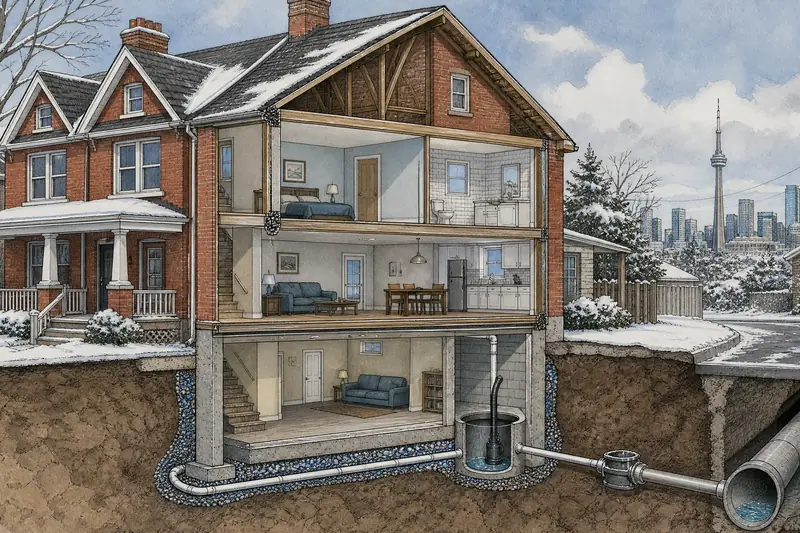
| Interior drainage channel with sump pit | Collects water at the floor edge and pumps it out | Basement floor along the walls | Sump pump subsidy up to $2,250 |
| Crack repair from inside | Seals a single leaking crack | One section of wall | Not a subsidy item |
| Backwater valve | Stops sewer water backing up through floor drains | Main sewer line in the basement | Subsidy up to $1,600 per valve; permit listed at $38.67, but a $214.79 minimum may apply |
Exterior work suits walls with many cracks or failing old coatings, and lets a contractor replace the foundation drain at the same time (see the weeping tile replacement cost guide). Interior systems avoid digging up gardens and driveways, which matters on narrow Toronto lots and semis with a shared wall, but they do not stop water from soaking the wall itself.
What drives waterproofing cost?
The main drivers of waterproofing cost are method, linear metres of wall, depth to the footing, access, restoration and drainage. A quote should list each one so two contractors can be compared fairly.
- Method and scope. A full exterior membrane on four walls is a different job from sealing one crack from inside.
- Depth and soil. Deeper footings and heavy clay take longer to dig and backfill.
- Access. Porches, driveways, decks, mature trees and the neighbour's foundation can force hand digging.
- Restoration. Interlock, concrete walks and landscaping outside, or drywall, flooring and trim inside, all have to be redone.
- Drainage and pumping. Interior systems need a sump pit; the Code sets a minimum depth of 750 mm with a cover (9.14.5.2). The sump pump installation cost guide covers that part.
- Permits and licences. Toronto Building decides whether a permit is needed; ask before work starts. The plumbing permit guide lists the 2026 fees.
Which cheaper fixes should come first?
Start with the steps the City and the Intact Centre on Climate Adaptation place at the bottom of the cost ladder, because many wet basements are a surface-water problem. The City's 2026 infographic groups these as things a homeowner can do "for $0 to $250."
- Clean eavestroughs and downspouts of leaves, ice and snow.
- Correct grading so water moves at least 2 m away from the foundation, without sending it onto a neighbour's lot.
- Disconnect downspouts and extend them, and any sump discharge pipe, at least 2 m from the foundation (see the downspout disconnection guide).
- Fit window wells that sit 10 to 15 cm above ground, with covers where fire escape rules permit.
- Seal leaks in windows and foundations, and test the sump pump regularly.
The Intact Centre's Three Steps to Cost-Effective Home Flood Protection (University of Waterloo) uses three tiers: maintenance at $0 done at least twice a year, simple upgrades under $250, and contractor work over $250 such as a backwater valve or a backup sump pump with a battery. If water still comes in after the cheaper steps, the case for paying for waterproofing is much stronger.
How do you choose a waterproofing contractor?
Choose on licences, written scope and paperwork, not on a single price. This guide does not recommend or rank firms; these are the questions to ask any of them.
- City licence. For any work you plan to claim under the City subsidy, every firm on the job, subcontractors included, needs a current Toronto business licence, "or funding is denied." Drain work also needs a City Drain Layer licence.
- Plumbing trade. Plumbing is a compulsory trade in Ontario; you can look a person up on the Skilled Trades Ontario Public Register.
- Written, itemized quote. Method, length of wall, depth, membrane or drainage product, sump pit and pump, restoration, permit and clean-up, each priced.
- Warranty in writing. Who holds it, what it covers, and whether it transfers if you sell.
- Permit. Who applies and who books the inspections.
Does Toronto subsidize basement waterproofing?
No: Toronto does not subsidize waterproofing membranes, interior drainage channels or crack repair. The Basement Flooding Protection Subsidy Program pays 80% of the invoiced cost, up to set caps, for specific devices that often go with waterproofing work, for work done on or after November 12, 2025.
| Device | Subsidy: 80% of the invoice, capped at |
|---|---|
| Backwater valve | $1,600 each, two at most |
| Sump pump | $2,250 |
| Sump pump battery backup | $300 |
| Foundation drain severance and capping | $400 |
| Home plumbing assessment | $500 |
Worked example using the City's own average: a $3,800 backwater valve invoice times 80% comes to $3,040; the cap stops the City's share at $1,600, leaving $2,200 for the homeowner before permit fees (the valve page lists $38.67, but the schedule's $214.79 minimum may apply, so ask Toronto Building). For a sump pump, any invoice of $2,812.50 or more reaches the $2,250 cap. Downspouts must be disconnected (or exempted) to qualify, and the backwater valve guide explains that device in detail.
Basement flooding figures for Toronto
- $909 million+Insured damage from the July 15 to 16, 2024 Toronto-area floodsInsurance Bureau of Canada, July 2026
- $3,800Average market cost of a backwater valve installationToronto Water staff report, Oct 22, 2025
- $6,650Most the City will pay one property across all flood itemsCity of Toronto subsidy page, June 2026
- 2 mDistance to move water from the foundationCity of Toronto, 2026 infographic
How we put this page together
Sources behind this page: Part 9 of Ontario's 2024 Building Code compendium (dampproofing, waterproofing and drainage), Toronto's subsidy program page (modified June 18, 2026), its 2026 flood-readiness infographic, Toronto Water's October 22, 2025 staff report, the Intact Centre's three-step guide, the City's Drain Layer licence page and the Insurance Bureau of Canada, all checked in October 2026. Contractor price ranges, per-foot estimates and product comparisons are deliberately absent, since none comes from a public body; the contractor questions are general and do not point to any firm.
Common questions
Is interior waterproofing a real fix or a stopgap?
It manages water that reaches the wall by collecting and pumping it, which can keep a basement dry; it does not stop the wall itself from getting wet. Whether that is enough depends on the source of the water, so ask each contractor to explain where the water is coming from.
Does basement waterproofing need a permit in Toronto?
Toronto Building decides. Work on buried drainage piping, a backwater valve or a sump with a pump appears in its 2026 fee schedule, so ask before work starts and get the permit number in writing.
Can grading alone fix a wet basement?
Sometimes. The City lists correcting grading and extending downspouts so water lands at least 2 m away among its $0 to $250 steps, and they are worth trying before larger work, especially if leaks follow heavy rain on one side.
Does home insurance pay for waterproofing?
Insurance policies generally pay for sudden damage, not upgrades, and the Insurance Bureau of Canada says sewer backup damage is "typically not covered by a standard policy" unless optional cover is bought. Check the wording of your own policy with your insurer or broker, and see how sewer backup cover works.
Is waterproofing worth it before finishing a basement?
Finishing hides the walls, so problems are cheaper to deal with first. Fixing grading, downspouts and any active leaks, and deciding on a backwater valve and sump pump, before drywall goes up avoids tearing it out later.
Why do contractor quotes for the same basement differ so much?
They often describe different jobs: one wall versus four, interior versus exterior, with or without a new foundation drain, sump pump or restoration. Ask each to price the same scope line by line.
Does the City's $500 home plumbing assessment help here?
It can. The subsidy pays 80% up to $500, once, for an assessment by a licensed plumber using the City's Home Plumbing Assessment Form, which can show where water and sewer risks are before you commit to bigger work.
Related guides
More help: see our guide to water and plumbing in Toronto homes.