
Basement flooding
Backwater Valve: How It Protects a Toronto Basement
A backwater valve is a one-way flap on your home's main sewer pipe that closes when the City sewer surcharges, so sewage cannot flow back up through basement drains.
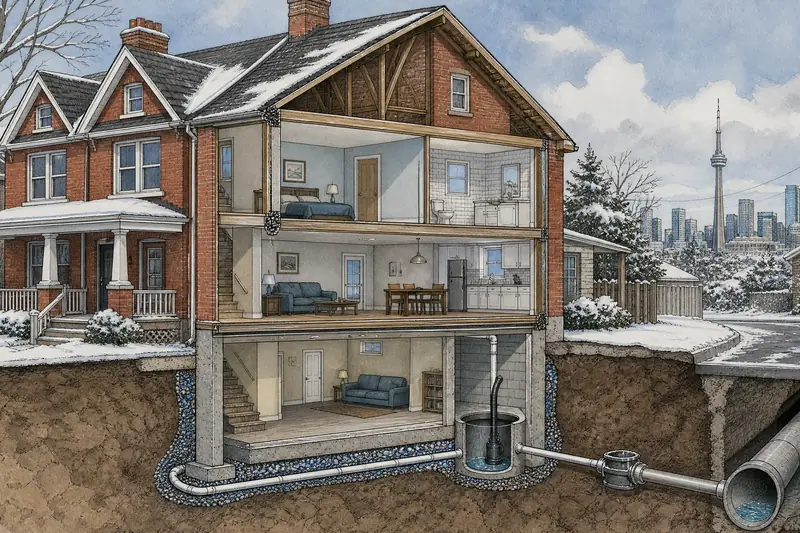
On this page
Key takeaways
- The Ontario Building Code (2024), Division B, 7.4.6.4 allows a backwater valve in a building drain only if it is a "normally open" design and serves no more than one dwelling unit.
- Toronto requires a standalone drain permit for each valve, with no plans needed for one- and two-unit houses. The backwater valve permit page lists $38.67 per valve from January 1, 2026; the City's general fee schedule also sets a $214.79 minimum for all work, so confirm the fee with Toronto Building before you budget.
- The City's subsidy pays 80% of the invoiced cost up to $1,600 per valve, two valves at most, for work done on or after November 12, 2025.
- The City's 2026 flood infographic says to clean the valve every two to three months and before heavy rain.
- July and August 2024 storms flooded basements in more than one thousand Toronto properties, according to a Toronto Water staff report.
- The Insurance Bureau of Canada lists a backwater valve "as recommended by your municipality" among its flood-protection tips.
Backwater valve facts for Toronto (as of October 2026)
- $38.67Per-valve permit fee on the City's backwater valve page, from Jan 1, 2026 (a $214.79 minimum for all work may also apply)Toronto Building
- $1,600Most the City pays toward one valve (80% of the invoice, two valves maximum)City of Toronto
- 2-3 monthsHow often the City says to clean out a backwater valveCity of Toronto, 2026 infographic
- 1,000+Toronto properties with basement flooding after the July and August 2024 stormsToronto Water staff report, Oct 2025
What is a backwater valve?
A backwater valve is a device fitted into the building drain, the main pipe that carries wastewater from the house to the City sewer, with a flap that lets water leave but closes if water tries to come back in. In Toronto it is usually called a mainline or fullport backwater valve, because it sits on the main line and keeps the full pipe opening clear in normal use.
The City's permit page allows a "fullport (normally open) backwater valve conforming to the appropriate CSA standard" in a building drain that serves only one occupancy. The Ontario Building Code sets the same limits: normally open, made to one of the listed CSA pipe and fitting standards, and serving no more than one dwelling unit.
A backwater valve is not the same as a sump pump. The valve keeps sewer water out; a sump pump removes groundwater collected by the weeping tile. Many Toronto basements use both, and the subsidy program pays toward each.
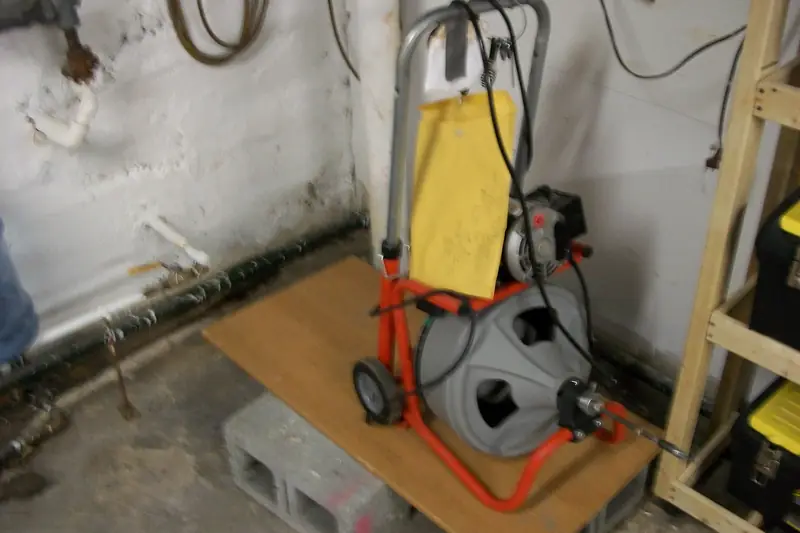
How does a backwater valve stop sewer backup?
The valve closes its flap when the City sewer fills faster than it can drain, so the surge stops at the valve instead of rising through floor drains, toilets and basement sinks. During heavy rain, sewers can become overloaded, the City explains on its 2026 infographic, and a surcharged sewer pushes water back up any connected pipe that sits lower than the water level in the street.
In normal use the flap hangs open and wastewater flows out by gravity. When water starts moving the wrong way, the flap swings shut and seals against its seat. Once the sewer drains down, the flap opens again on its own.
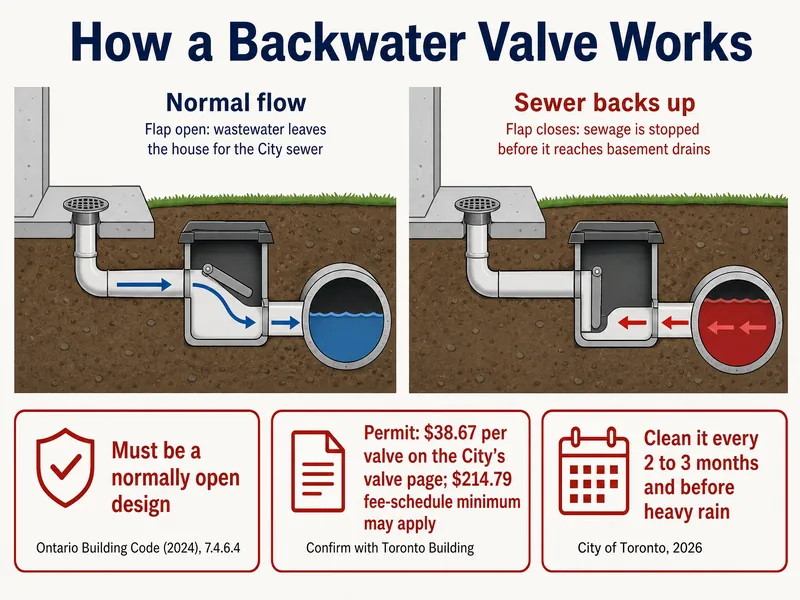
There is a practical consequence while the flap is shut: wastewater from the house has nowhere to go either. Water run into sinks, showers or washing machines during a backup collects on the house side of the closed valve. Ask the installer how your valve behaves when closed and where that water would surface.
Do Toronto homes need a permit for a backwater valve?
Yes. Toronto's 311 permit guidance (modified July 21, 2026) lists "Install a backwater valve" among the jobs that need a building permit. For one- and two-unit houses it is a standalone drain permit, applied for online, with no plans required.
The backwater valve permit page lists the fee as $38.67 per valve, effective January 1, 2026. The fee schedule under Municipal Code Chapter 441 also says a $214.79 minimum is charged for all work and names no exemption for valves, so ask Toronto Building which amount applies. If you plan to claim the City subsidy, the permit is mandatory, the valve must pass inspection before it is covered, and you must let City staff access the property and take photos. The plumbing permit guide explains how Toronto Building permits and inspections work for other plumbing jobs.
The permit page also sets a hard rule: a valve designed to sit in the normally closed position cannot be installed in a building drain or building sewer.
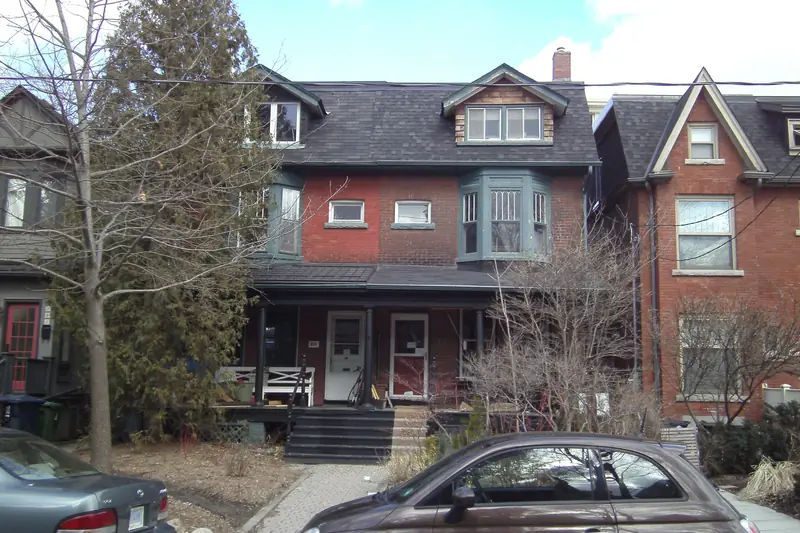
Where is a backwater valve installed?
It goes on the building drain inside the house, usually under the basement floor near the front wall where the drain leaves for the street, so that every fixture below street level sits upstream of it. Installing one normally means cutting the basement slab, opening the drain, fitting the valve with an access cover and re-pouring the concrete.
The Building Code says where a building drain "may be subject to backflow", a backwater valve is needed on fixture drains below the adjoining street level, or to protect fixtures below the upstream sanitary manhole cover in a residential building on a public sanitary sewer. Where several fixtures on one storey share a branch, the valve may go on that branch.
Some houses have two sewer connections. A Toronto Water staff report gives the example of homes built in the 1950s and 1960s with a storm connection as well as the sanitary one, which is why the 2026 subsidy now covers a second valve. A licensed plumber, or the City's subsidized home plumbing assessment, can tell you how many connections your house has.
How do you maintain a backwater valve?
Open the access cover, check that the flap moves freely and seals, and clear out any debris, every two to three months and before heavy rain, as the City's 2026 infographic recommends. The Intact Centre on Climate Adaptation at the University of Waterloo puts cleaning the valve in its no-cost "maintain what you've got" step, at least twice a year, in Three Steps to Cost-Effective Home Flood Protection.
- Follow the maker's instructions for your model; designs differ in how the flap and cover come apart.
- Wear gloves, since the valve sits in a sewer line.
- Make sure the access cover is sealed again afterwards and is not buried under flooring or storage.
- If the valve has an alarm, test it at the same time.
| Item | What applies | Source |
|---|---|---|
| Cleaning | Every 2 to 3 months and before heavy rain | City of Toronto, 2026 flooding infographic |
| Minimum cleaning | At least twice a year | Intact Centre on Climate Adaptation |
| Valve type | Normally open design only in a building drain | Ontario Building Code 2024, 7.4.6.4 |
| Permit | Required; $38.67 per valve on the valve permit page, or possibly the $214.79 minimum | Toronto Building, Chapter 441 |
| Subsidy | Up to $1,600 a valve (80% of cost), max two valves | Basement Flooding Protection Subsidy Program |
What can go wrong with a backwater valve?
The common problems are a flap held open by debris, a cover that cannot be reached, a valve that is not on the right pipe, and water used inside the house while the flap is closed. Each can let water into the basement even with a valve in place.
- Debris or grease can stop the flap from sealing, which is why cleaning is on the City's list of $0 to $250 actions.
- Access buried under finished flooring makes cleaning impossible; keep the cover exposed.
- Fixtures downstream of the valve, or a second sewer connection, are not protected.
- The wrong kind of valve: a normally closed design is prohibited in a building drain by both the Code and the City.
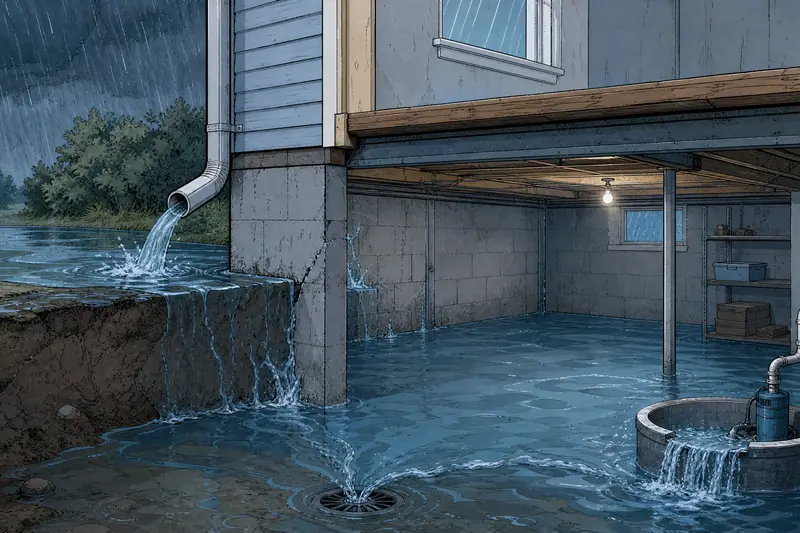
- Other water paths: a valve does nothing about groundwater through cracks, or surface water through windows. Grading, downspout disconnection and a working sump pump with battery backup deal with those.
A valve also does not settle insurance questions. Sewer backup damage is usually covered only under optional coverage; the sewer backup insurance guide explains what to ask.
How we put this page together
Sources read for this page in October 2026: Article 7.4.6.4 of Part 7 in Ontario's 2024 Building Code Compendium; Toronto Building's permit guide for backwater valves (dated July 14, 2026); Toronto's 311 list of work that needs a permit (dated July 21, 2026); the City subsidy page (dated June 18, 2026); the City flood-readiness infographic for 2026; Toronto Water's October 22, 2025 report to committee; the University of Waterloo Intact Centre's three-step flood guide; and IBC's water damage page. No primary source gives a valve lifespan or an installed price range, so neither appears here.
Common questions
Is a backwater valve the same as a backflow preventer?
No. A backwater valve keeps sewage from flowing back into the house through the drain. A backflow prevention device protects the drinking water supply; Toronto treats it as a separate permit item with its own $92.79 fee.
Can a backwater valve go outside the house?
Toronto's permit page covers valves in the building drain of one- and two-unit houses and does not describe an exterior option. Ask Toronto Building before planning one, since the Code limits where the valve can be and what it can serve.
Will a backwater valve stop all basement flooding?
No. It addresses sewage backing up from the City sewer. Groundwater, overland water and plumbing leaks reach a basement by other routes, which is why the City lists grading, downspouts and sump pumps alongside it.
Do new Toronto houses need a backwater valve?
The Ontario Building Code requires backflow protection where a drain may be subject to backflow and fixtures sit below street level or below the upstream manhole cover. No separate Toronto by-law requiring a valve in every new house was found.
What does the valve alarm do?
Some valves include an alarm that sounds when the flap closes or water rises. The City's subsidy for a backwater valve covers the valve and its alarm.
How long does a backwater valve last?
No government or code source gives a lifespan. Regular cleaning and inspection, as the City advises, is how you find a worn flap or seal before a storm does.
Related guides
More help: see our Toronto water and plumbing guide.