
Tap water
GTA Water Hardness by City and Region
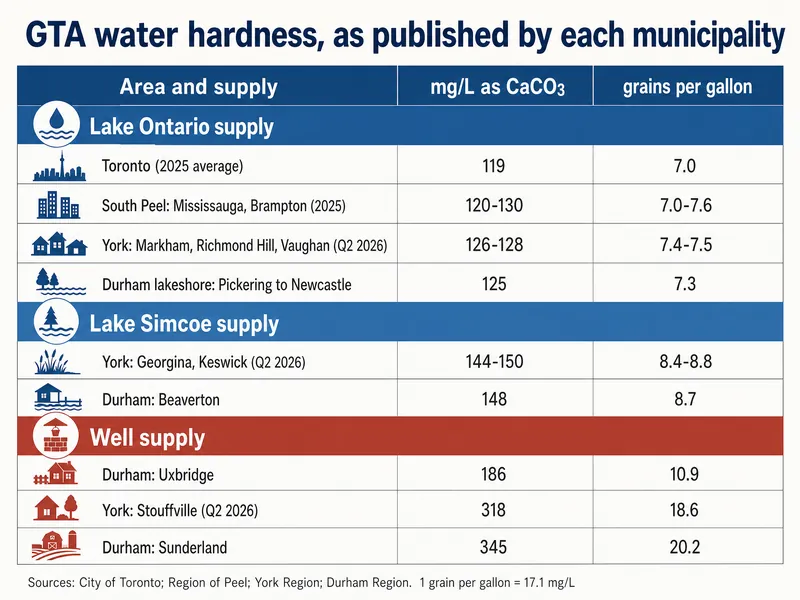
GTA water hardness depends on the source: lakeshore cities on Lake Ontario water report about 119 to 130 mg/L (7 to 7.6 grains per gallon), while well-supplied towns report roughly 186 to 345 mg/L.
On this page
Key takeaways
- Toronto's 2025 average, 119 mg/L or 7.0 gpg, was the lowest figure among the big lakeshore systems, per the City's 2025 results.
- The Region of Peel reports 120 to 130 mg/L for South Peel (Mississauga, Brampton) in 2025 and calls it "moderately hard".
- York Region lists Markham at 126, Richmond Hill at 127 and Vaughan at 128 mg/L for the second quarter of 2026.
- Durham Region lists 125 mg/L for its lakeshore system from Pickering to Newcastle, and 345 mg/L for Sunderland.
- York Region says groundwater "is usually harder than surface water", which is why well towns such as Stouffville (318 mg/L) stand out.
- Halton Region's figures could not be verified for this page; check halton.ca directly.
GTA hardness in four numbers
- 119 mg/LToronto average hardness, 2025 (7.0 gpg)City of Toronto
- 120–130 mg/LSouth Peel (Mississauga, Brampton) hardness, 2025Region of Peel, 2025 South Peel report
- 80%Share of York Region's water that comes from Lake Ontario via Toronto and PeelYork Region
- 345 mg/LHardest system figure found: Sunderland, Durham Region (20.2 gpg)Durham Region
How hard is water across the GTA?
Across the lakeshore GTA, water is moderately hard: between 119 and 130 mg/L as calcium carbonate, or about 7 to 7.6 grains per gallon. That band covers Toronto, Mississauga, Brampton, Markham, Richmond Hill, Vaughan and the Durham lakeshore from Pickering to Newcastle, because all of them drink treated Lake Ontario water.
Outside that band are the smaller towns on wells, where published figures run from 186 mg/L (Uxbridge) to 345 mg/L (Sunderland), and the Lake Simcoe communities in between at 144 to 150 mg/L. Each figure below comes from the municipality's own report or web page, converted to grains per gallon at 17.1 mg/L per grain.
| Area | Supply | Hardness (mg/L as CaCO3) | Grains per gallon | Period |
|---|---|---|---|---|
| Toronto | Lake Ontario | 119 average (115–122) | 7.0 | 2025 |
| South Peel: Mississauga, Brampton, south Caledon | Lake Ontario | 120–130 | 7.0–7.6 | 2025 |
| York: Markham / Richmond Hill / Vaughan | Lake Ontario via Toronto and Peel | 126 / 127 / 128 | 7.4 / 7.4 / 7.5 | Q2 2026 |
| York: Aurora / King City / Newmarket | Mixed | 130 / 131 / 141 | 7.6 / 7.7 / 8.2 | Q2 2026 |
| Durham: Pickering, Ajax, Whitby, Oshawa, Bowmanville, Newcastle | Lake Ontario | 125 | 7.3 | Not dated |
| York: Georgina / Keswick | Lake Simcoe | 144 / 150 | 8.4 / 8.8 | Q2 2026 |
| Durham: Beaverton | Lake Simcoe | 148 | 8.7 | Not dated |
| Peel: Caledon Village / Alton | Wells | 190–280 / 320–330 | 11.1–16.4 / 18.7–19.3 | 2025 |
| York: Nobleton, Schomberg / Mount Albert / Stouffville | Wells | 264 / 317 / 318 | 15.4 / 18.5 / 18.6 | Q2 2026 |
| Durham: Uxbridge / Port Perry / Sunderland | Wells | 186 / 274 / 345 | 10.9 / 16.0 / 20.2 | Not dated |
| Halton: Burlington, Oakville, Milton, Halton Hills | Lake and wells | Not verified | — | — |
Which GTA cities have the hardest water?
Among the large GTA cities, the differences are small: Toronto is lowest at 119 mg/L, and Vaughan, at 128 mg/L in York Region's latest quarter, is near the top of the lakeshore band. None of the big lakeshore cities comes close to the well towns.
The hardest figures belong to small communities on groundwater. Sunderland tops Durham Region's list at 345 mg/L, followed by Blackstock at 316, Cannington at 312 and Orono at 309. In York Region's Q2 2026 averages, Stouffville is at 318 and Mount Albert at 317. The Region of Peel reports Alton at 320 to 330 mg/L in 2025 and says that although the water there "is considered hard, it is still acceptable for domestic purposes".
Why does water hardness differ between GTA regions?
The source decides it: lake water is softer than well water. York Region explains that groundwater "is usually harder than surface water" because it moves slowly through mineral-rich sediments, picking up minerals on the way. Durham Region's page makes the same point, defining hardness as the concentration of minerals such as calcium and magnesium.
Supply arrangements explain why neighbouring cities match so closely. York Region says about 80 per cent of its water comes from Lake Ontario via the City of Toronto and the Region of Peel, so Markham and Vaughan taps get water much like Toronto's. Georgina draws from two intakes in Lake Simcoe, which is slightly harder, and the rest of York relies on 40 wells. Mixed systems such as Newmarket and Aurora sit between the two.
How do Peel, York, Durham and Halton report hardness?
Each region publishes hardness differently, so check the date and format before comparing:
- Toronto gives a yearly average, minimum and maximum in its analysis summary; reading Toronto's water report walks through the table.
- Peel prints a range per treatment plant in an annual water quality report for each system, in mg/L and grains per gallon, alongside the 80 to 100 mg/L operational guideline.
- York posts quarterly averages by community on one web page, which it updates through the year; the figures here are its Q2 2026 averages.
- Durham lists a single number per drinking water system on its "About Water" page without a measurement date.
- Halton publishes water quality information on halton.ca, but its pages could not be loaded and checked for this guide, so no Halton figure appears here. Readers in Burlington, Oakville, Milton or Halton Hills should use Halton's own published number.
Peel's reports carry a useful footnote on scale: supplies above 200 mg/L "are considered tolerable while those in excess of 500 mg/L are unacceptable for most domestic uses." That matches the thresholds in Health Canada's guidance.
Do you need a softener anywhere in the GTA?
On Lake Ontario water, softening is optional rather than needed. The City of Toronto says softening systems are usually not needed for its water, and the Region of Peel's report answers the same question by saying the purchase of a water softener "is based mostly on personal preference". Health Canada's operational guidance says levels greater than 200 mg/L are "considered poor but have been tolerated by consumers", and that levels above 500 mg/L "may require softening".
Well towns are a different decision. Communities such as Stouffville, Port Perry, Sunderland and Alton are above 200 mg/L, where scale on fixtures and water heaters is more noticeable, though still below the 500 mg/L level Health Canada links to softening. Peel's report notes the trade-off: soap forms suds more readily in soft water, so less detergent is needed, but some people do not like how softened water feels and may notice a soap film on the skin after rinsing.
Before buying, read the Toronto softener decision guide, how a water softener works for the mechanics, and water softener cost for what a written quote should itemize. If your concern is taste or chlorine rather than scale, water softener vs water filter sets the two side by side.
How do you find your own area's water report?
Start with the body that sends your water bill, since that is your supplier. The current pages are:
- City of Toronto: 2025 drinking water analysis
- Region of Peel: 2025 South Peel water quality report and the Caledon Village and Alton report
- York Region: Drinking Water Quality and Monitoring
- Durham Region: About Water
If you are on a private well, none of these applies: your hardness depends on your own well, and a lab test of your water is the only way to know. For Toronto's figure in detail, see the Toronto water hardness page.
How we put this page together
Figures come from each supplier's own publication, checked in October 2026: the City of Toronto's 2025 analysis summary; the Region of Peel's 2025 South Peel and Caledon Village and Alton reports; York Region's drinking water quality page (second-quarter 2026 averages); and Durham Region's About Water page, which gives no measurement date. Health Canada's operational guidance supplies the 200 and 500 mg/L reference points. Grains per gallon are this guide's conversion at 17.1 mg/L per grain, rounded to one decimal. Left out: any Halton figure (its pages could not be checked), older search-summary numbers for Peel's smaller well systems, and hardness figures published only by equipment sellers.
Common questions
Is Mississauga water harder than Toronto water?
Slightly. The Region of Peel reports 120 to 130 mg/L for South Peel in 2025, while Toronto averaged 119 mg/L. Both come from Lake Ontario, so in practice they are very similar.
What is the water hardness in Markham?
York Region's Q2 2026 average for Markham is 126 mg/L, which is about 7.4 grains per gallon. Most of Markham's water comes from Lake Ontario through Toronto. York updates the figure quarterly.
Why is Stouffville water so hard?
Stouffville is supplied by wells, and York Region notes groundwater is usually harder than lake water because it picks up minerals underground. Its second-quarter 2026 average was 318 mg/L, about 18.6 grains per gallon. That is more than two and a half times Toronto's figure.
What is Oshawa's water hardness?
Durham Region lists 125 mg/L for the drinking water system that serves Pickering, Ajax, Whitby, Brooklin, Oshawa, Bowmanville and Newcastle. That is about 7.3 grains per gallon. The page does not say when it was measured.
What is Burlington or Oakville water hardness?
This guide could not verify Halton Region's figures, because its pages could not be loaded for checking. Use the number Halton Region publishes on halton.ca. Avoid hardness figures quoted on equipment sellers' sites.
Does Brampton have the same water as Mississauga?
Yes. Both are on the South Peel system, which draws from Lake Ontario through the Arthur P. Kennedy and Lorne Park treatment plants. Peel reports 120 to 130 mg/L for 2025.
How do you convert a region's hardness to grains per gallon?
Divide the mg/L figure by 17.1. For example, York's 128 mg/L for Vaughan is about 7.5 grains per gallon, and Durham's 274 mg/L for Port Perry is about 16.0.
Related guides
More help: see our Toronto Home Water Guide home page.