
Winter & emergencies
Frozen Pipes in Toronto: How to Thaw Them Safely
Frozen pipes in Toronto thaw safely with gentle heat: open the basement cold tap, warm the pipe with a heating pad, hair dryer or warm towels, never a flame, and expect one to six hours.
On this page
Key takeaways
- The City of Toronto's Prevent or Thaw Frozen Pipes page (modified October 19, 2026) puts the usual thaw at anywhere from one hour up to six.
- Safe heat sources named by the City: a heating pad, hair dryer or warm towels. It says never use "a blowtorch, propane heater or any open flame."
- When a pipe has split or seems about to, the first step is to turn off the main water supply; the main valve is usually on the foundation wall just before the water meter.
- Municipal Code Chapter 851, s. 851-4 N, makes thawing a frozen private water service "the owner's responsibility."
- 311 staff will investigate a no-water call, but if the freeze is on private property they will advise you to contact a plumber.
- The Insurance Bureau of Canada says most policies exclude freezing damage in a vacant home; check your own policy wording.
How do you know your pipes are frozen?
The clearest sign of frozen pipes is a tap that gives no water, or only a trickle, on a very cold day while other taps or the neighbours still have water. Toronto's coldest stretches make this most likely: at Toronto Pearson, January averages 14.2 days with a low below −10 °C (Environment and Climate Change Canada, 1981–2010 normals).
Narrow down where the ice is. The City suggests checking likely spots first, such as pipes running along exterior walls and where the water service pipe comes through the foundation. Frost on an exposed pipe, a pipe that feels much colder than the rest, or one that runs through an unheated garage, crawl space or cold room are all good candidates.
If nothing in the house has water, the freeze may be at or near where the service enters, or out on the service pipe itself. If only one fixture is dry, the problem is probably in the pipe feeding that fixture, often on an outside wall.
How do you thaw frozen pipes safely?
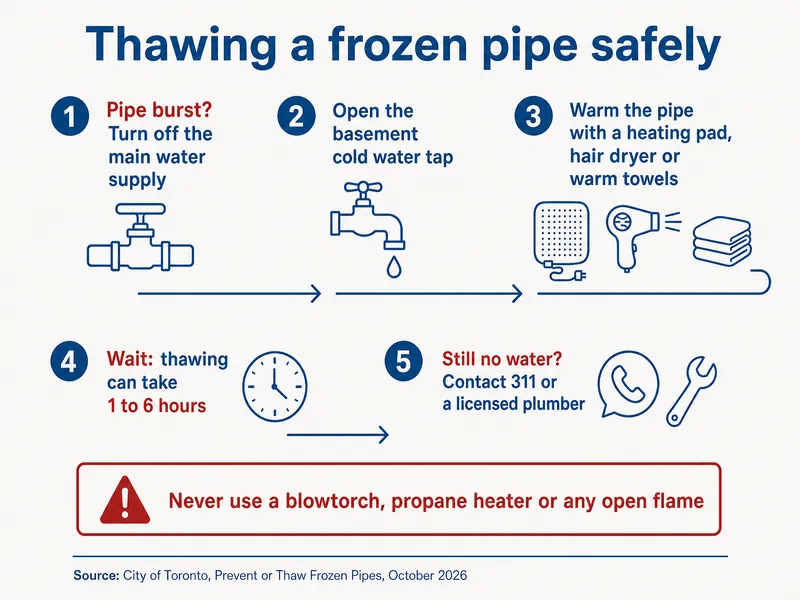
To thaw frozen pipes safely, open a cold tap so melting water can flow, then warm the frozen section slowly with low, controlled heat. The City's steps, in order:
- Check for a burst first. Where a pipe has split or seems about to, turn off the main water supply before warming anything (see the next sections).
- Open the basement cold water tap, ideally in the laundry room, so water can move as the ice melts and pressure has somewhere to go.
- Warm the pipe with a heating pad, a hair dryer or warm towels, starting nearest the open tap and working back toward the ice.
- Stay with it. The City says "Do not leave heating devices unattended."
- Be patient. Depending on the weather and how solid the ice is, thawing takes one to six hours.
- Still no water? Contact 311, or a licensed plumber if the frozen section is inside your property.
Keep the room warm while you work: raising the heat in the space or opening cabinet doors helps the pipe come up to temperature. Once water flows, leave the tap running gently for a few minutes and check the whole run of pipe for drips, because a crack often shows only after the ice melts.
| Method | Use it? | Why |
|---|---|---|
| Heating pad wrapped around the pipe | Yes | Named by the City; gentle, steady heat |
| Hair dryer moved along the pipe | Yes | Named by the City; keep it away from standing water |
| Warm towels | Yes | Named by the City; slow but safe |
| Blowtorch | Never | City: fire risk; can overheat solder joints and nearby framing |
| Propane heater | Never | City: fire and carbon monoxide hazard |
| Any open flame | Never | City lists every open flame as off-limits |
What should you never use on frozen pipes?
Never use a blowtorch, a propane heater or any open flame on frozen pipes. The City's page is direct about it, and it warns these are fire and carbon monoxide hazards. Old Toronto houses have wood framing, paper-faced insulation and dust right beside basement pipes, and a torch can ignite them in seconds.
Use electrical heat with care too. Keep hair dryers and heating pads away from water on the floor, plug them into a grounded outlet, and unplug them when you step away. If water has reached outlets, a panel or appliances, stay out of the water and have power to that area shut off safely; electrical repairs are work for a licensed electrician.
Do not try to warm a pipe by changing anything on a gas water heater, furnace or tankless heater. Gas appliances in Ontario may only be worked on by certificate holders, under O. Reg. 212/01.
What if a frozen pipe bursts?
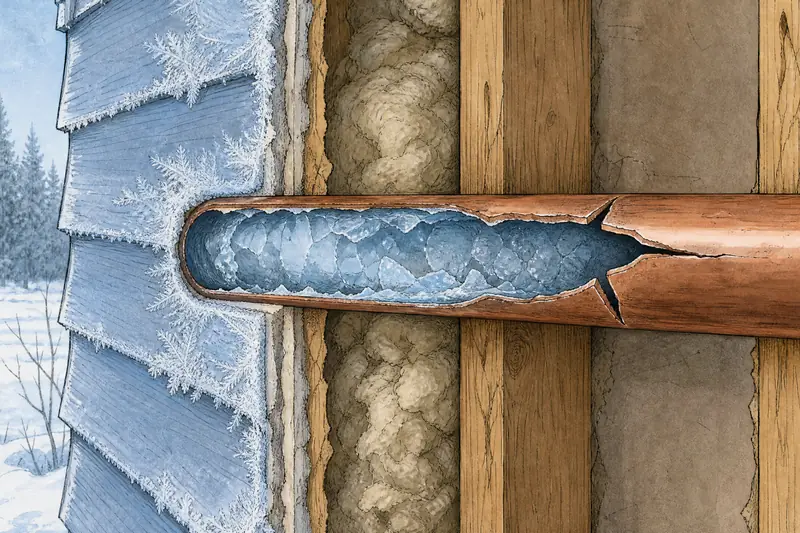
If a frozen pipe bursts, turn off the main water supply right away, then deal with the water and the repair. Ice expands as it forms, so the split often only leaks once the pipe thaws.
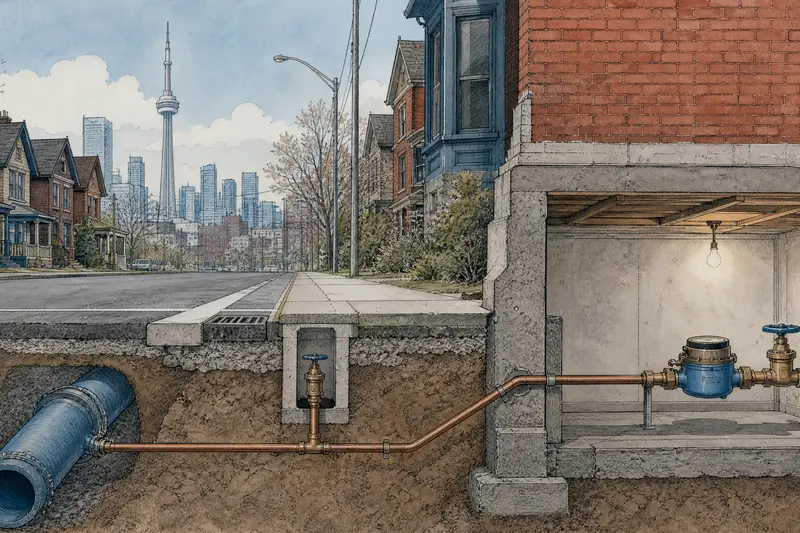
The City's Pipe Leak or Burst page says the main shut-off valve is "typically located on the foundation wall where the drinking water pipe enters the home, just before the water meter." Learn where yours is before winter; the shut-off guide shows how valves close.
- If your valve will not close, call 311 for a City turn-off at the property line. Staff aim to arrive within two hours, someone must be home, and there is a fee.
- Open a cold tap low in the house to drain what is left in the pipes once the water is off.
- Move valuables, photograph the damage and keep receipts for clean-up.
- Call your insurer early. IBC notes most insurers take claims at any hour; your own policy wording decides what is paid.
Repairs to pipes inside the home are private work: the City's page says you will need a plumber. The plumber cost guide explains what a call-out bill is made of.
Is a frozen water service the City's job?
No. In Toronto, thawing a frozen water service on private property is the owner's job, not the City's. The City looks after the service pipe only up to the property line; from there into the house, it belongs to the owner or landlord.
Chapter 851 of the Municipal Code puts it in plain terms. Section 851-4 N says owners must keep private water service pipes "protected from freezing," are responsible for damage and water loss when they freeze, and that "Thawing out frozen water service pipes shall be the owner's responsibility." If the City does help on private property at the owner's request, the work is done "at the owner's risk." Separately, s. 851-5 O makes the owner responsible for damage to the water meter, "including any damage from freezing."
Calling 311 is still worthwhile: staff will come and investigate, and they can tell whether the problem is on the City side. "If the frozen pipes are on private property, staff will advise you to contact a plumber." A break in the street is a different event; see what to do in a water main break.
When should you call a licensed plumber?
Call a licensed plumber when the pipe is split, when you cannot reach or find the frozen section, when the water service itself is frozen where it enters the house, or when gentle heat has not restored water after several hours. The City suggests a plumber if there is still no water after thawing.
Ontario treats plumbing as compulsory: whoever works on your pipes needs a Certificate of Qualification, a provisional one, or a registered training agreement, and names can be looked up on the Public Register kept by Skilled Trades Ontario. For a business, Toronto issues a separate City Plumbing Contractor licence.
Ask for a written note of where the freeze or break was and what caused it. That record helps with insurance and with deciding how to stop it happening again, which the frozen pipe prevention guide covers in detail. The Ontario Building Code (2024) requires piping that "may be exposed to freezing conditions" to be "protected from the effects of freezing" (Article 7.3.5.3), so a pipe that keeps freezing may need rerouting or insulating.
Frozen pipe figures for Toronto
- 1 to 6 hoursTime thawing can take, depending on weather and how frozen the pipe isCity of Toronto, modified Oct 19, 2026
- 2 hoursTarget arrival time for a City water turn-off requested through 311City of Toronto, Pipe Leak or Burst
- 14.2Average January days with a low below −10 °C at Toronto PearsonEnvironment and Climate Change Canada, Canadian Climate Normals 1981–2010
- 851-4 NMunicipal Code section making thawing a private service the owner's responsibilityCity of Toronto, Chapter 851
How we put this page together
This page is based on the City of Toronto's Prevent or Thaw Frozen Pipes page (modified October 19, 2026) and Pipe Leak or Burst page, Municipal Code Chapter 851 (sections 851-4 N and 851-5 O), Ontario Building Code (2024) Article 7.3.5.3, O. Reg. 212/01, Skilled Trades Ontario, Environment and Climate Change Canada climate normals and the Insurance Bureau of Canada (January 17, 2025), all checked October 2026. Plumber rates, product recommendations for heat tape and insurance promises were left out; insurance coverage depends on each policy.
Common questions
Can frozen pipes thaw on their own?
They can as the weather warms, but waiting leaves a burst unnoticed until water is already spreading. The City's approach is to open a cold tap and warm the pipe gently so you are there when water starts to flow.
Should the main water be turned off while thawing?
Only if a pipe has burst or looks like it may burst: the City says to turn off the main supply in that case. Otherwise the open cold tap needs supply behind it so melting ice can be pushed out.
Is a space heater safe for thawing pipes?
An electric space heater can warm a cold room, but keep it well clear of anything that burns and never leave it unattended. Propane heaters are on the City's never-use list because of fire and carbon monoxide.
Who pays if the water meter freezes and cracks?
The owner. Municipal Code s. 851-5 O makes owners responsible for loss or damage to the meter on their property, "including any damage from freezing," and they pay the replacement cost set in Chapter 441.
What should tenants do when the water stops in winter?
Report it to the landlord or property manager right away, as the City advises. Under Chapter 851, protecting the private service from freezing is the property owner's duty.
Will insurance pay for a burst frozen pipe?
That depends on your policy. The Insurance Bureau of Canada says standard policies usually respond only if the pipes are in a heated part of the home and reasonable steps were taken to keep the heat on, and most exclude freezing damage when the home is vacant. Read your wording and ask your insurer.
Why did the pipe freeze when the house was warm?
Pipes along outside walls, in unheated garages or near drafts can sit well below room temperature. The City's advice is to hold any space with plumbing at 8 °C or warmer and seal drafts around pipes and vents.
Related guides
More help: see our Toronto water and plumbing guide.