
Winter & emergencies
Low Water Pressure in Your House: Causes and Fixes
Low water pressure in a house usually starts at one of four places: a clogged tap aerator, a main valve not fully open, old pipe, or City work nearby; Toronto Water tests chronic cases and accepts 7 L/min or more.
On this page
Key takeaways
- If only one tap or one part of the building is affected, the City says it "indicates a private plumbing issue" (City of Toronto, modified October 14, 2026).
- The main shut-off valve is part of your private plumbing and "must be open"; aerators, the screens on each tap, can clog after pipe work.
- For a sudden drop, submit a water pressure service request or contact 311: Toronto Water staff arrive within 24 hours.
- For chronic low pressure, the City runs a flow test: 7 L/min or more is acceptable; below that, the service pipe is made a priority and replaced in about seven days.
- The City does not test lead or galvanized steel pipes and advises those owners to contact a plumber.
- City watermains are designed for 350 to 550 kPa (about 51 to 80 psi) on average days, and the Ontario Building Code requires a pressure-reducing valve where fixture pressure may exceed 550 kPa.
Water pressure numbers for Toronto homes
- 7 L/minMinimum acceptable flow in Toronto Water's low-pressure testCity of Toronto, No Water or Low Water Pressure
- 24 hoursTime for Toronto Water staff to arrive after a sudden-drop request (houses)City of Toronto
- 350–550 kPaPreferred design pressure in City watermains, average and maximum day (about 51–80 psi)City of Toronto, Design Criteria for Sewers and Watermains (July 2026)
- 550 kPaStatic pressure at a fixture above which a pressure-reducing valve is requiredOntario Building Code (2024), Div. B, 7.6.3.3
Why is the water pressure low in the house?
Water pressure in a house is usually low for one of five reasons: a clogged aerator, a partly closed valve, a pressure-reducing valve problem, old or narrowed pipe, or something outside the house such as construction or a watermain repair. The City of Toronto's page on no water or low water pressure lists most of these as things to check before asking for help.
In winter, add frozen pipe to the list. The City notes that pipes in your home "can freeze in cold weather, which can leave you with no water", and a partly frozen line can show up first as weak flow at one tap. The frozen pipes guide covers how to thaw them safely, never with an open flame.
Working through the causes in order, from the tap back to the street, usually finds the problem quickly. The sections below follow that order.
Is it one tap or the whole house?
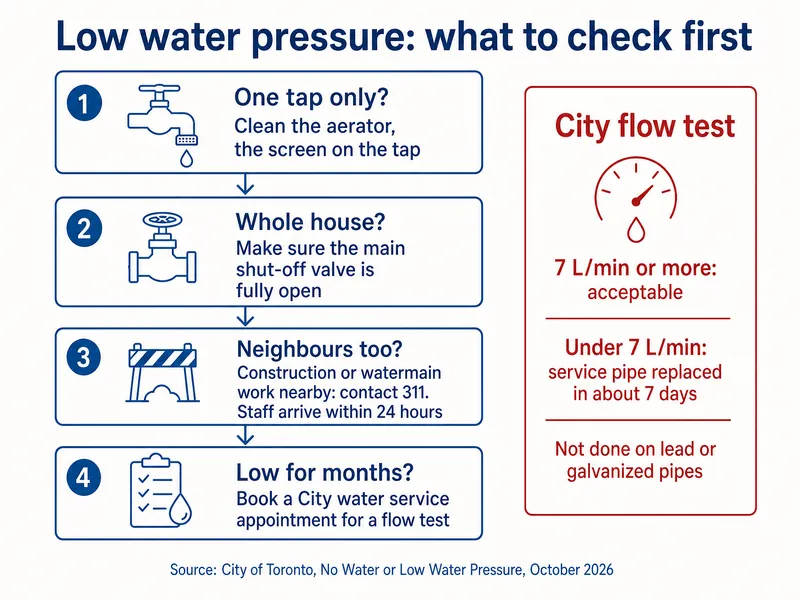
Start by checking whether low pressure is at one tap or the whole house, because the answer tells you where to look. The City says that if only one tap or part of the building has low pressure, "This indicates a private plumbing issue and you may wish to contact a plumber."
One tap. Unscrew the aerator, the small screen at the tip of the faucet, and rinse out grit and scale. The City notes that "If you have recently completed construction on your pipes, the screens can get clogged with dirt." Shower heads have a similar screen. If one tap is weak on hot water only, the problem is more likely on the hot side, around the water heater or its valves.
Whole house. If every tap is weak, the cause is at or before the point where water enters the house: the main valve, a pressure-reducing valve, the service pipe or the City supply. Ask a neighbour. The City says that if more than one household has low pressure, it is "a good indication" that work in the area is the cause.
Can the main shut-off valve cause low pressure?
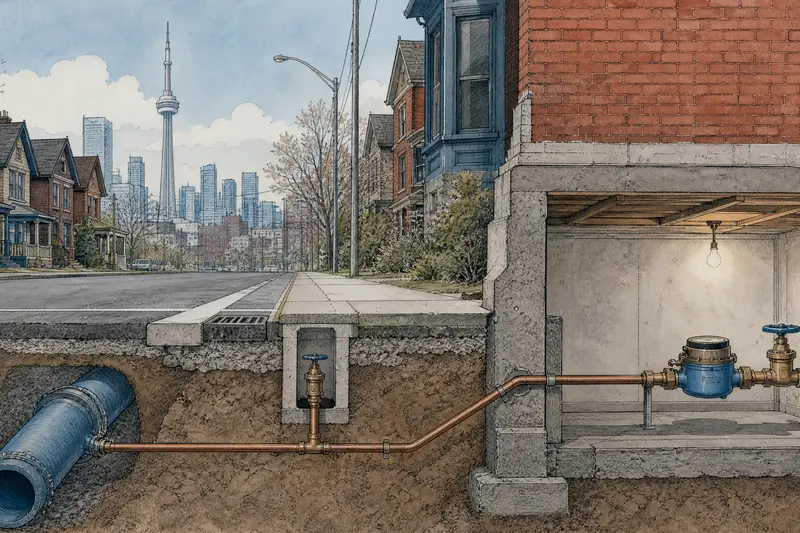
Yes, a main shut-off valve that is not fully open can cause low pressure through the whole house. The City says the main valve "is part of your private plumbing system and must be open", and it is usually in the basement near the water meter, where the service pipe comes through the wall.
Valves get left partly closed after plumbing work, a renovation or a meter change. On a round-handle (gate or globe) valve, turn the handle counter-clockwise until it stops; on a lever (quarter-turn ball) valve, the handle should run along the pipe, not across it. Do not force a stiff old valve: if it will not move, or starts to leak at the stem, stop and call a licensed plumber.
The shut-off valve guide shows how to find and work the valve. A stuck valve on the City side of the property line is a 311 call, not a job for the owner.
| Symptom | Where to look | First step |
|---|---|---|
| One tap or shower weak | Aerator or shower-head screen; fixture valve | Clean the screen; check the valve under the sink |
| Hot water weak, cold fine | Water heater valves and connections | Check the heater's supply valve; ask a plumber |
| Whole house weak, neighbours fine | Main shut-off valve, pressure-reducing valve, service pipe | Open the main valve fully; then a plumber or a City test |
| Whole street weak or no water | Construction or watermain work | Ask neighbours; contact 311 |
| Weak for months, valves open | Service pipe (City or private side) | Book a City water service appointment |
Do old galvanized or lead pipes reduce pressure?
Old galvanized steel pipe is one possible cause of low pressure, and in Toronto it also changes what the City will do. The City's low-pressure page says "Tests will not be conducted on pipes that are made of lead or galvanized steel", and owners with those pipes "will be advised to contact a plumber".
Health Canada's 2025 corrosion guidance says galvanized steel "was commonly used in plumbing pipes" until 1980 and refers to iron deposits forming within home plumbing; deposits narrow the inside of a pipe. Galvanized pipe can also hold lead and release it later, so a pressure problem in an old house is a good time to test for lead too; the City's kit is free for homes built before the mid-1950s.
Houses built before the mid-1950s may have a lead water service, according to the City. The polybutylene and galvanized pipe guide and the lead pipes guide explain how to identify each and which City programs apply.
What does a pressure regulator do?
A pressure regulator, or pressure-reducing valve, lowers high street pressure to a safe level inside the house. The Ontario Building Code (2024), Division B, Article 7.6.3.3, requires one "Where the static pressure at any fixture may exceed 550 kPa", set to limit pressure at the fixture to 550 kPa (about 80 psi).
Not every Toronto house has one. If yours does, it is usually on the main line near the main valve and water meter. A regulator that is set too low, or that has worn out, can make the whole house weak even when the street supply is normal.
Adjusting or replacing a regulator is plumbing work: leave it to a licensed plumber, who can measure the pressure with a gauge before and after. For context, the City's July 2026 Design Criteria for Sewers and Watermains says the preferred design pressure in its mains is 350 to 550 kPa on average and maximum days, with a minimum of 275 kPa (about 40 psi) and a maximum static pressure that should not exceed 690 kPa (about 100 psi).
When is low pressure the City's problem?
Low pressure is the City's to investigate when it affects several homes, follows nearby construction or a watermain break, or persists after your own valves and taps have been checked. Responsibility splits at the lot line: the City looks after the service pipe on the street side, and the owner looks after everything on the house side.
Sudden drop. Submit a water pressure service request online or contact 311. The City says "Toronto Water staff will arrive within 24 hours" for houses (24 to 48 hours for multi-residential, commercial, industrial and institutional buildings), and someone must be there to let staff in.
Chronic low pressure. Book a water service appointment online or through 311. Appointments run "between 8 a.m. and 2 p.m., Monday to Friday" and "take approximately 90 minutes"; someone over 18 must be home. Staff check that the valves are open and then run a flow test. The City says "Water pressure equal to or more than 7 L/min is considered acceptable"; below 7 L/min, "The water service pipe will be deemed a priority and will be replaced in approximately seven days."
The test needs the house plumbing to be in working order, and it is not done on lead or galvanized steel pipes. If you are told your pipes are the problem, a licensed plumber is the next step; the plumber cost guide explains how to compare quotes.
How we put this page together
Sources checked in October 2026: the City of Toronto page No Water or Low Water Pressure (modified October 14, 2026), the City's Design Criteria for Sewers and Watermains (July 2026, Chapter 4, pressure range and limits), the Ontario Building Code (2024) Division B Part 7 (Articles 7.6.3.3 and 7.6.3.1), Health Canada's 2025 lead corrosion guidance, and the City's Prevent or Thaw Frozen Pipes and Lead and Drinking Water pages. Left out: typical household psi figures from contractor sites, booster pump sales advice, and any promise that a City test will fix the problem.
Common questions
What is normal water pressure in Toronto?
The City designs its mains for 350 to 550 kPa (about 51 to 80 psi) on average and maximum days, and at least 275 kPa (about 40 psi) in non-fire conditions. Pressure inside a house can be lower, depending on the service pipe and plumbing.
Is the City's 7 L/min test a pressure test or a flow test?
The City calls it a low water pressure test, but its threshold is a flow rate: 7 litres a minute. Flow and pressure are related, and a narrowed service pipe reduces both.
Can a water softener or whole-house filter lower pressure?
Any treatment device on the main line adds some resistance, and a clogged filter cartridge can restrict flow. Check the bypass valve and the cartridge schedule in the maker's manual; the whole-house filter guide has more.
Why is pressure low only on hot water?
If cold water is normal, the main supply is fine and the cause is on the hot side: the water heater's valves, connections or sediment. Gas water heater work needs a TSSA-registered contractor.
Does the City charge for a low-pressure appointment?
The City's page describes the appointment and the test without listing a fee. Ask 311 when you book.
Can a pressure gauge be used at home?
Hose-thread gauges exist for outdoor taps, and a reading helps a plumber. The Building Code's 550 kPa limit applies at the fixture, so a high reading is also worth raising.
Who replaces the service pipe if the flow test fails?
The City's page says the water service pipe will be made a priority and replaced in about seven days. Ask 311 which part of the service the City will replace, since the private side is the owner's responsibility.
Related guides
More help: see our Toronto Home Water Guide home page.