
Softeners & filters
Water Softener Cost: Purchase, Installation and Running
Water softener cost has three parts: the unit, the installation and the yearly running bill for salt, water and power. No public Canadian source publishes a price range, so compare itemized written quotes.
On this page
Key takeaways
- No government, standards body or university publishes a Canadian price range for softeners, so the sections below break down what you pay for rather than quoting dollars (CAD, as of October 2026).
- City water measured 119 mg/L, or 7.0 gpg, on average through 2025 (City of Toronto), and the City says softening is "usually not needed".
- A unit certified to NSF/ANSI 44 must bring hardness below 1.0 gpg (17.1 mg/L), per Health Canada.
- Running costs come from salt or potassium chloride, regeneration water and electricity; the salt setting and the hardness programmed into the valve drive the first two.
- Ontario bans door-to-door softener contracts unless you invited the seller, and gives a 10-day cooling-off period (Government of Ontario).
- A softener bought on a rental or financing contract has its own exit terms: read them before signing.
Prices for water softeners in Canada come almost entirely from sellers and installers, and they vary with the equipment, the house and the contract. This guide does not repeat those figures. Instead it breaks the cost into the parts you will actually pay for, shows what a fair written quote should list, and sets out the Ontario rules that protect buyers.
What sets the bill
- 7.0 gpgToronto's 2025 average hardness, the number a softener's valve is programmed withCity of Toronto, 2025 water analysis
- 1.0 gpgMaximum hardness left after treatment by a unit certified to NSF/ANSI 44Health Canada, 2025
- 10 daysCooling-off period on Ontario home-service contracts covering water softenersGovernment of Ontario
- 125 psiMaximum water pressure (8.6 bar) one maker's control valve is rated forA softener maker's service manual
How much does a water softener cost?
The honest answer is that no public, primary source sets a Canadian price, so your total depends on the quotes you collect. The total has three layers: the purchase price of the unit, the installation, and the running cost over the years you own it. Ask each seller for all three in writing, in CAD, with taxes shown.
Before pricing anything, check whether you need one. The City of Toronto's tap water page (modified July 22, 2026) says Lake Ontario water has relatively low mineral levels and that softening systems "are usually not needed". The Toronto softener decision guide walks through when one still makes sense.
What drives the purchase price?
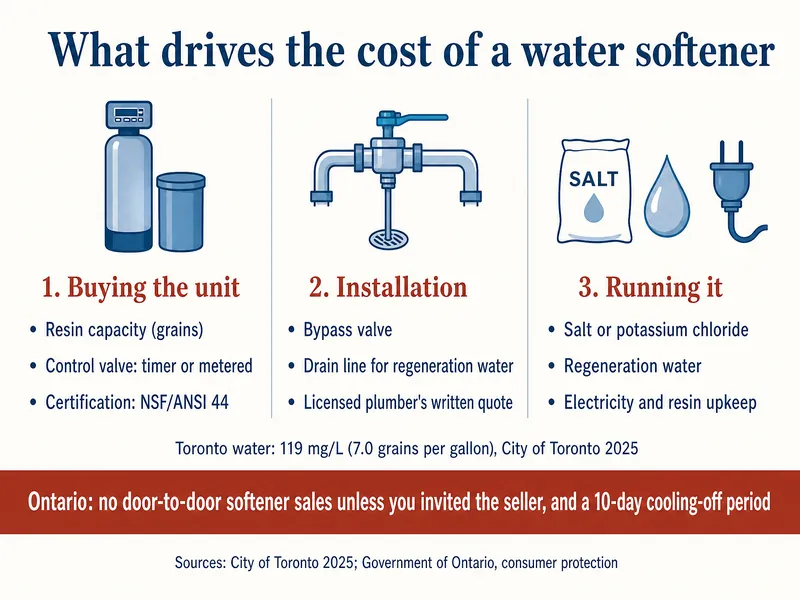
Capacity, the control valve and certification are the three things that move the price of the unit itself. Capacity is the number of grains of hardness the resin holds between regenerations; a larger resin tank costs more but regenerates less often. Sizing for Toronto's 7.0 gpg is explained on how a water softener works.
The control valve decides when the unit regenerates. A timer valve regenerates on a set schedule whether or not the resin is spent; a metered (demand) valve counts the litres used and regenerates when the programmed capacity is reached. One softener maker's service manual shows both a day-of-week schedule and a salt setting per regeneration among the programmable settings, which is why the same tank can run cheaply or wastefully.
Certification is the third factor. Health Canada strongly recommends devices certified by an accredited body, and points to NSF/ANSI 44 for softeners. Ask for the certification listing by model number, not a sticker on the box.
What does installation add?
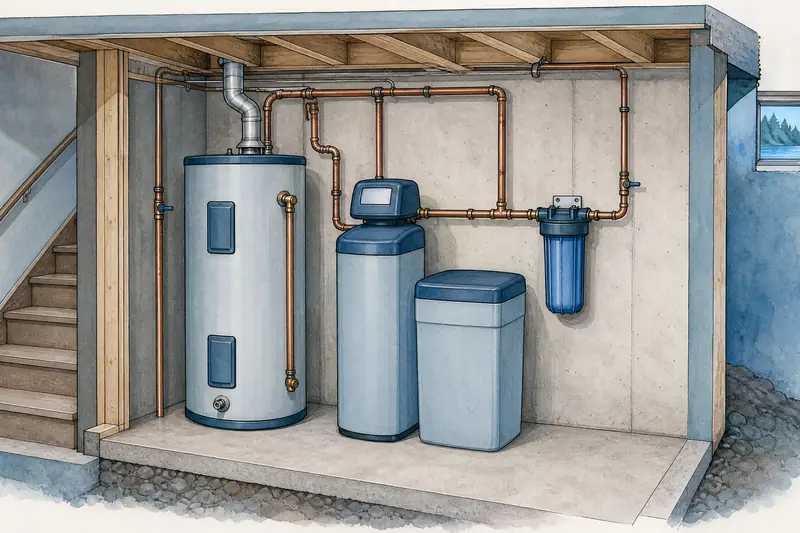
Installation covers the plumbing connections, a bypass valve, a drain connection for regeneration water and an electrical outlet. The same manual tells installers to provide a bypass valve if the unit lacks one, to keep the softener close to a drain, to use a residential drain line of at least 13 mm (1/2 in), and to plug the controller into an uninterrupted outlet. It also limits inlet pressure to 125 psi (8.6 bar) and water temperature to 43 °C, and says the unit "cannot be subjected to freezing conditions".
Each of those items can add labour or parts in an older Toronto basement, for example if the nearest floor drain is far away or the main line needs re-routing. Toronto Building's 311 list says a permit is needed to "install or modify" plumbing systems and does not mention softeners by name, so ask Toronto Building or your plumber whether your job needs one; the plumbing permit guide explains fees under Municipal Code Chapter 441. Plumbing work should be done by a licensed plumber; plumber cost in Toronto covers how to check a licence.
What does a softener cost to run each year?
The yearly running cost is the salt or potassium chloride you buy, the water used during regeneration, a small amount of electricity, and occasional service. None of these has a published Canadian average, and they depend heavily on how the valve is set. Two settings matter most: the hardness value programmed into the valve and the salt dose per regeneration.
You can estimate your own costs from three facts on your bills and the unit's manual: the water your household uses (the cubic metres on your water bill; 1 m³ is 1,000 L), the hardness setting (7 gpg for City water), and the salt and water the manual lists for each regeneration at your chosen setting. Multiply by the number of regenerations a year and price the salt at your local store. Health Canada's 2025 document notes softeners "typically use sodium chloride or potassium chloride" as the brine.
How much salt and water does a softener use?
Salt and water use depend on the unit's capacity, the salt setting and how much hard water the household runs through it, so there is no single figure to quote. A metered valve generally regenerates only after the programmed volume has been used; a timer valve may regenerate on schedule even after a quiet week. Higher salt doses restore more capacity per regeneration but use more salt, which is a setting your installer chooses.
Every regeneration sends backwash, brine and rinse water to the drain. The maker's start-up steps run a backwash "for 10 minutes or until the water runs clear" and a rapid rinse "for 5 minutes", which shows why the drain connection and the regeneration schedule both matter. Health Canada also flags that spent regeneration brine raises environmental concerns.
| Line item | What to ask for | Why it matters |
|---|---|---|
| Unit and model number | Resin capacity in grains, valve type, NSF/ANSI 44 listing | Capacity and valve set the running cost |
| Installation | Bypass valve, drain connection, any re-piping, permit if needed | Older basements may need extra work |
| Valve settings | Hardness entered (7 gpg for Toronto), salt dose per regeneration | Over-setting wastes salt and water |
| Drinking-water bypass | Kitchen tap left unsoftened | Health Canada advises it for sodium |
| Contract terms | Purchase, rental or financing; exit fees; cooling-off date | Ontario's 10-day cooling-off applies |
Is a water softener worth the cost in Toronto?
For most City homes the value is limited, because the water is only medium hard and the City sees no general need for softening. It is a personal choice weighed against scale on fixtures and in the water heater, not a safety purchase. Hardness carries no health-based value in Health Canada's guidelines, and the department advises that the kitchen tap bypass a sodium or potassium unit.
If you buy, protect yourself under Ontario law. Ontario's rules on home-service contracts (updated June 19, 2026) put softeners on the restricted list: a seller may sign a contract in your home only if you invited them, and a deal struck in breach of that rule is void, with the equipment yours to keep, under sections 43 and 43.1 of the Consumer Protection Act, 2002. Every home-service agreement has a 10-day cooling-off period starting the day you receive the written copy. For hardness figures across the region, see GTA water hardness by city.
How we put this page together
Sources: the City's 2025 analysis of tap water and its tap water web page, Health Canada's calcium and magnesium guideline document, Ontario's door-to-door sales and home-service contracts page (updated June 19, 2026), and a softener maker's service manual, all reviewed October 2026. Softener prices, installation charges and salt, water or power figures are not printed here because only sellers and contractors publish them, and the page makes no claim that a softener saves money.
Common questions
Where are the softener prices on this page?
Every published range found came from a seller or installer, not a government, standards or university source. Prices also change with the model, the basement and the contract, so itemized written quotes are the reliable comparison.
Is renting a softener cheaper than buying one?
No public source compares the two for softeners. Read any rental or financing contract for the monthly charge, the term, buyout terms and removal fees, and remember the 10-day cooling-off period.
What hardness should the valve be set to in Toronto?
The City's 2025 average was 7.0 gpg (119 mg/L), with samples from 6.7 to 7.1 gpg. Ask the installer what value they enter and why; a higher setting means more frequent regeneration.
Can a door-to-door seller sign up a homeowner after a free water test?
Only if the homeowner asked them to come. Softeners, filters and treatment devices are on Ontario's restricted door-to-door list, and an uninvited contract has no force.
Does a softener need its own electrical outlet?
Electronic control valves need power. One maker's manual asks for an uninterrupted outlet and says electrical connections must follow local codes.
Is potassium chloride a good substitute for salt?
Health Canada lists both as regeneration brines. Potassium softening can add potassium to the water in the same way sodium units add sodium, so the kitchen-tap bypass advice applies to both.
Can the softener sit in an unheated garage?
Maker instructions commonly forbid freezing. One softener maker's manual says the unit "cannot be subjected to freezing conditions", so a heated space is the safe choice in a Toronto winter.
More on softeners
More help: see our guide to water and plumbing in Toronto homes.