
Tap water
Toronto Tap Water: Is It Safe to Drink?
Toronto tap water is safe to drink, according to the City of Toronto: it comes from Lake Ontario, is treated at four plants and tested thousands of times a year, with lead pipes in older homes the main exception.
On this page
Key takeaways
- The City's Tap Water in Toronto page, last updated on July 22, 2026, states plainly: "Toronto's tap water is safe to drink."
- Four treatment plants turn Lake Ontario water into more than one billion litres of drinking water each day.
- In the City's 2025 analysis summary, 99.99% of 11,792 E. coli presence/absence samples came back absent.
- The chlorine smell is chloramine: the 2025 residual averaged 1.6 mg/L, and Health Canada says no maximum is needed for chloramines.
- Fluoride averaged 0.65 mg/L in 2025, against Health Canada's 1.5 mg/L maximum and 0.7 mg/L optimal level.
- Homes built before the mid-1950s may have a lead service pipe; the City offers free lead testing through 311.
Toronto tap water at a glance
- 1 billion+ litresDrinking water treated each day at four plantsCity of Toronto, Tap Water in Toronto
- 99.99%Share of 11,792 E. coli presence/absence samples that were absent, 2025Toronto Water, 2025 analysis summary
- 1.6 mg/LAverage total chlorine residual (chloramines) in the distribution system, 2025Toronto Water, 2025 analysis summary
- 0.65 mg/LAverage fluoride, 2025 (Health Canada maximum 1.5 mg/L)City of Toronto; Health Canada
Is Toronto tap water safe to drink?
Yes, according to the City of Toronto, which runs the system and publishes the test results. Its Tap Water in Toronto page says "Toronto's tap water is safe to drink" and that it meets or exceeds Ontario's standards, which the City describes as among the strictest in the world. This guide reports that position as the City states it, no stronger.
The test data back the statement up in specific terms. The City's Drinking Water Analysis Summary 2025 lists 11,792 presence/absence samples for E. coli, with 99.99% absent. That is not the same as "never detected", and the summary's notes say those samples include water collected after watermain repairs and in response to quality inquiries.
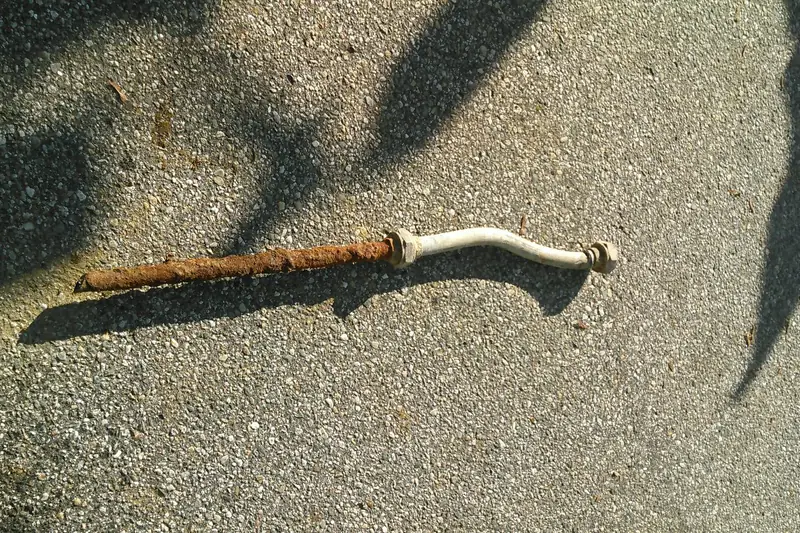
The main exception is inside older houses. Water leaving the plants contains no lead, according to the City's 2025 lead mitigation report, but a lead service pipe or old solder can add some on the way to your tap. The lead pipes in Toronto guide explains how to check.
Where does Toronto's tap water come from?
All of it comes from Lake Ontario. The City calls the lake "a high-quality source" and treats more than one billion litres a day at four plants, according to its tap water page. The City's 2025 Drinking Water System Annual Report lists their rated capacities:
| Plant | Location | Rated capacity (m³ a day) |
|---|---|---|
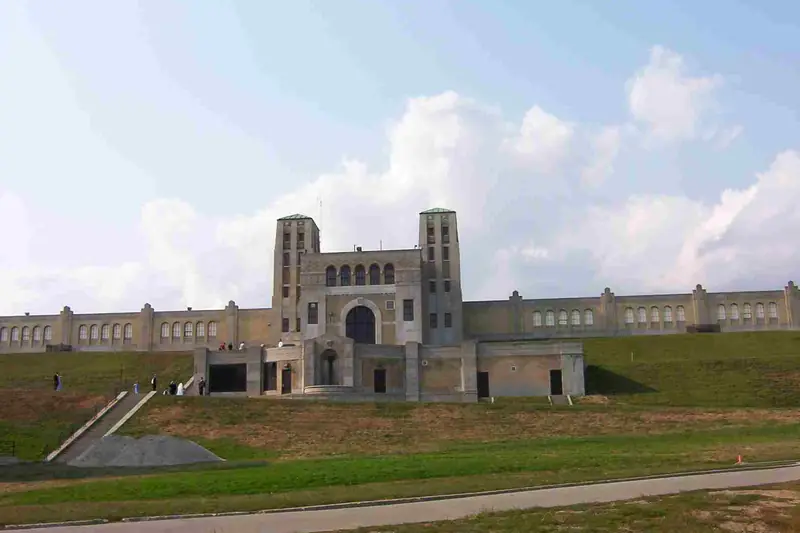
| R.C. Harris | 2701 Queen Street East | 950,000 |
| F.J. Horgan | 201 Copperfield Road | 800,000 |
| R.L. Clark | 45 Twenty Third Street | 615,000 |
| Island | Centre Island | 440,000 |
From the plants, water moves through 18 pumping stations, 11 major underground reservoirs and 4 elevated tanks, according to the same annual report, then into more than 6,100 km of watermains, according to the City's watermain page. Neighbouring York Region also buys much of its water from Toronto and Peel, which is one reason hardness is so similar across the lakeshore (see GTA water hardness by city).
How is Toronto tap water treated?
Treatment uses chlorine to disinfect, ammonia to keep the disinfectant working through the pipes, fluoride for teeth and phosphate for corrosion control. The City's tap water page says chlorine is used "to control bacteria, algae and viruses", and ammonia is added to maintain chlorine levels as water travels through the system. Chlorine and ammonia together form chloramine, which is how the City's 2025 table labels the residual.
Phosphate is the lead-control step. The City's Annual Lead Mitigation Report 2025 explains that corrosion control began in December 2014 at all four plants, and that phosphate "forms a protective coating inside all pipes and household plumbing fixtures".
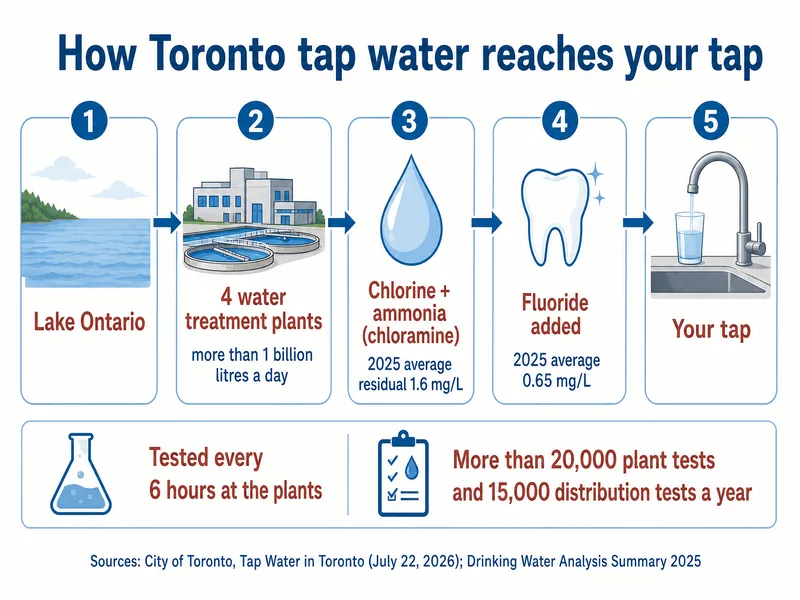
Testing runs alongside treatment. The City samples water every six hours for bacteriological quality, runs more than 20,000 tests a year at the plants and more than 15,000 on samples from the distribution system. The full year's results appear in the analysis summary; the Toronto water quality report guide shows how to read it.
Why does Toronto tap water smell of chlorine?
The smell is the chloramine residual the City keeps in the pipes on purpose. In 2025 it averaged 1.6 mg/L, with readings from 0.28 to 2.5 mg/L across 6,635 distribution samples.
Health Canada's chloramines guideline (February 2020) concludes that a maximum acceptable concentration for chloramines is not needed, given the low toxicity of monochloramine, and notes most Canadian systems keep the residual below 4 mg/L. The City's table shows 3.0 mg/L in its limit column; that is the City's figure, not a Health Canada limit.
If the taste bothers you, Health Canada notes that devices to reduce chloramine exist for taste reasons, but it advises against removing the disinfectant from water you plan to store. A different taste, an earthy or musty one, can appear in late summer or early fall; the City says the water stays safe to drink during those events. Filter options are compared in water softener vs water filter.
Is there fluoride in Toronto tap water?
Yes. The City adds fluoride to help prevent tooth decay, and the 2025 average was 0.65 mg/L, with samples from 0.15 to 0.83 mg/L. Health Canada's fluoride page sets the maximum acceptable concentration at 1.5 mg/L and gives 0.7 mg/L as the optimal level for fluoridated water.
Ontario's standard under O. Reg. 169/03 is also 1.5 mg/L. Toronto's highest 2025 sample was about half of that. Questions about fluoride and your own family's teeth belong with a dentist or Toronto Public Health.
| Measure | Toronto 2025 average | Reference value |
|---|---|---|
| Fluoride | 0.65 mg/L | 1.5 mg/L maximum (Health Canada, Ontario) |
| Chloramine residual | 1.6 mg/L | No maximum set (Health Canada, 2020) |
| Sodium | 14.8 mg/L | 200 mg/L in the City's table |
| pH | 7.5 | 6.5–8.5 in the City's table |
| Hardness | 119 mg/L | 80–100 mg/L operational guideline |
When should you take extra care with tap water?
Take extra care if your home may have a lead service pipe, if you keep fish, if someone in the house uses home dialysis, or after the water has been shut off for repairs. Lead is the one that matters most for health. Houses older than roughly 1955 can still be connected by a lead pipe, and the City's lead guidance gives pregnancy, formula-fed babies and young children particular attention, recommending a certified lead filter in those homes. Toronto Public Health or your doctor can advise on health questions.
- Old houses: when water has been standing in the pipes, for example overnight, let the cold tap run before drinking (the City's guidance gives a five-minute minimum), and cook with cold water. Free testing is covered on the lead pipes page.
- Fish tanks: Health Canada says aquarium owners should know the water is chloraminated and need chlorine/chloramine quenching before water goes in a tank.
- Dialysis: Health Canada says dialysis providers should be told that water is chloraminated; follow your clinic's instructions.
- After a break or shut-off: if the water looks discoloured when service returns, the watermain break guide covers what to do and when to contact 311.
Hardness is not on this list. The City does not consider it a concern for most homeowners; the Toronto water hardness page explains why.
How we put this page together
This page draws on the City's tap water page (updated July 22, 2026), the City's 2025 drinking water analysis summary (published June 2026), the 2025 Drinking Water System Annual Report, the City's 2025 report on lead mitigation, its lead and watermain pages, Health Canada's chloramine and fluoride guidance, and the provincial drinking water standards regulation, reviewed in October 2026. Left out: bottled-water comparisons, filter brand claims, health advice beyond what Health Canada and the City publish, and any reading of the data stronger than the City's own.
Common questions
Can you drink Toronto tap water straight from the tap?
The City of Toronto says its tap water is safe to drink, and it tests it every six hours at the plants. In a house built before the mid-1950s, run the cold tap for a few minutes first if the water has been sitting, because of possible lead pipes. Bottled water is a preference, not a City recommendation.
Is Toronto tap water chlorine or chloramine?
Chloramine. The City adds chlorine and then ammonia, which combine into chloramine so the disinfectant lasts through the pipes. The 2025 table labels the residual "Chloramines" and reports a 1.6 mg/L average.
Why does my tap water taste earthy in September?
The City notes that an earthy or musty taste or smell can occur in late summer or early fall. It says the water remains safe to drink during these events. The Region of Peel, which also draws from Lake Ontario, links the same odour to seasonal changes in the lake.
Is Toronto tap water safe for baby formula?
The City's lead guidance says to use cold tap water for preparing baby formula, and, in homes that may have a lead service pipe, to use an NSF-053 certified filter or bottled water until a filter is in place. For anything beyond that, ask Toronto Public Health or your doctor.
What should you do about lead in an older Toronto home?
The City recommends flushing standing water out of the pipes before drinking, sticking to cold water for anything you consume, and fitting a filter certified to NSF-053. It also offers free lead testing through 311. Boiling is not among the steps the City lists.
Do Toronto apartment buildings get different water?
They get the same City water. The City says lead service pipes are not found in buildings above six units, but older plumbing inside any building can still affect the water. Ask your building manager if you notice a change in colour or taste.
How many tests does Toronto run on its water each year?
More than 20,000 at the treatment plants and more than 15,000 on distribution samples, according to the City. The 2025 analysis summary also lists 6,635 chlorine-residual readings and 11,792 E. coli samples. Results are published once a year.
Related guides

More help: see our Toronto home water guide.